

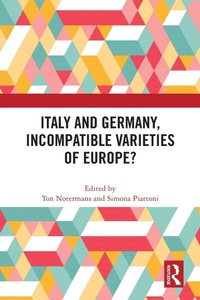
Italy and Germany, Incompatible Varieties of Europe?
1st Edition
Published on 29. January 2024
Book
Paperback/Softback
168 pages
978-1-032-24896-7 (ISBN)
Description
Can Italy and Germany thrive within the confines of the common currency, or do they display two fundamentally incompatible models? This book examines this question by means of detailed comparisons in the fields of labour market policies, welfare provisions and financial and economic management, since the onset of the financial crisis and through the euro and COVID-19 crises.
The rapid succession of the financial crisis, the Eurozone crisis and COVID-19 have again brought to the fore questions that have beset European integration since its inception; does the EU promote convergence or divergence? Have these crises served to reveal pre-existing politico-economic incompatibilities or were these incompatibilities created by the euro and the measures propounded by the Economic and Monetary Union (EMU)? Should EMU recipes be followed, or should they be fundamentally revised in an effort to come good on the convergence promises underpinning the European project? And, lastly, is the COVID-19 crisis likely to mitigate or exacerbate these problems? These questions are addressed in this volume by means of a tight comparison between Germany and Italy, two countries that have displayed strikingly divergent trajectories but also share many more politico-economic traits than the conventional wisdom would allow for. By exploring in detail how the main elements of the euro and EMU management have played out, the volume highlights the externalities that becoming part of a currency union has created and that strengthened the economic success of one while consolidating the decline of the other and analyses the likely impact of the measures introduced to fight the economic consequences of the COVID-19 pandemic.
The chapters in this book were originally published as a special issue of the journal, German Politics.
The rapid succession of the financial crisis, the Eurozone crisis and COVID-19 have again brought to the fore questions that have beset European integration since its inception; does the EU promote convergence or divergence? Have these crises served to reveal pre-existing politico-economic incompatibilities or were these incompatibilities created by the euro and the measures propounded by the Economic and Monetary Union (EMU)? Should EMU recipes be followed, or should they be fundamentally revised in an effort to come good on the convergence promises underpinning the European project? And, lastly, is the COVID-19 crisis likely to mitigate or exacerbate these problems? These questions are addressed in this volume by means of a tight comparison between Germany and Italy, two countries that have displayed strikingly divergent trajectories but also share many more politico-economic traits than the conventional wisdom would allow for. By exploring in detail how the main elements of the euro and EMU management have played out, the volume highlights the externalities that becoming part of a currency union has created and that strengthened the economic success of one while consolidating the decline of the other and analyses the likely impact of the measures introduced to fight the economic consequences of the COVID-19 pandemic.
The chapters in this book were originally published as a special issue of the journal, German Politics.
More details
Language
English
Place of publication
London
United Kingdom
Publishing group
Taylor & Francis Ltd
Target group
College/higher education
Postgraduate and Undergraduate
Dimensions
Height: 234 mm
Width: 156 mm
Thickness: 10 mm
Weight
284 gr
ISBN-13
978-1-032-24896-7 (9781032248967)
Copyright in bibliographic data and cover images is held by Nielsen Book Services Limited or by the publishers or by their respective licensors: all rights reserved.
Schweitzer Classification
Other editions
Additional editions
Ton Notermans | Simona Piattoni
Italy and Germany, Incompatible Varieties of Europe?
Book
04/2022
1st Edition
Routledge
€205.90
Shipment within 10-20 days
Ton Notermans | Simona Piattoni
Italy and Germany, Incompatible Varieties of Europe?
E-Book
04/2022
1st Edition
Routledge
€59.49
Available for download
Ton Notermans | Simona Piattoni
Italy and Germany, Incompatible Varieties of Europe?
E-Book
04/2022
1st Edition
Routledge
€59.49
Available for download
Persons
Ton Notermans is Senior Lecturer of Political Economy at the Tallinn University of Technology, Estonia. He taught at the Universities of Trento, Italy; Innsbruck, Austria; Pusan National University, Korea and the Azerbaijan Diplomatic Academy. His research interests focus mainly on the history and political economy of monetary unions.
Simona Piattoni is Professor of Political Science at the University of Trento, Italy. She taught at the Universities of Tromso and Agder, Norway and Innsbruck, Austria, and is currently affiliated with the ARENA European Centre at the University of Oslo, Norway. Her research interests include economic development, clientelism, cohesion policy, multilevel governance, and European democracy.
Simona Piattoni is Professor of Political Science at the University of Trento, Italy. She taught at the Universities of Tromso and Agder, Norway and Innsbruck, Austria, and is currently affiliated with the ARENA European Centre at the University of Oslo, Norway. Her research interests include economic development, clientelism, cohesion policy, multilevel governance, and European democracy.
Content
Preface Introduction: Italy and Germany - Incompatible Varieties of Europe? 1. Italy and Germany: Incompatible Varieties of Europe or Dissimilar Twins? 2. Competitiveness Revisited: Labour Costs, Financial Flows and the Case of Italy 3. German Labour Market Resilience in Times of Crisis: Revealing Coordination Mechanisms in the Social Market Economy 4. Varieties of Private Household Debt in Europe: Incompatibility of Culturally Diverse Lending Regimes Between Germany and Italy? 5. German and Italian Pensions: Similar Roots, Different Reform Paths, Comparable Trajectories? 6. The Financial Consequences of Export- led Growth in Germany and Italy 7. Safe and Risky Sovereigns in the Euro Area Capital Market: Financial Drivers of Fiscal Policies in Germany and Italy