


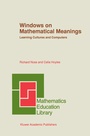
Windows on Mathematical Meanings
Learning Cultures and Computers
Published on 30. June 1996
Book
Paperback/Softback
XII, 278 pages
978-0-7923-4074-4 (ISBN)
Description
This book is the culmination of some ten years' theoretical and empirical investigation. Throughout this period, we have come into contact with many who have stimulated our thinking, some of whom belong to the community of Mathematics Educators. Our membership of that community has challenged us to make sense of some deep issues related to mathematical learning, especially the cognitive and pedagogical faces of mathematical meaning making. Alongside this community, we are privileged to have been part of another, whose members are centrally concerned both with mathematics and educa tion. Yet many of them might reject the label of Mathematics Educators. This community has historically been clustered around what is now called the Epistemology and Learning Group at the Massachusetts Institute of Technol ogy. Their work has focused our attention on cognitive science, ethnography, sociology, artificial intelligence and other related disciplines. Crucially, it has forced our awareness of the construction of computational settings as a crucial component of the struggle to understand how mathematical learning happens. We have sometimes felt that few have tried to span both communities. Indeed, an analysis of the references in the literature would, we are sure, reveal that the two communities have often ignored each other's strengths. One reason for writing this book is born of our hope that we might draw together Mathematics Educators and mathematics educators, and assist both communities in recognising that there are insights that might be derived from each other.
Reviews / Votes
"Noss and Hoyles take on the field of Mathematics Education as a whole to develop a coherent theoretical framework that will encompass its psychological, social, pedagogical and epistemological dimensions. Their pages abound with socratic flies to torment anyone who claims to understand concepts like abstract, concrete, formal, common-sensical and even mathematics, without the context of an elaborated theory. At the same time they present the most elaborated theoretical discussion to date of how the computer presence might contribute to the development of the field."Seymour Papert, Massachusetts Institute of Technology
` I would say that the book is very readable, and contains a number of interesting details as well as the construction of a theory. It is one important step in developing a theoretical framework for the use of technology in mathematics education. '
Nordic Studies in Mathematical Education, 3 (1997)
More details
Series
Edition
Softcover reprint of the original 1st ed. 1996
Language
English
Place of publication
Dordrecht
Netherlands
Target group
College/higher education
Professional and scholarly
Research
Product notice
Paperback (trade)
Unsewn / adhesive bound
Illustrations
XII, 278 p.
Dimensions
Height: 240 mm
Width: 160 mm
Thickness: 17 mm
Weight
477 gr
ISBN-13
978-0-7923-4074-4 (9780792340744)
DOI
10.1007/978-94-009-1696-8
Schweitzer Classification
Other editions
Additional editions
E-Book
12/2012
Springer
€149.79
Available for download
Book
06/1996
Kluwer Academic Publishers
€160.49
Shipment within 15-20 days
Content
1. Visions of the mathematical.- 1. Reshaping mathematics, revisioning learning.- 2. Computers.- 3. .and cultures.- 4. Windows on methodologies.- 2. Laying the Foundations.- 1. Introduction.- 2. Meanings in mathematics education: a brief survey.- 3. Vignette: The N-task.- 4. The influence of setting on mathematical behaviour.- 5. Street mathematics.- 6. A way out of the cul-de-sac?.- 7. Rethinking abstraction.- 3. Tools and technologies.- 1. Computers and educational cultures.- 2. A preliminary case for programming.- 3. The development of a programming culture.- 4. Micro worlds: the genesis of the idea.- 5. Opening windows on microworlds.- 6. Objects and structures.- 4. RatioWorld.- 1. What do we - and learners - know?.- 2. Building an alternative methodology.- 3. The data set.- 4. The microworld activities and student responses.- 5. Quantitative windows on learning.- 6. Reflections.- 5. Webs and situated abstractions.- 1. Reviewing the foundations.- 2. Webs of meaning.- 3. Domains of situated abstraction.- 6. Beyond the individual learner.- 1. Extending the web.- 2. Collaborative activity in mathematics.- 3. A study of groupwork.- 4. Opening new windows.- 7. Cultures and change.- 1. Innovation and inertia.- 2. Visions of Logo.- 3. Myths and methodologies: a case study of Logo research.- 4. The struggle for meanings.- 8. A window on teachers.- 1. Investigating teachers' attitudes and interactions.- 2. Teachers making meanings.- 3. Connections and cultures.- 9. A window on schools.- 1. The background to the case study.- 2. The teachers' voices.- 3. The students' voices.- 4. Meanings in conflict.- 10. Re-visioning mathematical meanings.- 1. Reviewing the scene.- 2. Epistemological revisions: six examples.- 3. Reconnecting mathematics and culture.- References.