

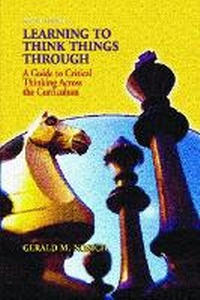
Learning to Think Things Through
A Guide to Critical Thinking Across the Curriculum
2nd Edition
Published on 22. July 2004
Book
Paperback/Softback
240 pages
978-0-13-114152-0 (ISBN)
Description
For Freshman Orientation/Critical Thinking courses as well as a supplementary text for use in any subject-matter course at any educational level.
This short, inexpensive guide is designed to help students learn to think critically in any subject-matter course. A combination of instruction and exercises shows them how to use critical thinking to more fully appreciate the power of the discipline they are studying, to see its connections to other fields and to their day-to-day lives, to maintain an overview of the field so they can see the parts in terms of the whole, and to become active learners rather than passive recipients of information.
This short, inexpensive guide is designed to help students learn to think critically in any subject-matter course. A combination of instruction and exercises shows them how to use critical thinking to more fully appreciate the power of the discipline they are studying, to see its connections to other fields and to their day-to-day lives, to maintain an overview of the field so they can see the parts in terms of the whole, and to become active learners rather than passive recipients of information.
More details
Edition
2nd edition
Language
English
Place of publication
United States
Publishing group
Pearson Education (US)
Target group
Professional and scholarly
Dimensions
Height: 229 mm
Width: 152 mm
Thickness: 10 mm
Weight
313 gr
ISBN-13
978-0-13-114152-0 (9780131141520)
Copyright in bibliographic data and cover images is held by Nielsen Book Services Limited or by the publishers or by their respective licensors: all rights reserved.
Schweitzer Classification
Other editions
New editions
Book
02/2008
3rd Edition
Pearson
€18.59
Article exhausted; check for reprint
Previous edition
Book
02/2002
Pearson
€16.11
Article exhausted; check for reprint
Person
Dr. Gerald Nosich is a Professor at the University of New Orleans. He has given more than 150 national and international workshops on all aspects of teaching for critical thinking. He's also worked for the U.S. Department of Education on a project for a National Assessment of Higher Order Thinking Skills, served as the Assistant Director at the Center for Critical Thinking at Sonoma State University, and been featured as a Noted Scholar at the University of British Columbia.
On a more personal note, he has at times exercised and not exercised good judgment: he has ridden a motorcycle to Baghdad (and to Ur of the Chaldees, the birthplace of Abraham); he has worked as an immigrant ditch-digger in Switzerland; been imprisoned by Communist authorities in Czechoslovakia; stowed away on a Sicilian ship to Algeria; sailed up the Nile with his family in a felucca; and lived with Maasai warriors in central Africa and in a Yurt in Mongolia. He currently lives in New Orleans with his son.
On a more personal note, he has at times exercised and not exercised good judgment: he has ridden a motorcycle to Baghdad (and to Ur of the Chaldees, the birthplace of Abraham); he has worked as an immigrant ditch-digger in Switzerland; been imprisoned by Communist authorities in Czechoslovakia; stowed away on a Sicilian ship to Algeria; sailed up the Nile with his family in a felucca; and lived with Maasai warriors in central Africa and in a Yurt in Mongolia. He currently lives in New Orleans with his son.
Content
(NOTE: Each chapter concludes with a Some Outcomes section and Exercises.)
1. What Is Critical Thinking?
Some Definitions of Critical Thinking. Some Prominent Features of Critical Thinking. Three Parts of Critical Thinking. What Critical Thinking Is Not. Impediments to Critical Thinking. Deeper, More Pervasive Impediments to Critical Thinking. How Deep Is Our Need for Critical Thinking? The Experience of Learning to Think Things Through. An Overview of the Book That Lies Ahead.
2. The Elements of Reasoning.
The Nuts and Bolts of Critical Thinking. The Elements of Reasoning. Three Additional Elements of Reasoning. How to Analyze a Piece of Reasoning Using the Elements. Example: Thinking Through the Logic of Getting Married. Trusting the Process.
3. What Is Critical Thinking Within a Field or Discipline?
The Parts of Critical Thinking Within a Field. Thinking Biologically, Thinking Sociologically, Thinking Philosophically, Thinking Musically ... The Logic of the Field or Discipline. Learning the Vocabulary of the Discipline. Fundamental and Powerful Concepts. The Central Question of the Course as a Whole. The Point of View of the Discipline. Impediments to Thinking Critically Within a Discipline. Trusting the Discipline.
4. Standards of Critical Thinking.
Clearness. Accuracy. Importance, Relevance. Sufficiency. Depth and Breadth. Precision. Understanding and Internalizing Critical-Thinking Standards. Additional Critical-Thinking Standards. Non-Critical-Thinking Standards. Evaluating Around the Circle. A Note on Reading as a Critical-Thinking Process.
5. Putting It All Together: Answering Critical-Thinking Questions.
The Core Process of Critical Thinking. How Do You Fit into the Picture: Becoming a Critical Thinker. Thinking Through Important Critical-Thinking Questions.
Responses to Starred Exercises.
Notes.
Index.
1. What Is Critical Thinking?
Some Definitions of Critical Thinking. Some Prominent Features of Critical Thinking. Three Parts of Critical Thinking. What Critical Thinking Is Not. Impediments to Critical Thinking. Deeper, More Pervasive Impediments to Critical Thinking. How Deep Is Our Need for Critical Thinking? The Experience of Learning to Think Things Through. An Overview of the Book That Lies Ahead.
2. The Elements of Reasoning.
The Nuts and Bolts of Critical Thinking. The Elements of Reasoning. Three Additional Elements of Reasoning. How to Analyze a Piece of Reasoning Using the Elements. Example: Thinking Through the Logic of Getting Married. Trusting the Process.
3. What Is Critical Thinking Within a Field or Discipline?
The Parts of Critical Thinking Within a Field. Thinking Biologically, Thinking Sociologically, Thinking Philosophically, Thinking Musically ... The Logic of the Field or Discipline. Learning the Vocabulary of the Discipline. Fundamental and Powerful Concepts. The Central Question of the Course as a Whole. The Point of View of the Discipline. Impediments to Thinking Critically Within a Discipline. Trusting the Discipline.
4. Standards of Critical Thinking.
Clearness. Accuracy. Importance, Relevance. Sufficiency. Depth and Breadth. Precision. Understanding and Internalizing Critical-Thinking Standards. Additional Critical-Thinking Standards. Non-Critical-Thinking Standards. Evaluating Around the Circle. A Note on Reading as a Critical-Thinking Process.
5. Putting It All Together: Answering Critical-Thinking Questions.
The Core Process of Critical Thinking. How Do You Fit into the Picture: Becoming a Critical Thinker. Thinking Through Important Critical-Thinking Questions.
Responses to Starred Exercises.
Notes.
Index.