

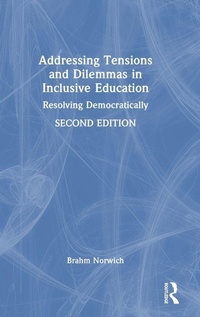
Addressing Tensions and Dilemmas in Inclusive Education
Resolving Democratically
2nd Edition
Published on 25. October 2023
Book
Hardback
248 pages
978-1-032-35351-7 (ISBN)
Description
This updated second edition of Addressing Tensions and Dilemmas in Inclusive Education further develops the critical analysis of the initial edition that integrates the interaction between different perspectives and positions in the field of inclusive education.
This key resource expands the arguments present in the first edition with clearer implications about how to address tensions and dilemmas in inclusive education, and resolve them through democratic deliberation. Based on contemporary research, theory and policy, as well as responding to current perspectives towards the education of children and young people with learning difficulties and disabilities, Brahm Norwich extends and refines the original core argument of the previous edition - the practical realisation of inclusion involves tensions and dilemmas that have to be addressed and resolved. This core analysis focuses on:
- identification and classification
- current national and international conceptions
- pedagogic and curriculum issues
- organisation of schooling
- parental and student perspectives and the contribution of research to policy and practice.
Re-engaging with the fundamental issues in the field and providing a coherent perspective that recognises and justifies the inter-connection between specialised and general school provision, this accessible new edition will be of interest to all students and researchers of inclusive education.
This key resource expands the arguments present in the first edition with clearer implications about how to address tensions and dilemmas in inclusive education, and resolve them through democratic deliberation. Based on contemporary research, theory and policy, as well as responding to current perspectives towards the education of children and young people with learning difficulties and disabilities, Brahm Norwich extends and refines the original core argument of the previous edition - the practical realisation of inclusion involves tensions and dilemmas that have to be addressed and resolved. This core analysis focuses on:
- identification and classification
- current national and international conceptions
- pedagogic and curriculum issues
- organisation of schooling
- parental and student perspectives and the contribution of research to policy and practice.
Re-engaging with the fundamental issues in the field and providing a coherent perspective that recognises and justifies the inter-connection between specialised and general school provision, this accessible new edition will be of interest to all students and researchers of inclusive education.
More details
Edition
2nd edition
Language
English
Place of publication
London
United Kingdom
Publishing group
Taylor & Francis Ltd
Target group
College/higher education
Professional and scholarly
Postgraduate, Professional, and Undergraduate
Illustrations
9 s/w Zeichnungen, 9 s/w Abbildungen, 9 s/w Tabellen
9 Tables, black and white; 9 Line drawings, black and white; 9 Illustrations, black and white
Dimensions
Height: 240 mm
Width: 161 mm
Thickness: 19 mm
Weight
558 gr
ISBN-13
978-1-032-35351-7 (9781032353517)
Copyright in bibliographic data and cover images is held by Nielsen Book Services Limited or by the publishers or by their respective licensors: all rights reserved.
Schweitzer Classification
Other editions
Additional editions
E-Book
10/2023
2nd Edition
Routledge
€52.49
Available for download
Book
10/2023
2nd Edition
Routledge
€61.40
Shipment within 10-20 days
E-Book
10/2023
2nd Edition
Routledge
€52.49
Available for download
Previous edition
Book
07/2013
1st Edition
Routledge
€206.10
Shipment within 15-20 days
Person
Brahm Norwich is Professor Emeritus of Educational Psychology and Special Educational Needs at the School of Education, University of Exeter, UK.
Content
1. Setting the agenda 2. Special educational needs, barriers and disability 3. Classification and identification of special educational needs or disability in education 4. Inclusive curriculum issues 5. Inclusive pedagogy 6. Inclusive educational institutions: schools and universities 7. Parents and children: participation, partnerships and preferences 8. Philosophical issues 9. Researching inclusive education 10. Conclusions