

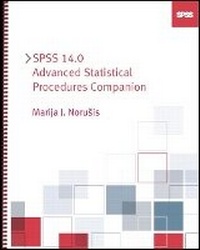
SPSS 14.0 Advanced Statistical Procedures Companion
Published on 30. March 2006
Book
Mixed media product
379 pages
978-0-13-174700-5 (ISBN)
Description
A statistical procedure is not like a sausage: you want to know its contents; you want to know the types of questions it can be used to answer and the types of data for which it is appropriate. The goal of the SPSS 14.0 Advanced Statistical Procedures Companion is to provide you with background information and examples for statistical procedures in the SPSS Advanced and Regression Models modules. It aims to make it less likely that you will succumb to the siren song of melodic statistical procedure names and unleashes a disastrous assault on a mutely suffering data file.
For additional information, go to This site offers a detailed Table of Contents, features, examples included in the book, and a sample chapter for download.
For additional information, go to This site offers a detailed Table of Contents, features, examples included in the book, and a sample chapter for download.
More details
Language
English
Place of publication
United States
Publishing group
Pearson Education (US)
Target group
Professional and scholarly
Illustrations
Illustrations
Dimensions
Height: 229 mm
Width: 189 mm
Thickness: 14 mm
Weight
592 gr
ISBN-13
978-0-13-174700-5 (9780131747005)
Copyright in bibliographic data and cover images is held by Nielsen Book Services Limited or by the publishers or by their respective licensors: all rights reserved.
Schweitzer Classification
Other editions
New editions
Marija Norusis
SPSS 15.0 Advanced Statistical Procedures Companion
Book
04/2007
Pearson
€47.03
Article exhausted; check for reprint
Previous edition
Marija Norusis
SPSS 13.0 Advanced Statistical Procedures Companion
Book
04/2005
Pearson
€53.22
Article exhausted; check for reprint
Content
SPSS 14.0 Advanced Statistical Procedures Companion: Chapters
1. Model Selection in Loglinear Analysis. Model formulation; parameters in saturated models; hypothesis testing; convergence; goodness-of-fit tests; hierarchical models; generating classes; model selection with backward elimination.
2. Logit Loglinear Analysis. Dichotomous logit model; loglinear representation; parameter estimates; goodness-of-fit statistics; measures of dispersion and association; polychotomous logit model; interpreting parameters; examining residuals; introducing covariates.
3. Multinomial Logistic Regression. Baseline logits; likelihood-ratio tests for models and individual effects; evaluating the model; calculating predicted probabilities; the classification table; goodness-of-fit tests; residuals; pseudo R-square measures; overdispersion; model selection; matched case-control studies.
4. Ordinal Regression. Modeling cumulative counts; parameter estimates; testing for parallel lines; model fit; observed and expected counts; measures of strength of association; classifying cases; link functions; fitting a heteroscedastic probit model; fitting location and scale parameters.
5. Probit Regression. Probit and logit response models; confidence intervals for effective dosages; comparing groups; comparing relative potencies; estimating the natural response rate; multiple stimuli.
6. Kaplan-Meier Survival Analysis. Calculating survival time; estimating the survival function, the conditional probability of survival, and the cumulative probability of survival; plotting survival functions; comparing survival functions; stratified comparisons.
7. Life Tables. Calculating survival probabilities; assumptions; observations lost to follow-up; plotting survival functions; comparing survival functions.
8. Cox Regression. The model; proportional hazards assumption; coding categorical variables; interpreting the regression coefficients; baseline hazard and cumulative survival rates; global tests of the model; checking the proportional hazards assumption; stratification; log-minus-log survival plot; identifying influential cases; examining residuals; partial (Schoenfeld) residuals; martingale residuals; variable-selection methods; time-dependent covariates; specifying a time-dependent covariate; calculating segmented time-dependent covariates; testing the proportional hazards assumption with a time-dependent covariate; fitting a conditional logistic regression model.
9. Variance Components. Factors, effects, and models; model for one-way classification; estimation methods; negative variance estimates; nested design model for two-way classification; univariate repeated measures analysis; using a Mixed Models Approach; distribution assumptions; estimation methods.
10. Linear Mixed Models. Background; Unconditional random-effects models; hierarchical models; random-coefficient model; model with school-level and individual-level covariates; three-level hierarchical model; repeated measurements; selecting a residual covariance structure.
11. Nonlinear Regression. The nonlinear model; transforming nonlinear models; intrinsically nonlinear models; fitting a logistic population growth model; finding starting values; approximate confidence intervals for the parameters;bootstrapped estimates; starting values from previous analysis; linear approximation; computational issues; common models for nonlinear regression; specifying a segmented model.
12. Two-Stage Least-Squares Regression. Demand-price-income economic model; estimation with ordinary least squares; feedback and correlated errors; estimation with two-stage least squares.
13. Weighted Least-Squares Regression. Diagnosing the problem; estimating weights; examining the log-likelihood function; the WLS solution; estimating weights from replicates; diagnostics from the linear regression procedure.
14. Multidimensional Scaling. Data, models, and multidimensional scaling analysis; nature of data analyzed in MDS; measurement level of data; shape of data; conditionality of data; missing data; multivariate data; classical MDS; Euclidean model; details of CMDS; Replicated MDS; Weighted MDS; geometry of the weighted Euclidean model; algebra of the weighted Euclidean model; matrix algebra of the weighted Euclidean model; Weirdness index; flattened weights.
1. Model Selection in Loglinear Analysis. Model formulation; parameters in saturated models; hypothesis testing; convergence; goodness-of-fit tests; hierarchical models; generating classes; model selection with backward elimination.
2. Logit Loglinear Analysis. Dichotomous logit model; loglinear representation; parameter estimates; goodness-of-fit statistics; measures of dispersion and association; polychotomous logit model; interpreting parameters; examining residuals; introducing covariates.
3. Multinomial Logistic Regression. Baseline logits; likelihood-ratio tests for models and individual effects; evaluating the model; calculating predicted probabilities; the classification table; goodness-of-fit tests; residuals; pseudo R-square measures; overdispersion; model selection; matched case-control studies.
4. Ordinal Regression. Modeling cumulative counts; parameter estimates; testing for parallel lines; model fit; observed and expected counts; measures of strength of association; classifying cases; link functions; fitting a heteroscedastic probit model; fitting location and scale parameters.
5. Probit Regression. Probit and logit response models; confidence intervals for effective dosages; comparing groups; comparing relative potencies; estimating the natural response rate; multiple stimuli.
6. Kaplan-Meier Survival Analysis. Calculating survival time; estimating the survival function, the conditional probability of survival, and the cumulative probability of survival; plotting survival functions; comparing survival functions; stratified comparisons.
7. Life Tables. Calculating survival probabilities; assumptions; observations lost to follow-up; plotting survival functions; comparing survival functions.
8. Cox Regression. The model; proportional hazards assumption; coding categorical variables; interpreting the regression coefficients; baseline hazard and cumulative survival rates; global tests of the model; checking the proportional hazards assumption; stratification; log-minus-log survival plot; identifying influential cases; examining residuals; partial (Schoenfeld) residuals; martingale residuals; variable-selection methods; time-dependent covariates; specifying a time-dependent covariate; calculating segmented time-dependent covariates; testing the proportional hazards assumption with a time-dependent covariate; fitting a conditional logistic regression model.
9. Variance Components. Factors, effects, and models; model for one-way classification; estimation methods; negative variance estimates; nested design model for two-way classification; univariate repeated measures analysis; using a Mixed Models Approach; distribution assumptions; estimation methods.
10. Linear Mixed Models. Background; Unconditional random-effects models; hierarchical models; random-coefficient model; model with school-level and individual-level covariates; three-level hierarchical model; repeated measurements; selecting a residual covariance structure.
11. Nonlinear Regression. The nonlinear model; transforming nonlinear models; intrinsically nonlinear models; fitting a logistic population growth model; finding starting values; approximate confidence intervals for the parameters;bootstrapped estimates; starting values from previous analysis; linear approximation; computational issues; common models for nonlinear regression; specifying a segmented model.
12. Two-Stage Least-Squares Regression. Demand-price-income economic model; estimation with ordinary least squares; feedback and correlated errors; estimation with two-stage least squares.
13. Weighted Least-Squares Regression. Diagnosing the problem; estimating weights; examining the log-likelihood function; the WLS solution; estimating weights from replicates; diagnostics from the linear regression procedure.
14. Multidimensional Scaling. Data, models, and multidimensional scaling analysis; nature of data analyzed in MDS; measurement level of data; shape of data; conditionality of data; missing data; multivariate data; classical MDS; Euclidean model; details of CMDS; Replicated MDS; Weighted MDS; geometry of the weighted Euclidean model; algebra of the weighted Euclidean model; matrix algebra of the weighted Euclidean model; Weirdness index; flattened weights.