

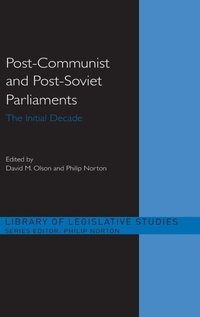
Post-Communist and Post-Soviet Parliaments
The Initial Decade
1st Edition
Published on 20. December 2007
Book
Hardback
214 pages
978-0-415-36557-4 (ISBN)
Description
The sudden collapse of communism stimulated both the rapid emergence of fledgling democracies and scholarly attention to the post-communist transition. These newly democratized parliaments have been described as "parliaments in adolescence".
This book identifies six parliaments which exemplify the wide range of developments in the new post-communist political systems, from the stable consolidated democracies to the less stable and more authoritarian states, within which their respective parliaments function.
Finally the post-communist parliaments are compared with the presumptively more established west European parliaments. This book bridges the usual gap in research between the post-communist parliaments and more "normal" democratic parliaments to develop a common legislative research perspective on both new and established parliaments.
This book was previously published as a special issue of the Journal of Legislative Studies.
This book identifies six parliaments which exemplify the wide range of developments in the new post-communist political systems, from the stable consolidated democracies to the less stable and more authoritarian states, within which their respective parliaments function.
Finally the post-communist parliaments are compared with the presumptively more established west European parliaments. This book bridges the usual gap in research between the post-communist parliaments and more "normal" democratic parliaments to develop a common legislative research perspective on both new and established parliaments.
This book was previously published as a special issue of the Journal of Legislative Studies.
More details
Series
Language
English
Place of publication
London
United Kingdom
Publishing group
Taylor & Francis Ltd
Target group
College/higher education
Professional and scholarly
Dimensions
Height: 240 mm
Width: 161 mm
Thickness: 16 mm
Weight
493 gr
ISBN-13
978-0-415-36557-4 (9780415365574)
Copyright in bibliographic data and cover images is held by Nielsen Book Services Limited or by the publishers or by their respective licensors: all rights reserved.
Schweitzer Classification
Other editions
Additional editions
E-Book
09/2013
1st Edition
Routledge
€64.49
Available for download
E-Book
09/2013
1st Edition
Routledge
€64.49
Available for download
Book
02/2009
1st Edition
Routledge
€71.20
Shipment within 15-20 days
Persons
Philip Norton [Lord Norton of Louth]: Professor of Government and Director of the Centre for Legislative Studies, University of Hull.
David M. Olson: Professor Emeritus of Political Science, and Co-Director, Center for Legislative Studies, University of North Carolina at Greensboro; Co-Chair of Research Committee of Legislative Specialists, International Political Science Association
David M. Olson: Professor Emeritus of Political Science, and Co-Director, Center for Legislative Studies, University of North Carolina at Greensboro; Co-Chair of Research Committee of Legislative Specialists, International Political Science Association
Content
INTRODUCTION Post-Communist and Post-Soviet Legislatures: Beyond Transition Philip Norton and David M. Olson THE PARLIAMENTS: DEMOCRATIC POST-COMMUNIST PARLIAMENTS 1. The Parliament of the Czech Republic, 1993-2004 Lukas Linek and Zdenka Mansfeldova 2. From Minimal to Subordinate: A Final Verdict? The Hungarian Parliament, 1990-2002 Gabriella Ilonszki 3. Five Terms of the Polish Parliament, 1989-2005 Ewa Nalewajko and Wlodzimierz Wesolowski 4. Slovenia's National Assembly, 1992-2004 Drago Zajc THE PARLIAMENTS: AUTHORITARIAN POST-SOVIET PARLIAMENTS 5. Development of the Moldovan Parliament One Decade After Independence: Slow Going William E. Crowther 6. The Russian Federal Assembly, 1994-2004 Thomas F. Remington POST-COMMUNIST AND POST-SOVIET PARLIAMENTS COMPARED 7. MPs in Post-Communist and Post-Soviet Nations: A Parliamentary Elite in the Making Gabriella Ilonszki and Michael Edinger 8. Post-Communist and Post-Soviet Parliaments: Divergent Paths from Transition David M. Olson and Philip Norton