

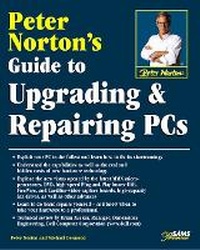
Peter Norton's Guide to Upgrading and Repairing PCs,
Published on 2. December 1997
Book
Paperback/Softback
704 pages
978-0-672-31140-6 (ISBN)
Description
Peter Norton's Guide to Upgrading and Repairing PCs provides expert advice using a friendly, step-by-step approach. Understand how each component of your PC system functions and why earlier models and technologies can often prove to be bottlenecks in your day-to-day work. Learn about the new technologies, such as MMX-equipped Pentium IIs, DVD, USB, and FireWire, and determine whether each spells death or renewal for your aging PC and existing peripherals. Each chapter begins with an overview that sets forth the underlying technology. Chapters outline the pros and cons of alternative upgrade options without overlooking the costs, future prospects, and timeline for a best buy, and typically end with step-by-step installation and troubleshooting procedures. In addition, Peter's Principles, Upgrade Advice, Buying Tips, Compatibility Notes, and other icons make it easy to find exactly what you need.
More details
Language
English
Place of publication
Indianapolis
United States
Publishing group
Pearson Education (US)
Target group
College/higher education
Dimensions
Height: 230 mm
Width: 186 mm
Thickness: 42 mm
Weight
1162 gr
ISBN-13
978-0-672-31140-6 (9780672311406)
Copyright in bibliographic data and cover images is held by Nielsen Book Services Limited or by the publishers or by their respective licensors: all rights reserved.
Schweitzer Classification
Other editions
New editions
Peter Norton | Michael Desmond
Peter Norton's Complete Guide to PC Upgrades
Book
02/1999
2nd Edition
Sams Publishing
€33.37
Article is exhausted; no reprint
Previous edition

Book
01/1998
Sams Publishing
€54.11
Article exhausted; check different version
Content
Section 1 Introduction: the PC - a view from 30,000 feet; operating system issues; troubleshooting overview; upgrade strategies; repair strategies; think before you shop. Section 2 Core components: heart and soul - the CPU; BIOS; RAM; cache; power supplies and UPS; motherboards and cases. Section 2 Basic storage media: IDE and SCSI controllers; hard disk; CD-ROM drive; floppy drives; DVD. Section 4 Advanced storage media: fast magnetic media (Zip and Jaz); CD-recordable drives; magneto-optical media (Syquest, others); tape backup. Section 5 Multimedia: graphics accelerators; audio; display; video capture board. Section 6 Connectivity: modems; I/O (serial parallel, USB, Firewire, IR); network adapters. Section 7 Input and output: printers; keyboard; mouse/pointing device; camera; scanner.