

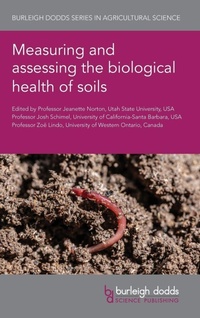
Measuring and Assessing the Biological Health of Soils
Will be published approx. on 16. December 2025
Book
Hardback
400 pages
978-1-83545-075-8 (ISBN)
Description
One of the most important topics in soil science is understanding the relationship between soil biodiversity and soil ecosystem function. This relies on techniques able to accurately identify different soil organisms and how they interact in the soil microbiome.
Measuring and assessing the biological health of soils provides a comprehensive overview of the range of techniques used to assess microbial/faunal diversity activity in soils and its impact on key ecological processes. The book also reviews how biological indicators can be integrated into soil health testing programmes to improve the quality of agricultural, grassland and forest soils.
The book builds on a successful earlier volume published by Burleigh Dodds Science: Advances in measuring soil health (2021).
Measuring and assessing the biological health of soils provides a comprehensive overview of the range of techniques used to assess microbial/faunal diversity activity in soils and its impact on key ecological processes. The book also reviews how biological indicators can be integrated into soil health testing programmes to improve the quality of agricultural, grassland and forest soils.
The book builds on a successful earlier volume published by Burleigh Dodds Science: Advances in measuring soil health (2021).
More details
Series
Language
English
Place of publication
Cambridge
United Kingdom
Target group
College/higher education
Professional and scholarly
University and other researchers in soil and crop science, companies providing soil monitoring services, as well as government and other agencies responsible for ensuring the health of agricultural soils.
Product notice
Paper over boards
Illustrations
Color tables, photos and figures
Dimensions
Height: 235 mm
Width: 157 mm
Thickness: 30 mm
Weight
837 gr
ISBN-13
978-1-83545-075-8 (9781835450758)
DOI
10.19103/AS.2025.0159
Copyright in bibliographic data and cover images is held by Nielsen Book Services Limited or by the publishers or by their respective licensors: all rights reserved.
Schweitzer Classification
Other editions
Additional editions
Jeanette Norton | Josh Schimel | Zoe Lindo
Measuring and Assessing the Biological Health of Soils
E-Book
12/2025
Burleigh Dodds Science Publishing Limited
€196.99
Available for download
Persons
Dr Jeanette Norton is Professor of Soil Microbiology in the Department of Plants, Soils and Climate at Utah State University, USA. She is a Fellow of the Soil Science Society of America. Professor Norton is internationally known for her research on ways of analysing the soil microbiome, including its role in nitrogen and carbon cycling.
Dr Josh Schimel is Professor of Soil Ecology in the Faculty of Ecology, Evolution and Marine Biology at the University of California-Santa Barbara, USA. Professor Schimel is Co-Editor in Chief of Soil Biology and Biochemistry. His research focuses on role of soil microbes in controlling ecosystem-scale processes.
Dr Zoe Lindo is Professor in the Department of Biology at the University of Western Ontario, Canada. Professor Lindo is Co-Chair of the FAO International Initiative on Soil Biodiversity (NETSOB) and Editor-in-Chief of Pedobiologia: Journal Of Soil Ecology as well as being an acknowledged expert on soil biodiversity and its impact on ecosystem function.
Dr Josh Schimel is Professor of Soil Ecology in the Faculty of Ecology, Evolution and Marine Biology at the University of California-Santa Barbara, USA. Professor Schimel is Co-Editor in Chief of Soil Biology and Biochemistry. His research focuses on role of soil microbes in controlling ecosystem-scale processes.
Dr Zoe Lindo is Professor in the Department of Biology at the University of Western Ontario, Canada. Professor Lindo is Co-Chair of the FAO International Initiative on Soil Biodiversity (NETSOB) and Editor-in-Chief of Pedobiologia: Journal Of Soil Ecology as well as being an acknowledged expert on soil biodiversity and its impact on ecosystem function.
Editor
Utah State University
University of California-Santa Barbara (United States)
University of Western Ontario
Contributions
Wageningen University
University of Maryland
James Hutton Institute
Virginia Tech
University of Florence (Italy)
Northern Arizona University (United States)
Curtin University
Content
1.Soil biology, soil health and ecosystem services: an overview: Rachel Creamer, Wageningen University, The Netherlands;
Part 1 Advances in DNA-based methods, biological and other indicators to investigate soil microbial activity
2.Advances in DNA based methods for assessing abundance and diversity and of microbial groups: Stephanie Yarwood, University of Maryland, USA;
3.Advances in quantitative PCR (qPCR) techniques for identifying and studying soil microbial communities: Maddy Giles, James Hutton Institute, UK;
4.Advances in soil respiration techniques as an indicator of soil microbial activity: Ryan Stewart, Virginia Tech, USA;
5.Enzyme assays for measuring soil microbial activity: Paolo Nannipieri, University of Florence, Italy;
6.Advances in stable isotope profiling (SIP) techniques to track plant-microbial interactions: Bruce Hungate, Northern Arizona University, USA;
7.Applications and advances in using phospholipid fatty acids (PLFA) as biomarkers in analysing soil microbial communities: Sarina Claassens, Curtin University, Australia;
Part 2 Fauna as indicators of soil health
8.Earthworms/macrofauna as indicators of soil health: Jan Willem Van Groenigen, Wageningen University, The Netherlands;
9.Mesofauna as indicators of soil health: Stefaan De Neve, Ghent University, Belgium;
10.Nematodes/microfauna as indicators of soil health: Deborah Neher, University of Vermont, USA;
Part 3 Applications
11.Integrating biological indicators into soil health testing programmes: Joseph Amsili, Cornell University, USA;
12.Using biological indicators of soil health to assess the impact of particular cropping practices: Joann Whalen, McGill University, Canada;
13.Using biological indicators to assess the health of forest soils: Weixin Zhang, Henan University, China;
Part 1 Advances in DNA-based methods, biological and other indicators to investigate soil microbial activity
2.Advances in DNA based methods for assessing abundance and diversity and of microbial groups: Stephanie Yarwood, University of Maryland, USA;
3.Advances in quantitative PCR (qPCR) techniques for identifying and studying soil microbial communities: Maddy Giles, James Hutton Institute, UK;
4.Advances in soil respiration techniques as an indicator of soil microbial activity: Ryan Stewart, Virginia Tech, USA;
5.Enzyme assays for measuring soil microbial activity: Paolo Nannipieri, University of Florence, Italy;
6.Advances in stable isotope profiling (SIP) techniques to track plant-microbial interactions: Bruce Hungate, Northern Arizona University, USA;
7.Applications and advances in using phospholipid fatty acids (PLFA) as biomarkers in analysing soil microbial communities: Sarina Claassens, Curtin University, Australia;
Part 2 Fauna as indicators of soil health
8.Earthworms/macrofauna as indicators of soil health: Jan Willem Van Groenigen, Wageningen University, The Netherlands;
9.Mesofauna as indicators of soil health: Stefaan De Neve, Ghent University, Belgium;
10.Nematodes/microfauna as indicators of soil health: Deborah Neher, University of Vermont, USA;
Part 3 Applications
11.Integrating biological indicators into soil health testing programmes: Joseph Amsili, Cornell University, USA;
12.Using biological indicators of soil health to assess the impact of particular cropping practices: Joann Whalen, McGill University, Canada;
13.Using biological indicators to assess the health of forest soils: Weixin Zhang, Henan University, China;