

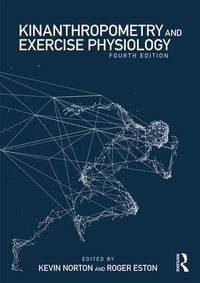
Kinanthropometry and Exercise Physiology
Volume One: Anthropometry
4th Edition
Published on 8. August 2018
Book
Paperback/Softback
558 pages
978-1-138-23052-1 (ISBN)
Description
Fully updated, revised and consolidated into one single volume, the fourth edition of Kinanthropometry and Exercise Physiology offers the best theoretically contextualised, practical resource for instructors and students available.
Incorporating substantial sections on kinanthropometry, exercise physiology, energy systems and the application of science in health and high performance settings, the book covers the basics of measurement in exercise science through to advanced methods, and includes brand new chapters on:
Pre-exercise screening and health risk stratification
Functional movement assessment
Point of care testing
Anthropometry standards
Anaerobic power and capacity
History of exercise for health benefits
Monitoring training loads in high-performance athletes
Measuring game style in team sports
Offering on-line access to newly developed exercise science measurement tools through the Exercise Science Toolkit - www.exercisesciencetoolkit.com - no other book offers such a complete resource, from the science of kinanthropometry and exercise physiology to their applications in health and performance, through practical, interactive learning. This book is an essential companion for students on any sport and exercise science-related degree programme and any instructor leading practical, laboratory-based classes.
Incorporating substantial sections on kinanthropometry, exercise physiology, energy systems and the application of science in health and high performance settings, the book covers the basics of measurement in exercise science through to advanced methods, and includes brand new chapters on:
Pre-exercise screening and health risk stratification
Functional movement assessment
Point of care testing
Anthropometry standards
Anaerobic power and capacity
History of exercise for health benefits
Monitoring training loads in high-performance athletes
Measuring game style in team sports
Offering on-line access to newly developed exercise science measurement tools through the Exercise Science Toolkit - www.exercisesciencetoolkit.com - no other book offers such a complete resource, from the science of kinanthropometry and exercise physiology to their applications in health and performance, through practical, interactive learning. This book is an essential companion for students on any sport and exercise science-related degree programme and any instructor leading practical, laboratory-based classes.
More details
Edition
4th edition
Language
English
Place of publication
London
United Kingdom
Publishing group
Taylor & Francis Ltd
Target group
College/higher education
Professional and scholarly
Illustrations
191 s/w Photographien bzw. Rasterbilder, 63 s/w Tabellen
63 Tables, black and white; 191 Halftones, black and white
Dimensions
Height: 246 mm
Width: 174 mm
Weight
1126 gr
ISBN-13
978-1-138-23052-1 (9781138230521)
Copyright in bibliographic data and cover images is held by Nielsen Book Services Limited or by the publishers or by their respective licensors: all rights reserved.
Schweitzer Classification
Other editions
Additional editions
E-Book
09/2018
4th Edition
Routledge
€115.99
Available for download
E-Book
09/2018
4th Edition
Routledge
€115.99
Available for download
Book
08/2018
4th Edition
Routledge
€274.82
Shipment within 10-20 days
Previous edition
Roger Eston
Kinanthropometry and Exercise Physiology Laboratory Manual: Tests, Procedures and Data
Volume One: Anthropometry
Book
10/2008
3rd Edition
Routledge
€78.17
Article exhausted; check for reprint
Persons
Kevin Norton is a Professor of Exercise Science in the School of Health Sciences at the University of South Australia, Australia. His current research and teaching interests include exercise-induced changes to health risk factors, interventions to increase physical activity among adults, and limits to human performance in sport.
Roger Eston is a Professor of Exercise Science and Head of the School of Health Sciences at the University of South Australia, Australia. His research interests include anthropometry and physiology relating to health and performance in children and adults.
Roger Eston is a Professor of Exercise Science and Head of the School of Health Sciences at the University of South Australia, Australia. His research interests include anthropometry and physiology relating to health and performance in children and adults.
Content
Section I: Measurement in Exercise Science
1. Pre-exercise Screening and Health Risk Assessment
Lynda H. Norton and Kevin I. Norton
2. Movement Capacity Screening and Assessment
Max Martin, Hunter Bennett, Kade Davison, and John Arnold
3. Blood Sampling and Point-Of-Care Testing
Lynda H. Norton and Kevin I. Norton
4. Standards for Anthropometry Assessment
Kevin I. Norton
5. Human Body Composition
Jonathan Buckley, Michael Hawes, Alan Martin, and Roger G. Eston
6. Anthropometry and Body Image
Tim S. Olds
7. Growth, Maturation, and Physical Fitness
Alan R. Barker, Luis Gracia-Marco, Dimitris Vlachopoulos, and Craig A. Williams
8. Scaling: Adjusting for Differences in Body Size
Edward M. Winter and Alan M. Nevill
Section II: Physiological Systems at Rest and During Exercise
9. Lung Function
Alan J. Crockett, Tjard R. Schermer, and Roger G. Eston
10. Assessment of Neuromuscular Performance Using Electromyography
Nigel Gleeson
11. Thermoregulation
N. Tim Cable and Sam Chalmers
12. Anaerobic Lactacid Energy System: Measures of Anaerobic Lactacid Power and Capacity
David Bishop and Nicholas Jamnick
13. Aerobic Exercise Performance
Andrew M. Jones, Mark Burnley, and Anni Vanhatalo
14. Maximal Oxygen Uptake, Economy, and Efficiency
Carlton B. Cooke and Mark J. Cooke
15. Metabolic Rate and Energy Balance
Carlton B. Cooke and Mark J. Cooke
Section III: Applications for Health and Performance
16. The Exercise-health Paradigm: A Historical Perspective
Katherine Devonshire-Gill
17. Characterising Physical Behaviours in Free-Living Populations: How Much? When? Where? What?
Alex V. Rowlands
18. Perceived Exertion, Heart Rate and Other Non-Invasive Methods for Exercise Testing And Intensity Control
Roger G. Eston and Gaynor Parfitt
19. Physiological Basis for Training and Monitoring the Training Response
Stuart R. Graham and Grace Greenham
20. Game Style in Team Sports: What Is It and How to Measure It?
Stuart Gollan, Adam Hewitt, Grace Greenham, and Kevin I. Norton
21. Anaerobic Power and Capacity in Masters Athletes
Peter Reaburn, Thomas Doering, and Damon Arezzolo
1. Pre-exercise Screening and Health Risk Assessment
Lynda H. Norton and Kevin I. Norton
2. Movement Capacity Screening and Assessment
Max Martin, Hunter Bennett, Kade Davison, and John Arnold
3. Blood Sampling and Point-Of-Care Testing
Lynda H. Norton and Kevin I. Norton
4. Standards for Anthropometry Assessment
Kevin I. Norton
5. Human Body Composition
Jonathan Buckley, Michael Hawes, Alan Martin, and Roger G. Eston
6. Anthropometry and Body Image
Tim S. Olds
7. Growth, Maturation, and Physical Fitness
Alan R. Barker, Luis Gracia-Marco, Dimitris Vlachopoulos, and Craig A. Williams
8. Scaling: Adjusting for Differences in Body Size
Edward M. Winter and Alan M. Nevill
Section II: Physiological Systems at Rest and During Exercise
9. Lung Function
Alan J. Crockett, Tjard R. Schermer, and Roger G. Eston
10. Assessment of Neuromuscular Performance Using Electromyography
Nigel Gleeson
11. Thermoregulation
N. Tim Cable and Sam Chalmers
12. Anaerobic Lactacid Energy System: Measures of Anaerobic Lactacid Power and Capacity
David Bishop and Nicholas Jamnick
13. Aerobic Exercise Performance
Andrew M. Jones, Mark Burnley, and Anni Vanhatalo
14. Maximal Oxygen Uptake, Economy, and Efficiency
Carlton B. Cooke and Mark J. Cooke
15. Metabolic Rate and Energy Balance
Carlton B. Cooke and Mark J. Cooke
Section III: Applications for Health and Performance
16. The Exercise-health Paradigm: A Historical Perspective
Katherine Devonshire-Gill
17. Characterising Physical Behaviours in Free-Living Populations: How Much? When? Where? What?
Alex V. Rowlands
18. Perceived Exertion, Heart Rate and Other Non-Invasive Methods for Exercise Testing And Intensity Control
Roger G. Eston and Gaynor Parfitt
19. Physiological Basis for Training and Monitoring the Training Response
Stuart R. Graham and Grace Greenham
20. Game Style in Team Sports: What Is It and How to Measure It?
Stuart Gollan, Adam Hewitt, Grace Greenham, and Kevin I. Norton
21. Anaerobic Power and Capacity in Masters Athletes
Peter Reaburn, Thomas Doering, and Damon Arezzolo