

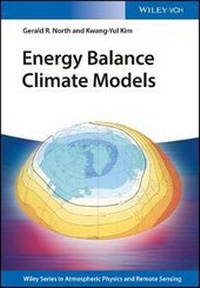
Energy Balance Climate Models
1st Edition
Will be published approx. on 23. December 2030
Book
Paperback/Softback
250 pages
978-3-527-41128-3 (ISBN)
Description
Written by well-known experts in the field, this textbook introduces and develops the energy balance climate models for the scientific community.
It begins with the global average models, and explores these from their elementary forms yielding the global average temperature to the incorporation of feedback mechanisms and some analytical properties of interest. The effect of stochastic forcing is then used to introduce natural variability in the models, with the global average models introducing the concept of stability theory.
The book then goes on to show that radiative equilibrium models are unstable to convection, thus leading to radiative-convective equilibrium models, and a study of their sensitivity and temporal adjustment times.
Further studies of the vertical include how heat is distributed below the Earth?s surface, including its transport in the oceans via a class of simplified ocean models, ranging from the mixed layer only to oceans that employ an upwelling-diffusion mechanism. The next step introduces the one-dimensional or zonally averaged models that take into account latitude dependence of the surface temperature fields.
Finally, the text turns to applications, including chapters paleoclimatology, detection of signals in the climate system, and optimal estimation of large scale quantities from point scale data.
Throughout, the authors work on two mathematical levels: Qualitative physical expositions of the material, and optional mathematical sections that include derivations and treatments of the equations along with some proofs of stability theorems, etc.
Thanks to its concise style, this book can be used as a supplement to a course on climate science or radiative transfer or equivalent, making it a must for many graduate students in oceanography, meteorology or climate science. It equally makes for a good introduction for policy makers, environmental agencies, and NGOs.
It begins with the global average models, and explores these from their elementary forms yielding the global average temperature to the incorporation of feedback mechanisms and some analytical properties of interest. The effect of stochastic forcing is then used to introduce natural variability in the models, with the global average models introducing the concept of stability theory.
The book then goes on to show that radiative equilibrium models are unstable to convection, thus leading to radiative-convective equilibrium models, and a study of their sensitivity and temporal adjustment times.
Further studies of the vertical include how heat is distributed below the Earth?s surface, including its transport in the oceans via a class of simplified ocean models, ranging from the mixed layer only to oceans that employ an upwelling-diffusion mechanism. The next step introduces the one-dimensional or zonally averaged models that take into account latitude dependence of the surface temperature fields.
Finally, the text turns to applications, including chapters paleoclimatology, detection of signals in the climate system, and optimal estimation of large scale quantities from point scale data.
Throughout, the authors work on two mathematical levels: Qualitative physical expositions of the material, and optional mathematical sections that include derivations and treatments of the equations along with some proofs of stability theorems, etc.
Thanks to its concise style, this book can be used as a supplement to a course on climate science or radiative transfer or equivalent, making it a must for many graduate students in oceanography, meteorology or climate science. It equally makes for a good introduction for policy makers, environmental agencies, and NGOs.
More details
Series
Language
English
Place of publication
Weinheim
Germany
Target group
Professional and scholarly
Illustrations
60 s/w Abbildungen
Dimensions
Height: 240 mm
Width: 170 mm
ISBN-13
978-3-527-41128-3 (9783527411283)
Copyright in bibliographic data and cover images is held by Nielsen Book Services Limited or by the publishers or by their respective licensors: all rights reserved.
Schweitzer Classification
Other editions
Additional editions
Gerald R. North | Kwang-Yul Kim
Energy Balance Climate Models
Book
09/2017
1st Edition
Wiley-VCH
€182.00
Shipment within 5-7 days
Persons
Gerald R. North is Distinguished Professor of Atmospheric Sciences and Oceanography at Texas A&M University, having obtained his BS degree in physics from the University of Tennessee, PhD (1966) in theoretical physics from the University of Wisconsin, Madison. Among other positions he served eight years as research scientist at Goddard Space Flight Center before joining Texas A&M in 1986, where he served as department head 1995-2003. He is a fellow of AAAS, AGU, AMS, and recipient of several awards including the Jule G. Charney Award of the American Meteorology Society. He has served as Editor in Chief of the Reviews of Geophysics and is currently Editor in Chief of the Encyclopedia of the Atmospheric Sciences, 2nd Edition.
Kwang-Yul Kim is a professor at Seoul National University. He graduated from Texas A&M with his Ph.D. degree in physical oceanography. He is the programmer of several new energy balance models.
Kwang-Yul Kim is a professor at Seoul National University. He graduated from Texas A&M with his Ph.D. degree in physical oceanography. He is the programmer of several new energy balance models.
Content
INTRODUCTION
GLOBAL AVERAGE MODELS
Solar Radiation
Terrestrial Radiation
Radiation Balance
Stability and Time Scale
Feedback Mechanisms
BELOW THE SURFACE
Mixed Layer Ocean
A Deeper Ocean Model
ABOVE THE SURFACE
Atmospheric Constituents
The Dry Atmosphere without GHGs
Gray Atmosphere Model
Infrared Spectra
MODTRAN
Introducing CO2 & Doubling it
Introducing Water Vapor
LATITUDINAL DEPENDENCE
Diffusive Heat Transport
Solution with Legendre Modes
Space and Time Scales
Climate Sensitivity
SOME NONLINEAR PROCESSES
Ice Caps
Small Ice Caps
Large Ice Caps
TWO HORIZONTAL DIMENSIONS
Earth`s Geography
The Seasonal Cycle
Changing Orbital Elements
APPLICATIONS TO PALEOCLIMATOLOGY
Moving Continents
Initiation of Ice Sheets
Milankovitch and EBCMs
WEATHER AS NOISE IN THE CLIMATE SYSTEM
EBCM with Noise Forcing
Length and Time Scales
Maps of the Moments
SOME APPLICATIONS OF THE STOCHASTIC MODELS
Estimation of Climate Parameters
Detecting Climate Signals
THE PLACE OF EBCMs IN CLIMATE RESEARCH
GLOBAL AVERAGE MODELS
Solar Radiation
Terrestrial Radiation
Radiation Balance
Stability and Time Scale
Feedback Mechanisms
BELOW THE SURFACE
Mixed Layer Ocean
A Deeper Ocean Model
ABOVE THE SURFACE
Atmospheric Constituents
The Dry Atmosphere without GHGs
Gray Atmosphere Model
Infrared Spectra
MODTRAN
Introducing CO2 & Doubling it
Introducing Water Vapor
LATITUDINAL DEPENDENCE
Diffusive Heat Transport
Solution with Legendre Modes
Space and Time Scales
Climate Sensitivity
SOME NONLINEAR PROCESSES
Ice Caps
Small Ice Caps
Large Ice Caps
TWO HORIZONTAL DIMENSIONS
Earth`s Geography
The Seasonal Cycle
Changing Orbital Elements
APPLICATIONS TO PALEOCLIMATOLOGY
Moving Continents
Initiation of Ice Sheets
Milankovitch and EBCMs
WEATHER AS NOISE IN THE CLIMATE SYSTEM
EBCM with Noise Forcing
Length and Time Scales
Maps of the Moments
SOME APPLICATIONS OF THE STOCHASTIC MODELS
Estimation of Climate Parameters
Detecting Climate Signals
THE PLACE OF EBCMs IN CLIMATE RESEARCH