

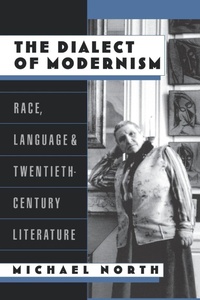
The Dialect of Modernism
Race, Language, and Twentieth-Century Literature
Published on 6. August 1998
Book
Paperback/Softback
272 pages
978-0-19-512291-6 (ISBN)
Description
The second volume in Oxford's new Race and American Culture series, The Dialect of Modernism uncovers the crucial role of racial masquerade and linguistic imitation in the emergence of literary modernism.
Rebelling against the standard language, and literature written in it, modernists, such as Joseph Conrad, Gertrude Stein, T.S. Eliot, Ezra Pound, and William Carlos Williams reimagined themselves as racial aliens and mimicked the strategies of dialect speakers in their work. In doing so, they made possible the most radical representational strategies of modern literature, which emerged from their attack on the privilege of standard language.
At the same time, however, another movement, identified with Harlem, was struggling to free itself from the very dialect the modernists appropriated, at least as it had been rendered by two generations of white dialect writers. For writers such as Claude McKay, Jean Toomer, and Zora Neale Hurston, this dialect became a barrier as rigid as the standard language itself.
Thus, the two modern movements, which arrived simultaneously in 1922, were linked and divided by their different stakes in the same language. In The Dialect of Modernism, Michael North shows, through biographical and historical investigation, and through careful readings of major literary works, that however different they were, the two movements are inextricably connected, and thus, cannot be considered in isolation. Each was marked, for good and bad, by the other.
Rebelling against the standard language, and literature written in it, modernists, such as Joseph Conrad, Gertrude Stein, T.S. Eliot, Ezra Pound, and William Carlos Williams reimagined themselves as racial aliens and mimicked the strategies of dialect speakers in their work. In doing so, they made possible the most radical representational strategies of modern literature, which emerged from their attack on the privilege of standard language.
At the same time, however, another movement, identified with Harlem, was struggling to free itself from the very dialect the modernists appropriated, at least as it had been rendered by two generations of white dialect writers. For writers such as Claude McKay, Jean Toomer, and Zora Neale Hurston, this dialect became a barrier as rigid as the standard language itself.
Thus, the two modern movements, which arrived simultaneously in 1922, were linked and divided by their different stakes in the same language. In The Dialect of Modernism, Michael North shows, through biographical and historical investigation, and through careful readings of major literary works, that however different they were, the two movements are inextricably connected, and thus, cannot be considered in isolation. Each was marked, for good and bad, by the other.
Reviews / Votes
All readers...will be hard-pressed to deny North's revisionary insight for twentieth-century literary studies: black dialect as performance is an unrecognized bridge between modernism and the Harlem Renaissance. With North's generative paradigm, we can examine the movements together in new ways. American LiteratureMore details
Series
Language
English
Place of publication
New York
United States
Target group
Professional and scholarly
Illustrations
4 Fotos bzw. Rasterbilder
halftones
Dimensions
Height: 229 mm
Width: 152 mm
Thickness: 16 mm
Weight
434 gr
ISBN-13
978-0-19-512291-6 (9780195122916)
Copyright in bibliographic data and cover images is held by Nielsen Book Services Limited or by the publishers or by their respective licensors: all rights reserved.
Schweitzer Classification
Other editions
Additional editions
E-Book
01/1998
1st Edition
OUP eBook
€44.99
Available for download
E-Book
08/1994
1st Edition
OUP eBook
€44.99
Available for download