

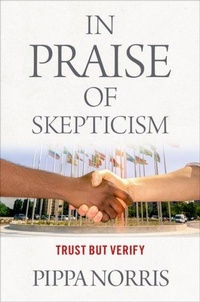
In Praise of Skepticism
Trust but Verify
Published on 14. November 2022
Book
Paperback/Softback
320 pages
978-0-19-753011-5 (ISBN)
Description
A culture of trust is usually claimed to have many public benefits--by lubricating markets, managing organizations, legitimating governments, and facilitating collective action. Any signs of its decline are, and should be, a matter of serious concern. Yet, In Praise of Skepticism recognizes that trust has two faces. Confidence in anti-vax theories has weakened herd immunity. Faith in Q-Anon conspiracy theories triggered insurrection. Disasters flow from gullible beliefs in fake Covid-19 cures, Madoff pyramid schemes, Russian claims of Ukrainian Nazis, and the Big Lie denying President Biden's legitimate election.
Trustworthiness involves an informal social contract by which principals authorize agents to act on their behalf in the expectation that they will fulfill their responsibilities with competency, integrity, and impartiality, despite conditions of risk and uncertainty. Skeptical judgments reflect reasonably accurate and informed predictions about agents' future actions based on their past performance and guardrails deterring dishonesty, mendacity, and corruption. We should trust but verify. Unfortunately, assessments are commonly flawed. Both cynical beliefs (underestimating performance) and credulous faith (over-estimating performance) involve erroneous judgements reflecting cultural biases, poor cognitive skills, and information echo chambers. These conclusions draw on new evidence from the European Values Survey/World Values Survey conducted among over 650,000 respondents in more than 100 societies over four decades.
In Praise of Skepticism warns that an excess of credulous trust poses serious and hitherto unrecognized risks in a world full of seductive demagogues playing on our insecurities, lying swindlers exploiting our greed, and silver-tongued conspiracy theorists manipulating our darkest fears.
Trustworthiness involves an informal social contract by which principals authorize agents to act on their behalf in the expectation that they will fulfill their responsibilities with competency, integrity, and impartiality, despite conditions of risk and uncertainty. Skeptical judgments reflect reasonably accurate and informed predictions about agents' future actions based on their past performance and guardrails deterring dishonesty, mendacity, and corruption. We should trust but verify. Unfortunately, assessments are commonly flawed. Both cynical beliefs (underestimating performance) and credulous faith (over-estimating performance) involve erroneous judgements reflecting cultural biases, poor cognitive skills, and information echo chambers. These conclusions draw on new evidence from the European Values Survey/World Values Survey conducted among over 650,000 respondents in more than 100 societies over four decades.
In Praise of Skepticism warns that an excess of credulous trust poses serious and hitherto unrecognized risks in a world full of seductive demagogues playing on our insecurities, lying swindlers exploiting our greed, and silver-tongued conspiracy theorists manipulating our darkest fears.
Reviews / Votes
All in all, an excellent contribution to scholarly research on the foundations of trust and a rich addition to the ever-growing body of knowledge on the importance of trust in our society, for which we can thank Pippa Norris. * Severin de Wit * Pippa Norris convincingly shows that our common understanding of trust needs to be challenged normatively by introducing cynicism and credulity, allowing a focus on a healthy dose of skepticism, through which risks are minimized and benefits are maximized * Severin de Wit, Journal of Trust Research * Pippa Norris offers a beautifully written, argued, and documented account of what we need to strengthen democracy. She emphasizes the combination of trustworthiness and healthy skepticism derived from considered judgment and critical deliberation. And she details the preconditions: an open society, a lack of strong ideological convictions, and education. In outlining the possible, Norris makes a reinvigorated democracy more probable. * Margaret Levi, Professor of Political Science, Stanford University * This is a landmark study in the discussion of trust as a major concept in political research. Norris differentiates the general concept by introducing cynicism and credulity, allowing a focus on prudence skepticism. Norris shows that there is no evidence for a simple claim of a steady erosion of trust. Rather, skeptical and informed judgments mostly support her trust-as-performance thesis. This book is fun to read and it addresses a wide audience. Political science as a profession will be theoretically enriched. Decision makers and the general public interested in evidence will find many empirical treasures. It is a must-read for all. * Hans-Dieter Klingemann, Professor Emeritus, WZB Berlin Social Science Center and Freie Universitaet Berlin * For too long, the scholarly mainstream treated political trust as the quintessential source of democratic legitimacy. Yet, a revisionist view using terms like 'critical' and 'assertive' citizens has challenged the mainstream, arguing that the complacency element in political trust actually undermines democracy. Pippa Norris' In Praise of Skepticism provides to date the firmest conceptual foundation and empirical confirmation of the revisionist camp in political culture research. * Christian Welzel, Political Culture Research Professor, Leuphana University of Lueneburg *More details
Language
English
Place of publication
New York
United States
Target group
Professional and scholarly
Dimensions
Height: 230 mm
Width: 156 mm
Thickness: 20 mm
Weight
508 gr
ISBN-13
978-0-19-753011-5 (9780197530115)
Copyright in bibliographic data and cover images is held by Nielsen Book Services Limited or by the publishers or by their respective licensors: all rights reserved.
Schweitzer Classification
Other editions
Additional editions
Book
09/2022
Oxford University Press Inc
€121.32
Shipment within 15-20 days
E-Book
08/2022
OUP eBook
€17.49
Available for download
E-Book
08/2022
OUP eBook
€17.49
Available for download
Person
Pippa Norris is the Paul McGuire Lecturer in Comparative Politics at Harvard University's Kennedy School of Government and Faculty Affiliate in the Department of Government at Harvard. A prolific and award-winning author, she has taught at Harvard for three decades.
Content
Preface and Acknowledgements
List of Tables and Figures
I: Introduction
1. Two Faces of Trust
2. The General Theory of Skeptical Trust
3. Evidence
II: What Causes Trust?
4. Comparing Trends in Trust Worldwide
5. Competency
6. Integrity and Impartiality
III: Conclusions
7. In Praise of Skepticism
Notes
Bibliography
Index
List of Tables and Figures
I: Introduction
1. Two Faces of Trust
2. The General Theory of Skeptical Trust
3. Evidence
II: What Causes Trust?
4. Comparing Trends in Trust Worldwide
5. Competency
6. Integrity and Impartiality
III: Conclusions
7. In Praise of Skepticism
Notes
Bibliography
Index