

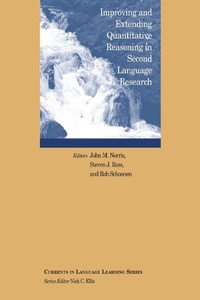
Improving and extending quantitative reasoning in second language research
1st Edition
Will be published approx. on 8. June 2015
Book
Paperback/Softback
272 pages
978-1-119-14820-3 (ISBN)
Description
Currents in Language Learning is a biennial book series published by Wiley and the Language Learning Research Club at the University of Michigan. It provides programmatic state-of-the-art overviews of current issues in the language sciences and their applications in first, second, and bi/multilingual language acquisition in naturalistic and tutored contexts. It brings together disciplinary perspectives from linguistics, psychology, education, anthropology, sociology, cognitive science, and neuroscience.
More details
Series
Language
English
Place of publication
Hoboken
United Kingdom
Publishing group
John Wiley and Sons Ltd
Target group
Primary & secondary/elementary & high school
Product notice
Paperback (trade)
Unsewn / adhesive bound
Dimensions
Height: 229 mm
Width: 152 mm
Thickness: 15 mm
Weight
402 gr
ISBN-13
978-1-119-14820-3 (9781119148203)
Copyright in bibliographic data and cover images is held by Nielsen Book Services Limited or by the publishers or by their respective licensors: all rights reserved.
Schweitzer Classification
Persons
John M. Norris and Steven J. Ross are the authors of Improving and extending quantitative reasoning in second language research, published by Wiley.
Content
Table of Contents
Foreword
Introduction
Chapter 1: Improving second language quantitative research (John M. Norris, Steven J. Ross, Rob Schoonen)
Section I: Current challenges in measurement, design, and analysis for L2 quantitative research
Chapter 2: Methodological synthesis in L2 quantitative research: A review of reviews and a case study of exploratory factor analysis (Luke Plonsky & Talip Gonulal)
Chapter 3: Improving the validity of quantitative measures in second language research (James Purpura, James Dean Brown, Rob Schoonen)
Chapter 4: Design issues and inference in L2 experimental research (Thom Hudson & Lorena Llosa)
Chapter 5: Statistical significance testing in second language research: Basic problems and suggestions for reform (John Norris)
Chapter 6: Reporting and interpreting quantitative research findings: What gets reported and recommendations for the field (Jenifer Larson-Hall & Luke Plonsky)
Section II: Alternatives, advances, and the future of L2 quantitative research
Chapter 7: Structural equation modeling: Possibilities for language learning researchers (Gregory R. Hancock & Rob Schoonen)
Chapter 8: The utility and application of mixed effects models in second language research (Jared A. Linck & Ian Cunnings)
Chapter 9: Bayesian approaches to imputation, hypothesis testing, and parameter estimation (Steven J. Ross & Beth Mackey)
Chapter 10: Statistical measures for usage-based linguistics (Stefan Gries & Nick Ellis)
Foreword
Introduction
Chapter 1: Improving second language quantitative research (John M. Norris, Steven J. Ross, Rob Schoonen)
Section I: Current challenges in measurement, design, and analysis for L2 quantitative research
Chapter 2: Methodological synthesis in L2 quantitative research: A review of reviews and a case study of exploratory factor analysis (Luke Plonsky & Talip Gonulal)
Chapter 3: Improving the validity of quantitative measures in second language research (James Purpura, James Dean Brown, Rob Schoonen)
Chapter 4: Design issues and inference in L2 experimental research (Thom Hudson & Lorena Llosa)
Chapter 5: Statistical significance testing in second language research: Basic problems and suggestions for reform (John Norris)
Chapter 6: Reporting and interpreting quantitative research findings: What gets reported and recommendations for the field (Jenifer Larson-Hall & Luke Plonsky)
Section II: Alternatives, advances, and the future of L2 quantitative research
Chapter 7: Structural equation modeling: Possibilities for language learning researchers (Gregory R. Hancock & Rob Schoonen)
Chapter 8: The utility and application of mixed effects models in second language research (Jared A. Linck & Ian Cunnings)
Chapter 9: Bayesian approaches to imputation, hypothesis testing, and parameter estimation (Steven J. Ross & Beth Mackey)
Chapter 10: Statistical measures for usage-based linguistics (Stefan Gries & Nick Ellis)