

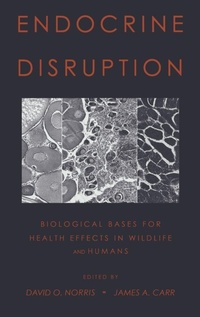
Endocrine Disruption
Biological bases for health effects in wildlife and humans
Published on 20. October 2005
Book
Hardback
496 pages
978-0-19-513749-1 (ISBN)
Description
This book addresses the biological effects of the large number of compounds that have been recognised as endocrine disrupters. These compounds have been found to persist as pollutants in the environment, and have been blamed for causing developmental disorders and/or fertility problems in fish, amphibians, reptiles, birds, and humans. The book presents the relevant fundamentals of the endocrine systems of animals and humans, the toxicology, developmental toxicology, ecology, and risk assessment methods, and lays out the current state of understanding for the whole field, organized by the classes of compounds that have been identified as endocrine disrupters.
More details
Language
English
Place of publication
New York
United States
Target group
Professional and scholarly
Illustrations
48 tables, 91 line illus.
Dimensions
Height: 240 mm
Width: 161 mm
Thickness: 31 mm
Weight
898 gr
ISBN-13
978-0-19-513749-1 (9780195137491)
Copyright in bibliographic data and cover images is held by Nielsen Book Services Limited or by the publishers or by their respective licensors: all rights reserved.
Schweitzer Classification
Other editions
Additional editions
David O. Norris | James A. Carr
Endocrine Disruption
Biological Bases for Health Effects in Wildlife and Humans
E-Book
09/2005
1st Edition
OUP eBook
€77.99
Available for download
David O. Norris | James A. Carr
Endocrine Disruption
Biological Bases for Health Effects in Wildlife and Humans
E-Book
09/2005
1st Edition
OUP eBook
€77.99
Available for download
Persons
Content
Part I. Vertebrate Chemical Regulation
1.: David O. Norris and James A. Carr: Introduction to Endocrinology
2.: Miles Orchinik and Catherine Propper: Hormone Action on Receptors
3.: James A. Carr and David O. Norris: The Hypothalamus-Pituitary Axis
4.: James A. Carr and David O. Norris: The Thyroid Gland
5.: James A. Carr and David O. Norris: The Adrenal Glands
6.: James A. Carr and David O. Norris: The Gonads
Part II. Toxicology and Risk Assessment
7.: Richard L. Dickerson and Ernest E. Smith: Introduction to the Science of Toxicology
8.: Kenneth R. Dixon and Clyde F. Martin: Probablistic Risk Assessment
9.: Lynn Frame and Richard L. Dickerson: Fish and Wildlife as Sentinels of Environmental Contamination
Part III. Representative EDCs in Animals
10.: Mary K. Walker: Polychlorinated Dibenzo-p-Dioxins: Potential Mechanisms and Risk as Endocrine Disruptors
11.: John P. Giesy, K. Kannan, Alan L. Blankenship, Paul D. Jones, and J.L. Newsted: Toxicology of PDBs and Related Compounds
12.: Louis J. Guillette, Jr., Stefan A.E. Kools, Mark P. Gunderson, and Dieldrich S. Bermudez: DDT and Its Analogues: New Insights into Their Endocrine-Disrupting Effects on Wildlife
13.: Alice Hontela and Alexandra Lacroix: Heavy Metals
14.: Werner Kloas: Effects of Alkyphenolic Compounds on Wildlife
15.: Alan M. Vajda and David O. Norris: Endocrine-Active Phytochemicals: Environmental Signaling Context and Mechanisms
16.: Timothy S. Gross and R. Heath Rauschenberger: Triazines
Appendices
1.: David O. Norris and James A. Carr: Introduction to Endocrinology
2.: Miles Orchinik and Catherine Propper: Hormone Action on Receptors
3.: James A. Carr and David O. Norris: The Hypothalamus-Pituitary Axis
4.: James A. Carr and David O. Norris: The Thyroid Gland
5.: James A. Carr and David O. Norris: The Adrenal Glands
6.: James A. Carr and David O. Norris: The Gonads
Part II. Toxicology and Risk Assessment
7.: Richard L. Dickerson and Ernest E. Smith: Introduction to the Science of Toxicology
8.: Kenneth R. Dixon and Clyde F. Martin: Probablistic Risk Assessment
9.: Lynn Frame and Richard L. Dickerson: Fish and Wildlife as Sentinels of Environmental Contamination
Part III. Representative EDCs in Animals
10.: Mary K. Walker: Polychlorinated Dibenzo-p-Dioxins: Potential Mechanisms and Risk as Endocrine Disruptors
11.: John P. Giesy, K. Kannan, Alan L. Blankenship, Paul D. Jones, and J.L. Newsted: Toxicology of PDBs and Related Compounds
12.: Louis J. Guillette, Jr., Stefan A.E. Kools, Mark P. Gunderson, and Dieldrich S. Bermudez: DDT and Its Analogues: New Insights into Their Endocrine-Disrupting Effects on Wildlife
13.: Alice Hontela and Alexandra Lacroix: Heavy Metals
14.: Werner Kloas: Effects of Alkyphenolic Compounds on Wildlife
15.: Alan M. Vajda and David O. Norris: Endocrine-Active Phytochemicals: Environmental Signaling Context and Mechanisms
16.: Timothy S. Gross and R. Heath Rauschenberger: Triazines
Appendices