

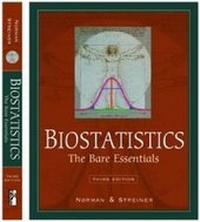
Biostatistics: The Bare Essentials, 3e with SPSS
3rd Edition
Published on 16. March 2012
Book
Paperback/Softback
393 pages
978-1-60795-163-6 (ISBN)
Description
Author Biography
Geoffrey Norman PhD Professor, Department of Clinical Epidemiology and Biostatics McMaster University Hamilton, Ontario
David Streiner PhD Assistant Vice President, Research Director Kunin-Lunenfeld Applied Research Unit Baycreat Centre of Geriatric Care Professor, Department of Psychiatry University of Toronto Toronto, Ontario
Analysis of Longitudinal Data: Hierarchical Linear ModelsEquivalence and Non-Inferiority TestingGetting Started with SPSSSurvival Analysis C.R.A.P Detectors for each section Students and Practitioners in the Health Profession.
This new edition of the book will be produced in two versions. The textbook will include a CD-Rom with two videotaped lectures by the authors.
This book translates biostatistics in the health sciences literature with clarity and irreverence. Students and practitioners alike, applaud Biostatistics as the practical guide that exposes them to every statistical test they may encounter, with careful conceptual explanations and a minimum of algebra.
What's New?
The new Bare Essentials reflects recent advances in statistics, as well as time-honored methods. For example, "hierarchical linear modeling" which first appeared in psychology journals and only now is described in medical literature. Also new, is a chapter on testing for equivalence and non-inferiority. As well as a chapter with information to get started with the computer statistics program, SPSS.
Free of calculations and jargon, Bare Essentials speaks so plainly that you won't need a technical dictionary. No math, all concepts. The objective is to enable you to determine if the research results are applicable to your own patients.
Throughout the guide, you'll find highlights of areas in which researchers misuse or misinterpret statistical tests. We have labeled these "C.R.A.P. Detectors" (Convoluted Reasoning and Anti-intellectual Pomposity), which help you to identify faulty methodology and misuse of statistics.
Geoffrey Norman PhD Professor, Department of Clinical Epidemiology and Biostatics McMaster University Hamilton, Ontario
David Streiner PhD Assistant Vice President, Research Director Kunin-Lunenfeld Applied Research Unit Baycreat Centre of Geriatric Care Professor, Department of Psychiatry University of Toronto Toronto, Ontario
Analysis of Longitudinal Data: Hierarchical Linear ModelsEquivalence and Non-Inferiority TestingGetting Started with SPSSSurvival Analysis C.R.A.P Detectors for each section Students and Practitioners in the Health Profession.
This new edition of the book will be produced in two versions. The textbook will include a CD-Rom with two videotaped lectures by the authors.
This book translates biostatistics in the health sciences literature with clarity and irreverence. Students and practitioners alike, applaud Biostatistics as the practical guide that exposes them to every statistical test they may encounter, with careful conceptual explanations and a minimum of algebra.
What's New?
The new Bare Essentials reflects recent advances in statistics, as well as time-honored methods. For example, "hierarchical linear modeling" which first appeared in psychology journals and only now is described in medical literature. Also new, is a chapter on testing for equivalence and non-inferiority. As well as a chapter with information to get started with the computer statistics program, SPSS.
Free of calculations and jargon, Bare Essentials speaks so plainly that you won't need a technical dictionary. No math, all concepts. The objective is to enable you to determine if the research results are applicable to your own patients.
Throughout the guide, you'll find highlights of areas in which researchers misuse or misinterpret statistical tests. We have labeled these "C.R.A.P. Detectors" (Convoluted Reasoning and Anti-intellectual Pomposity), which help you to identify faulty methodology and misuse of statistics.
More details
Edition
3rd edition
Language
English
Place of publication
Shelton
United States
Target group
College/higher education
Professional and scholarly
Dimensions
Height: 279 mm
Width: 213 mm
Thickness: 15 mm
Weight
1043 gr
ISBN-13
978-1-60795-163-6 (9781607951636)
Copyright in bibliographic data and cover images is held by Nielsen Book Services Limited or by the publishers or by their respective licensors: all rights reserved.
Schweitzer Classification
Other editions
Additional editions
E-Book
06/2014
4th Edition
Pmph-USA, Ltd.
€78.99
Available for download
Content
Tables of Contents
SECTION THE FIRST: THE NATURE OF DATA AND STATISTICS
1. The Basics
2. Looking at the Data: A First look at Graphing Data
3. Describing the Data with Numbers: Measures of Central Tendency and Dispersion
4. The Normal Distribution
5. Probability
6. Elements of Statistical Inference
C.R.A.P. DETECTORS SECTION THE SECOND: ANALYSIS OF VARIANCE
7. Comparing Two Groups: The t-Test
8. More than Two Groups: One-Way ANOVA
9. Factorial ANOVA
10. Two Repeated Observations: he Paired t-Test and Alternatives
11. Repeated-Measures ANOVA
12. Multivariate ANOVA (MANOVA)
C.R.A.P. DETECTORS SECTION THE THIRD: REGRESSION AND CORRELATION
13. Simple Regression and Correlation
14. Multiple Regression
15. Logistic Regression
16. Advanced Topics in Regression and ANOVA
17. Measuring Change
18. Analysis of Longitudinal Data: Hierarchical Linear Models
19. Principal Components and Factor Analysis: Fooling Around with Factors
20. Path Analysis and Structural Equation Modeling
C.R.A.P. DETECTORS SECTION THE FOURTH: NONPARAMETRIC STATISTICS
21. Tests of Significance for Categorical Frequency Data
22. Measures of Association for Categorical Data
23. Tests of Significance for Ranked Data
24. Measures of Association for Ranked Data
25. Survival Analysis
C.R.A.P. DETECTORS SECTION THE FIFTH: REPRISE
26. Equivalence and Non-Inferiority Testing
27. Screwups, Oddballs, and other Vagaries of Science Locating Outliers, Handling Missing Data, and Transformations
28. Putting it All Together
29. Getting Started with SPSS
Test Yourself (Being a Compendium of Questions and Answers)
Answers to Chapter Exercises
References and Further Reading
Unabashed Glossary
Appendices
Index
SECTION THE FIRST: THE NATURE OF DATA AND STATISTICS
1. The Basics
2. Looking at the Data: A First look at Graphing Data
3. Describing the Data with Numbers: Measures of Central Tendency and Dispersion
4. The Normal Distribution
5. Probability
6. Elements of Statistical Inference
C.R.A.P. DETECTORS SECTION THE SECOND: ANALYSIS OF VARIANCE
7. Comparing Two Groups: The t-Test
8. More than Two Groups: One-Way ANOVA
9. Factorial ANOVA
10. Two Repeated Observations: he Paired t-Test and Alternatives
11. Repeated-Measures ANOVA
12. Multivariate ANOVA (MANOVA)
C.R.A.P. DETECTORS SECTION THE THIRD: REGRESSION AND CORRELATION
13. Simple Regression and Correlation
14. Multiple Regression
15. Logistic Regression
16. Advanced Topics in Regression and ANOVA
17. Measuring Change
18. Analysis of Longitudinal Data: Hierarchical Linear Models
19. Principal Components and Factor Analysis: Fooling Around with Factors
20. Path Analysis and Structural Equation Modeling
C.R.A.P. DETECTORS SECTION THE FOURTH: NONPARAMETRIC STATISTICS
21. Tests of Significance for Categorical Frequency Data
22. Measures of Association for Categorical Data
23. Tests of Significance for Ranked Data
24. Measures of Association for Ranked Data
25. Survival Analysis
C.R.A.P. DETECTORS SECTION THE FIFTH: REPRISE
26. Equivalence and Non-Inferiority Testing
27. Screwups, Oddballs, and other Vagaries of Science Locating Outliers, Handling Missing Data, and Transformations
28. Putting it All Together
29. Getting Started with SPSS
Test Yourself (Being a Compendium of Questions and Answers)
Answers to Chapter Exercises
References and Further Reading
Unabashed Glossary
Appendices
Index