

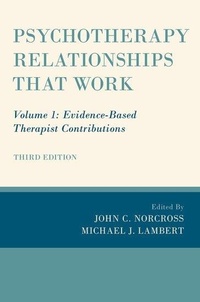
Psychotherapy Relationships that Work
Volume 1: Evidence-Based Therapist Contributions
3rd Edition
Published on 1. August 2019
Book
Hardback
688 pages
978-0-19-084395-3 (ISBN)
Description
First published in 2002, the landmark Psychotherapy Relationships That Work broke new ground by focusing renewed and corrective attention on the substantial research behind the crucial (but often overlooked) client-therapist relationship. This highly cited, widely adopted classic is now presented in two volumes: Evidence-based Therapist Contributions, edited by John C. Norcross and Michael J. Lambert; and Evidence-based Therapist Responsiveness, edited by John C. Norcross and Bruce E. Wampold.
Each chapter in the two volumes features a specific therapist behavior that improves treatment outcome, or a transdiagnostic patient characteristic by which clinicians can effectively tailor psychotherapy. In addition to updates to existing chapters, the third edition features new chapters on the real relationship, emotional expression, immediacy, therapist self-disclosure, promoting treatment credibility, and adapting therapy to the patient's gender identity and sexual orientation.
All chapters provide original meta-analyses, clinical examples, landmark studies, diversity considerations, training implications, and most importantly, research-infused therapeutic practices by distinguished contributors. Featuring expanded coverage and an enhanced practice focus, the third edition of the seminal Psychotherapy Relationships That Work offers a compelling synthesis of the best available research, clinical expertise, and patient characteristics in the tradition of evidence-based practice. Like the original, this new edition is "A veritable gold mine of research related to relationships, a volume that should be an invaluable reference for every student and practitioner of psychotherapy" (Psychotherapy).
Each chapter in the two volumes features a specific therapist behavior that improves treatment outcome, or a transdiagnostic patient characteristic by which clinicians can effectively tailor psychotherapy. In addition to updates to existing chapters, the third edition features new chapters on the real relationship, emotional expression, immediacy, therapist self-disclosure, promoting treatment credibility, and adapting therapy to the patient's gender identity and sexual orientation.
All chapters provide original meta-analyses, clinical examples, landmark studies, diversity considerations, training implications, and most importantly, research-infused therapeutic practices by distinguished contributors. Featuring expanded coverage and an enhanced practice focus, the third edition of the seminal Psychotherapy Relationships That Work offers a compelling synthesis of the best available research, clinical expertise, and patient characteristics in the tradition of evidence-based practice. Like the original, this new edition is "A veritable gold mine of research related to relationships, a volume that should be an invaluable reference for every student and practitioner of psychotherapy" (Psychotherapy).
Reviews / Votes
This is a timely and truly outstanding book which all concerned with quality health care should carefully review. The key to successful therapy IS, and has always been, the establishment of a genuine therapeutic relationship, not the blind application of cookbook techniques. Backed up by rigorous scientific studies, the authors cogently explore various elements of therapy in depth, while providing understandable examples. An extraordinarily timely text. * Patrick DeLeon, PhD, JD, Past-President, American Psychological Association * A veritable gold mine of research related to relationships, this is a volume that should be an invaluable reference for every student and practitioner of psychotherapy. * Psychotherapy * This excellent resource is a treasure! Psychotherapy Relationships That Work is the gold standard in providing current evidence on how the psychotherapist client/patient relationship promotes change. Educators, researchers and practitioners will be informed, inspired and moved by an immersion into the evidence-based understanding of the change process. * Melba Vasquez, PhD, ABPP, Independent Practice and former APA President * This edition of Psychotherapy Relationships That Work will have significant impact for several years. Training programs will find it an excellent tool to illuminate the link between science and practice, to say nothing of the superb guidelines for implementing relationship-focused strategies. Practitioners will also benefit from reviewing these processes and may come to a deeper understanding of their own work. This collection of research is an important step in the development of a much needed, richer synthesis. * PsycCritiques * Well written, well-explained, and a good blend of application make the book an essential addition for the practitioners, teachers, and therapy researchers. * The Family Psychologist *More details
Edition
3rd Revised edition
Language
English
Place of publication
New York
United States
Target group
College/higher education
Professional and scholarly
Edition type
Revised edition
Product notice
sewn/stitched
Cloth over boards
Dimensions
Height: 244 mm
Width: 159 mm
Thickness: 50 mm
Weight
1145 gr
ISBN-13
978-0-19-084395-3 (9780190843953)
Copyright in bibliographic data and cover images is held by Nielsen Book Services Limited or by the publishers or by their respective licensors: all rights reserved.
Schweitzer Classification
Other editions
Additional editions
John C. Norcross | Michael J. Lambert
Psychotherapy Relationships that Work
Volume 1: Evidence-Based Therapist Contributions
E-Book
06/2019
3rd Edition
OUP eBook
€57.99
Available for download
John C. Norcross | Michael J. Lambert
Psychotherapy Relationships that Work
Volume 1: Evidence-Based Therapist Contributions
E-Book
06/2019
3rd Edition
OUP eBook
€57.99
Available for download
Persons
John C. Norcross, PhD, ABPP, is Distinguished Professor of Psychology at the University of Scranton, Adjunct Professor of Psychiatry at SUNY Upstate Medical University, and a clinical psychologist in part-time practice. He is past-president of the APA Society of Clinical Psychology, the APA Division of Psychotherapy, and the Society for the Exploration of Psychotherapy Integration. Among his 25 coauthored books are the Handbook of Psychotherapy Integration, Clinician's Guide to Evidence-Based Practice in Behavioral Health, Insider's Guide to Graduate Programs in Psychology, Psychologists' Desk Reference, and Systems of Psychotherapy: A Transtheoretical Analysis, now in its 9th edition.
Michael J. Lambert, PhD, was Susa Young Gates University Professor and Professor of Psychology at Brigham Young University. He is currently retired from his academic position and is a part-time clinician in private practice. He authored Prevention of Treatment Failure and edited the fifth and sixth editions of Bergin and Garfield's Handbook of Psychotherapy and Behavior Change. He is past President of the Society for Psychotherapy Research.
Michael J. Lambert, PhD, was Susa Young Gates University Professor and Professor of Psychology at Brigham Young University. He is currently retired from his academic position and is a part-time clinician in private practice. He authored Prevention of Treatment Failure and edited the fifth and sixth editions of Bergin and Garfield's Handbook of Psychotherapy and Behavior Change. He is past President of the Society for Psychotherapy Research.
Content
Preface
Contents
Contributors
Editors 1. Evidence-Based Psychotherapy Relationships: The Third Task Force John C. Norcross & Michael J. Lambert 2. Alliance in Adult Psychotherapy Christoph Flueckiger, A. C. Del Re, Bruce E. Wampold, & Adam O. Horvath 3. Alliance in Child and Adolescent Psychotherapy
Marc S. Karver, Alessandro S. De Nadai, Maureen Monahan, & Stephen R. Shirk 4. Alliances in Couple and Family Therapy Myrna L. Friedlander, Valentin Escudero, Marianne J. Welmers-van de Poll, & Laurie Heatherington 5. Goal Consensus and Collaboration
Georgiana Shick Tryon, Sarah E. Birch, & Jay Verkuilen 6. Cohesion in Group Therapy
Gary M. Burlingame, Debra Theobald McClendon, & Chongming Yang 7. Empathy Robert Elliott, Arthur C. Bohart, Jeanne C. Watson, & David Murphy 8. Positive Regard and Affirmation
Barry A. Farber, Jessica Y. Suzuki, & David A. Lynch 9. Congruence/Genuineness Gregory G. Kolden, Chia-Chiang Wang, Sara B. Austin, Yunling Chang, & Marjorie H. Klein 10. The Real Relationship
Charles J. Gelso, Dennis M. Kivlighan, Jr., & Rayna D. Markin 11. Self-Disclosure and Immediacy
Clara E. Hill, Sarah Knox, & Kristen G. Pinto-Coelho 12. Emotional Expression Paul R. Peluso & Robert R. Freund 13. Cultivating Positive Outcome Expectation Michael J. Constantino, Andreea Visla, Alice E. Coyne, & James F. Boswell 14. Promoting Treatment Credibility
Michael J. Constantino, Alice E. Coyne, James F. Boswell, Brittany R. Iles, & Andreea Visla 15. Managing Countertransference Jeffrey A. Hayes, Charles J. Gelso, D. Martin Kivlighan, & Simon B. Goldberg 16. Repairing Alliance Ruptures Catherine F. Eubanks, J. Christopher Muran, & Jeremy D. Safran 17. Collecting and Delivering Client Feedback Michael J. Lambert, Jason L. Whipple, & Maria Kleinstaeuber 18. What Works in the Psychotherapy Relationship: Results, Conclusions, and Practices
John C. Norcross & Michael J. Lambert
Contents
Contributors
Editors 1. Evidence-Based Psychotherapy Relationships: The Third Task Force John C. Norcross & Michael J. Lambert 2. Alliance in Adult Psychotherapy Christoph Flueckiger, A. C. Del Re, Bruce E. Wampold, & Adam O. Horvath 3. Alliance in Child and Adolescent Psychotherapy
Marc S. Karver, Alessandro S. De Nadai, Maureen Monahan, & Stephen R. Shirk 4. Alliances in Couple and Family Therapy Myrna L. Friedlander, Valentin Escudero, Marianne J. Welmers-van de Poll, & Laurie Heatherington 5. Goal Consensus and Collaboration
Georgiana Shick Tryon, Sarah E. Birch, & Jay Verkuilen 6. Cohesion in Group Therapy
Gary M. Burlingame, Debra Theobald McClendon, & Chongming Yang 7. Empathy Robert Elliott, Arthur C. Bohart, Jeanne C. Watson, & David Murphy 8. Positive Regard and Affirmation
Barry A. Farber, Jessica Y. Suzuki, & David A. Lynch 9. Congruence/Genuineness Gregory G. Kolden, Chia-Chiang Wang, Sara B. Austin, Yunling Chang, & Marjorie H. Klein 10. The Real Relationship
Charles J. Gelso, Dennis M. Kivlighan, Jr., & Rayna D. Markin 11. Self-Disclosure and Immediacy
Clara E. Hill, Sarah Knox, & Kristen G. Pinto-Coelho 12. Emotional Expression Paul R. Peluso & Robert R. Freund 13. Cultivating Positive Outcome Expectation Michael J. Constantino, Andreea Visla, Alice E. Coyne, & James F. Boswell 14. Promoting Treatment Credibility
Michael J. Constantino, Alice E. Coyne, James F. Boswell, Brittany R. Iles, & Andreea Visla 15. Managing Countertransference Jeffrey A. Hayes, Charles J. Gelso, D. Martin Kivlighan, & Simon B. Goldberg 16. Repairing Alliance Ruptures Catherine F. Eubanks, J. Christopher Muran, & Jeremy D. Safran 17. Collecting and Delivering Client Feedback Michael J. Lambert, Jason L. Whipple, & Maria Kleinstaeuber 18. What Works in the Psychotherapy Relationship: Results, Conclusions, and Practices
John C. Norcross & Michael J. Lambert