

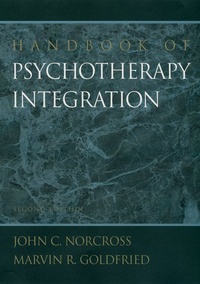
Handbook of Psychotherapy Integration
2nd Edition
Published on 10. March 2005
Book
Hardback
548 pages
978-0-19-516579-1 (ISBN)
Description
In the 13 years since the publication of the first edition of this book, there has been a growth in psychotherapy integration. The original classic was the first compilation of the early integrative approaches and was hailed by one reviewer as "the bible of the integration movement." In the interim, psychotherapy integration has grown into a mature, empirically supported, and international movement. This second edition provides a state-of-the-art, comprehensive
description of psychotherapy and its clinical practices by leading proponents.
In addition to updates of all of the chapters, the new edition features: eight new chapters covering topics such as cognitive-analytic therapy, integrative psychotherapy with culturally diverse clients, cognitive-behavioural analysis system, and blending spirituality with psychotherapy; an entirely new section with two chapters on assimilative integration; updated reviews of the empirical research on integrative and eclectic treatments; chapter guidelines that facilitate comparative analyses
and ensure comprehensiveness; and a summary outline to help readers compare the integrative approaches.
Blending the best of clinical expertise, empirical research, and theoretical pluralism, the revision of this book will prove invaluable to practitioners, researchers, and students alike.
description of psychotherapy and its clinical practices by leading proponents.
In addition to updates of all of the chapters, the new edition features: eight new chapters covering topics such as cognitive-analytic therapy, integrative psychotherapy with culturally diverse clients, cognitive-behavioural analysis system, and blending spirituality with psychotherapy; an entirely new section with two chapters on assimilative integration; updated reviews of the empirical research on integrative and eclectic treatments; chapter guidelines that facilitate comparative analyses
and ensure comprehensiveness; and a summary outline to help readers compare the integrative approaches.
Blending the best of clinical expertise, empirical research, and theoretical pluralism, the revision of this book will prove invaluable to practitioners, researchers, and students alike.
More details
Series
Edition
2nd Revised edition
Language
English
Place of publication
New York
United States
Target group
Professional and scholarly
Psychotherapists and psychotherapists-in-training of all theoretical orientations and professional disciplines, the first edition has been used in many courses and seminars on psychotherapy integration, typically, graduate-level courses/seminars in psychology, social work, counselling, and psychiatry
Edition type
Revised edition
Dimensions
Height: 260 mm
Width: 186 mm
Thickness: 42 mm
Weight
1286 gr
ISBN-13
978-0-19-516579-1 (9780195165791)
Copyright in bibliographic data and cover images is held by Nielsen Book Services Limited or by the publishers or by their respective licensors: all rights reserved.
Schweitzer Classification
Other editions
Additional editions
John C. Norcross | Marvin R. Goldfried
Handbook of Psychotherapy Integration
E-Book
02/2005
2nd Edition
OUP eBook
€78.99
Available for download
Previous edition
John C. Norcross | Marvin R. Goldfried
Handbook of Psychotherapy Integration
Book
12/2003
Oxford University Press Inc
€142.50
Shipment within 15-20 days
Persons
John C. Norcross is Professor of Psychology at the University in Scranton, PA. Marvin R. Goldfried is Professor of Psychology and Psychiatry at State University of New York at Stony Brook.
Content
PART 1: CONCEPTUAL AND HISTORICAL PERSPECTIVES; PART 2: INTEGRATIVE PSYCHOTHERAPY MODELS; A: COMMON FACTORS; B: TECHNICAL ECLECTICISM; C: THEORETICAL INTEGRATION; D: ASSIMILATIVE INTEGRATION; PART 3: INTEGRATIVE PSYCHOTHERAPISTS FOR SPECIFIC DISORDERS AND POPULATIONS; PART 4: INTEGRATIVE TREATMENT MODALITIES; PART 5: TRAINING RESEARCH AND FUTURE DIRECTIONS