

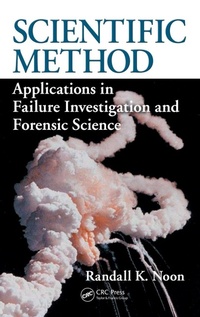
Scientific Method
Applications in Failure Investigation and Forensic Science
1st Edition
Published on 27. April 2009
Book
Hardback
214 pages
978-1-4200-9280-6 (ISBN)
Description
Most failure or accident investigations begin at the end of the story: after the explosion, after the fire has been extinguished, or after the collapse. In many instances, information about the last event and the starting event is known reasonably well. Information about what occurred between these endpoints, however, is often unclear, confusing, and perhaps contradictory. Scientific Method: Applications in Failure Investigation and Forensic Science explains how scientific investigative methods can best be used to determine why and how a particular event occurred.
While employing examples from forensic engineering, the book uses principles and ideas applicable to most of the forensic sciences. The author examines the role of the failure investigator, describes the fundamental method for investigation, discusses the optimal way to organize evidence, and explores the four most common reasons why some investigations fail. The book provides three case studies that exemplify proper report writing, contains a special chapter profiling a criminal case by noted forensic specialist Jon J. Nordby, and offers a reading list of resources for further study.
Concise and illustrative, this volume demonstrates how the scientific method can be applied to failure investigation in ways that avoid flawed reasoning while delivering convincing reconstruction scenarios. Investigators can pinpoint where things went wrong, providing valuable information that can prevent another catastrophe.
While employing examples from forensic engineering, the book uses principles and ideas applicable to most of the forensic sciences. The author examines the role of the failure investigator, describes the fundamental method for investigation, discusses the optimal way to organize evidence, and explores the four most common reasons why some investigations fail. The book provides three case studies that exemplify proper report writing, contains a special chapter profiling a criminal case by noted forensic specialist Jon J. Nordby, and offers a reading list of resources for further study.
Concise and illustrative, this volume demonstrates how the scientific method can be applied to failure investigation in ways that avoid flawed reasoning while delivering convincing reconstruction scenarios. Investigators can pinpoint where things went wrong, providing valuable information that can prevent another catastrophe.
Reviews / Votes
The well-organized text and excellent cause-and-effect tables and graphics make the subject matter very palatable while delivering a virtual investigation blueprint. If you are remotely interested in why something fails and how to prevent a recurrence, this book is not only a great read, but an absolute must for your personal maintenance Body of Knowledge!- Ken Bannister, writing in Maintenance TechnologyAt the end of the day a forensic reconstruction is only as reliable as the science applied
to the data, which in turn is only as reliable as the data collected, documented, and preserved. This book goes a long way in preparing or reminding a person of their obligations as a forensic investigator in order to distinguish what is reliable science and what is prejudice, chance, or just a good guess.
-Dalton Brown, writing in MVC Forensics The well-organized text and excellent cause-and-effect tables and graphics make the subject matter very palatable while delivering a virtual investigation blueprint. If you are remotely interested in why something fails and how to prevent a recurrence, this book is not only a great read, but an absolute must for your personal maintenance Body of Knowledge!- Ken Bannister, writing in Maintenance Technology
At the end of the day a forensic reconstruction is only as reliable as the science applied
to the data, which in turn is only as reliable as the data collected, documented, and preserved. This book goes a long way in preparing or reminding a person of their obligations as a forensic investigator in order to distinguish what is reliable science and what is prejudice, chance, or just a good guess.
-Dalton Brown, writing in MVC Forensics
More details
Series
Language
English
Place of publication
Bosa Roca
United States
Publishing group
Taylor & Francis Inc
Target group
Professional and scholarly
Academic and Professional Practice & Development
Product notice
Paper over boards
Illustrations
47 s/w Abbildungen, 6 s/w Tabellen
6 Tables, black and white; 47 Illustrations, black and white
Dimensions
Height: 240 mm
Width: 161 mm
Thickness: 16 mm
Weight
490 gr
ISBN-13
978-1-4200-9280-6 (9781420092806)
Copyright in bibliographic data and cover images is held by Nielsen Book Services Limited or by the publishers or by their respective licensors: all rights reserved.
Schweitzer Classification
Other editions
Additional editions
E-Book
04/2009
1st Edition
CRC Press
€205.99
Available for download
E-Book
04/2009
1st Edition
CRC Press
€205.99
Available for download
Person
Randall K. Noon owns a consulting firm in Hiawatha, Kansas.
Content
Introduction.The Fundamental Method. More about the Fundamental Method. Organizing Evidence. Four Common Reasons Why Some Investigations Fail. Report Writing: Three Case Studies. Misplaced Method in the Science of Murder. Reading List. Index.
.
.