

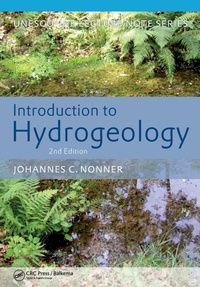
Introduction to Hydrogeology, Second Edition
Unesco-IHE Delft Lecture Note Series
2nd Edition
Published on 18. November 2009
Book
Paperback/Softback
264 pages
978-0-415-87555-4 (ISBN)
Description
Providing an introduction to the crucially important topic of groundwater, this text covers all major fields of hydrogeology and includes outlines of the occurrence of groundwater in various rock types, the movement and storage of groundwater, the formulation of groundwater balances, the development of groundwater chemistry, as well as the practical application of hydrogeology for groundwater development. Following a unique systems approach to describe and connect its various elements, the text also explores a large selection of examples of groundwater cases from various parts of the world. In addition, theoretical sections and examples are illustrated with a number of drawings, photos and computer printouts. Suitable for education in hydrogeology at postgraduate and graduate level, the text is also a useful reference tool for professionals and decision-makers involved in water or water-related activities. In the revised paperback edition of Introduction to Hydrogeology (February 2006), suggestions of reviewers, students and colleagues have been taken into account. This means that more attention is paid to the processes in the unsaturated zone, especially those relating to groundwater recharge. Also, in the revised edition, the investigation methods are highlighted in the sections where the related theory is dealt with, and they are not presented in the last chapter on groundwater management. Chapter titles are re-named and some definitions are adjusted. The References and Bibliography section is also extended, some figures are improved, and the inevitable 'typing errors' are corrected as well.
(c) 2009, Second edition, with revisions 2012.
(c) 2009, Second edition, with revisions 2012.
More details
Series
Edition
2nd edition
Language
English
Place of publication
London
United Kingdom
Publishing group
Taylor & Francis Ltd
Target group
Professional and scholarly
College/higher education
Product notice
Paperback (UK-B)
Illustrations
40 Farbfotos bzw. farbige Rasterbilder, 60 farbige Zeichnungen
60 Line drawings, color; 40 Halftones, color
Dimensions
Height: 244 mm
Width: 170 mm
Thickness: 14 mm
Weight
465 gr
ISBN-13
978-0-415-87555-4 (9780415875554)
Copyright in bibliographic data and cover images is held by Nielsen Book Services Limited or by the publishers or by their respective licensors: all rights reserved.
Schweitzer Classification
Other editions
New editions
Book
11/2015
3rd Edition
CRC Press
€69.00
Shipment within 10-20 days
Previous edition
Book
01/2002
1st Edition
Swets & Zeitlinger
€62.08
Article exhausted; check for reprint
Person
In his capacity as Associate Professor in Hydrogeology at IHE, Johannes C. Nonner lectures in hydrogeology and groundwater exploration techniques. His special field of research at IHE covers groundwater development and environmental integrity in The Netherlands and other parts of the world, for which he is heavily involved in groundwater flow- and transport modelling. After graduating in hydrogeology at the Free University of Amsterdam in 1972, and before joining IHE in 1989, Johannes C. Nonner was involved in groundwater consultancy and training assignments around the world.
Content
FOREWORD VII
1 INTRODUCTION 1
1.1 General background 1
1.1.1 The scope of the science 1
1.1.2 The application of hydrogeology 2
1.1.3 Historical background of the science 5
1.1.4 History of groundwater use 8
1.2 Hydrological systems 10
1.2.1 Earth and water 10
1.2.2 Water at land surface 15
1.2.3 Surface water systems 21
1.2.4 The unsaturated zone 24
1.2.5 Groundwater systems 29
2 ROCKS AND GROUNDWATER 39
2.1 Basic concepts 39
2.1.1 Physical properties of water and rock 39
2.1.2 Groundwater system terminology 46
2.2 Formation of groundwater systems 52
2.2.1 Groundwater systems in metamorphic and intrusive rock 52
2.2.2 Development of aquifers in volcanic rock 56
2.2.3 Aquifer formation in consolidated sediments 59
2.2.4 Unconsolidated sediments and groundwater systems 66
2.3 Groundwater exploration methods 70
2.3.1 Methods at land surface 70
2.3.2 Subsurface investigation methods 76
3 GROUNDWATER MOVEMENT 79
3.1 Principles of groundwater flow 79
3.1.1 Groundwater flow in unconsolidated rock 79
3.1.2 Groundwater flow in consolidated rock 93
3.2 Flow in groundwater systems 97
3.2.1 Basic concepts 97
3.2.2 Regional groundwater flow 101
3.2.3 Local groundwater flow 122
3.2.4 Pumping test methodology 127
3.3 The flow systems concept 129
3.3.1 Formation of flow systems 129
3.3.2 Flow computations 132
4 WATER BALANCES 135
4.1 Groundwater balance concepts 135
4.1.1 The general idea 135
4.1.2 Practical application of groundwater balances 140
4.2 Groundwater balance estimation methods 142
4.2.1 Basic concepts and recharge 142
4.2.2 Discharge and storage 150
4.2.3 Groundwater balances using flow computations and modelling 153
4.3 Groundwater balances and their environment 155
4.3.1 Groundwater recharge and climate 155
4.3.2 Groundwater balances and geology 160
5 GROUNDWATER CHEMISTRY 169
5.1 Groundwater and chemical processes 169
5.1.1 Chemical properties of water and rock 169
5.1.2 Development of groundwater chemistry 180
5.1.3 Assessment of groundwater chemistry 187
5.2 Groundwater chemistry and rock types 192
5.2.1 Groundwater chemistry in consolidated rocks 192
5.2.2 Groundwater chemistry in unconsolidated rocks 195
6 DEVELOPMENT OF GROUNDWATER 199
6.1 Groundwater management 199
6.1.1 Water management 199
6.1.2 The role of groundwater 202
6.2 Groundwater planning and investigations 204
6.2.1 Water planning 204
6.2.2 Selection of investigation methods 206
6.2.3 Groundwater monitoring 200
6.3 Groundwater resources studies 211
6.3.1 Regional groundwater availability 211
6.3.2 Groundwater demand 220
6.3.3 Local groundwater development 223
EXERCISES 231
SELECTED ANSWERS TO EXERCICES 245
REFERENCES AND BIBLIOGRAPHY 247
REGISTER 255
1 INTRODUCTION 1
1.1 General background 1
1.1.1 The scope of the science 1
1.1.2 The application of hydrogeology 2
1.1.3 Historical background of the science 5
1.1.4 History of groundwater use 8
1.2 Hydrological systems 10
1.2.1 Earth and water 10
1.2.2 Water at land surface 15
1.2.3 Surface water systems 21
1.2.4 The unsaturated zone 24
1.2.5 Groundwater systems 29
2 ROCKS AND GROUNDWATER 39
2.1 Basic concepts 39
2.1.1 Physical properties of water and rock 39
2.1.2 Groundwater system terminology 46
2.2 Formation of groundwater systems 52
2.2.1 Groundwater systems in metamorphic and intrusive rock 52
2.2.2 Development of aquifers in volcanic rock 56
2.2.3 Aquifer formation in consolidated sediments 59
2.2.4 Unconsolidated sediments and groundwater systems 66
2.3 Groundwater exploration methods 70
2.3.1 Methods at land surface 70
2.3.2 Subsurface investigation methods 76
3 GROUNDWATER MOVEMENT 79
3.1 Principles of groundwater flow 79
3.1.1 Groundwater flow in unconsolidated rock 79
3.1.2 Groundwater flow in consolidated rock 93
3.2 Flow in groundwater systems 97
3.2.1 Basic concepts 97
3.2.2 Regional groundwater flow 101
3.2.3 Local groundwater flow 122
3.2.4 Pumping test methodology 127
3.3 The flow systems concept 129
3.3.1 Formation of flow systems 129
3.3.2 Flow computations 132
4 WATER BALANCES 135
4.1 Groundwater balance concepts 135
4.1.1 The general idea 135
4.1.2 Practical application of groundwater balances 140
4.2 Groundwater balance estimation methods 142
4.2.1 Basic concepts and recharge 142
4.2.2 Discharge and storage 150
4.2.3 Groundwater balances using flow computations and modelling 153
4.3 Groundwater balances and their environment 155
4.3.1 Groundwater recharge and climate 155
4.3.2 Groundwater balances and geology 160
5 GROUNDWATER CHEMISTRY 169
5.1 Groundwater and chemical processes 169
5.1.1 Chemical properties of water and rock 169
5.1.2 Development of groundwater chemistry 180
5.1.3 Assessment of groundwater chemistry 187
5.2 Groundwater chemistry and rock types 192
5.2.1 Groundwater chemistry in consolidated rocks 192
5.2.2 Groundwater chemistry in unconsolidated rocks 195
6 DEVELOPMENT OF GROUNDWATER 199
6.1 Groundwater management 199
6.1.1 Water management 199
6.1.2 The role of groundwater 202
6.2 Groundwater planning and investigations 204
6.2.1 Water planning 204
6.2.2 Selection of investigation methods 206
6.2.3 Groundwater monitoring 200
6.3 Groundwater resources studies 211
6.3.1 Regional groundwater availability 211
6.3.2 Groundwater demand 220
6.3.3 Local groundwater development 223
EXERCISES 231
SELECTED ANSWERS TO EXERCICES 245
REFERENCES AND BIBLIOGRAPHY 247
REGISTER 255