

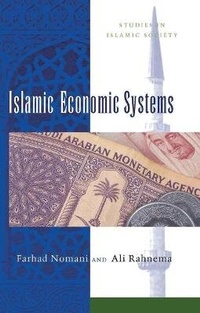
Islamic Economic Systems
Published on 1. September 1992
Book
Hardback
223 pages
978-1-85649-057-3 (ISBN)
Description
This major new study examines the central tenets of Islamic economics, both in theory and in practice. The authors pinpoint the uniqueness of the Islamic approach, both in its conception of the world's resources and in its attitude to human endeavour. Their book illuminates the distinctive nature of an economics which is based neither on meeting the demands of the individual consumer, nor on increasing the level of general welfare, but on maximising the pleasure of God. The different schools of Islamic thought are then compared and their interpretations analysed in terms of their approaches to plan and market, centralisation and decentralisation, property rights, profit and social obligation.
A detailed historical survey follows of the experience of four very different Muslim countries: Libya, Saudi Arabia, Pakistan and Iran. The authors examine how the implementation of Islamic economic solutions has worked out in reality, often in the context of a tense political situation. They look at the practicality of such solutions in the present day, assessing both their economic performance and their success in guiding society towards the Islamic ideal.
The book as a whole allows the reader to grasp the multifarious nature of Islamic thought in economic matters, its contradictory and often contentious character, and the uses to which Islam has been put by governments with clearly diverse aims. Students of economics and of the Middle East will find it a useful guide to the new terms in which an old and fierce debate is being conducted.
A detailed historical survey follows of the experience of four very different Muslim countries: Libya, Saudi Arabia, Pakistan and Iran. The authors examine how the implementation of Islamic economic solutions has worked out in reality, often in the context of a tense political situation. They look at the practicality of such solutions in the present day, assessing both their economic performance and their success in guiding society towards the Islamic ideal.
The book as a whole allows the reader to grasp the multifarious nature of Islamic thought in economic matters, its contradictory and often contentious character, and the uses to which Islam has been put by governments with clearly diverse aims. Students of economics and of the Middle East will find it a useful guide to the new terms in which an old and fierce debate is being conducted.
Reviews / Votes
'Nomani and Rahnema offer a welcome respite from the crude generalizations that too often pass as analysis of Islamic political culture.'Middle East Studies Association Bulletin
More details
Language
English
Place of publication
United Kingdom
Publishing group
Bloomsbury Publishing PLC
Target group
College/higher education
Professional and scholarly
ISBN-13
978-1-85649-057-3 (9781856490573)
Copyright in bibliographic data and cover images is held by Nielsen Book Services Limited or by the publishers or by their respective licensors: all rights reserved.
Schweitzer Classification
Other editions
New editions
Farhad Nomani | Ali Rahnema
Islamic Economic Systems
Book
09/1992
Zed Books Ltd
€63.32
Shipment within 3-4 weeks
Persons
Farhad Nomaniand Ali Rahnemaare are both professors of economics at the American University in Paris. Their previous publications include the widely acclaimed The Secular Miracle: Religion, Politics and Economic Policy in Iran (Zed 1990).
Content
Acknowledgements
Introduction
1. Shari'a: The Legal Foundation of the Islamic Economy
2. The Economic Philosophy of Islam
3. The Islamic Economic System
4. Islamic Micro- and Macroeconomics
5. Islamisation of Pakistan's Economy by the Bureaucracy
6. Islamic Economy According to the Saudi-Wahhabi
7. Islamisation of the Iranian Economy at the Behest of the Clergy
8. The Islamic Socialism of Qadhafi in Libya
Bibliography
Index
Introduction
1. Shari'a: The Legal Foundation of the Islamic Economy
2. The Economic Philosophy of Islam
3. The Islamic Economic System
4. Islamic Micro- and Macroeconomics
5. Islamisation of Pakistan's Economy by the Bureaucracy
6. Islamic Economy According to the Saudi-Wahhabi
7. Islamisation of the Iranian Economy at the Behest of the Clergy
8. The Islamic Socialism of Qadhafi in Libya
Bibliography
Index