

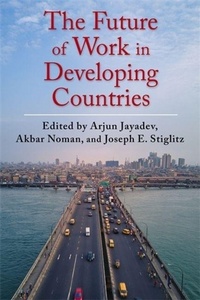
The Future of Work in Developing Countries
Will be published approx. on 3. March 2026
Book
Hardback
480 pages
978-0-231-22033-0 (ISBN)
Description
One of the most pressing issues in development today is the employment challenge in low- and middle-income countries. As more young people enter the labor force-and as structural transformation unfolds amid deindustrialization, technological disruption, and global competition-the question of how to create sufficient decent jobs has become central to the economic future of the Global South. Although this is a shared challenge across developing regions, it is particularly acute in Africa, where rapid demographic change and urbanization are colliding with limited industrial expansion.
Bringing together leading international scholars, The Future of Work in Developing Countries examines the employment problem from multiple perspectives. Early chapters develop conceptual frameworks around corporations and the global hierarchy of production. Subsequent contributions investigate the dynamics of structural transformation, the role of firms in linking production and labor to surplus, and the design of industrial and technology policies. Later chapters turn to detailed case studies-especially from Africa-that illustrate the possibilities and limits of different growth paths, and comparative insights from Asia and Latin America provide further perspective.
By combining rigorous theoretical analysis with grounded empirical research, this book demonstrates that employment creation is not an automatic byproduct of growth but a political and institutional project. It offers fresh insights for scholars of development, political economy, and economic history, as well as for policy makers seeking strategies to promote inclusive transformation in Africa and beyond.
Bringing together leading international scholars, The Future of Work in Developing Countries examines the employment problem from multiple perspectives. Early chapters develop conceptual frameworks around corporations and the global hierarchy of production. Subsequent contributions investigate the dynamics of structural transformation, the role of firms in linking production and labor to surplus, and the design of industrial and technology policies. Later chapters turn to detailed case studies-especially from Africa-that illustrate the possibilities and limits of different growth paths, and comparative insights from Asia and Latin America provide further perspective.
By combining rigorous theoretical analysis with grounded empirical research, this book demonstrates that employment creation is not an automatic byproduct of growth but a political and institutional project. It offers fresh insights for scholars of development, political economy, and economic history, as well as for policy makers seeking strategies to promote inclusive transformation in Africa and beyond.
Reviews / Votes
The Future of Work in Developing Countries examines the unique challenges to economic development and employment growth as they are currently being experienced in many low and middle-income contexts. Through this collection of high-quality empirical studies with detailed analyses, readers can examine these issues through a number of different contexts. -- Michael Rogan, Rhodes University Discussions on the future of work often generate more heat than light, with the interplay of fear-mongering on one side and complacency on the other creating much confusion. This excellent set of studies provides a clear, compelling set of analyses to help us understand what is clearly one of the "wicked problems" of our times, and provides a mapping of possible pathways to solve it. -- Jayati Ghosh, University of Massachusetts AmherstMore details
Series
Language
English
Place of publication
New York
United States
Target group
Professional and scholarly
Product notice
Trade binding
Illustrations
189 b&w figures, 26 tables
Dimensions
Height: 236 mm
Width: 166 mm
Thickness: 35 mm
Weight
868 gr
ISBN-13
978-0-231-22033-0 (9780231220330)
Copyright in bibliographic data and cover images is held by Nielsen Book Services Limited or by the publishers or by their respective licensors: all rights reserved.
Schweitzer Classification
Other editions
Additional editions
Akbar Noman | Joseph E. Stiglitz | Arjun Jayadev
The Future of Work in Developing Countries
E-Book
03/2026
Columbia University Press
€73.49
Available for download
Persons
Arjun Jayadev is professor of economics and director of the Centre for the Study of the Indian Economy at Azim Premji University, Bangalore.
Akbar Noman is senior fellow at the Initiative for Policy Dialogue and adjunct professor at the School of International and Public Affairs at Columbia University.
Joseph E. Stiglitz, a recipient of the Nobel Memorial Prize in Economic Sciences, is University Professor and founding president of the Initiative for Policy Dialogue at Columbia University.
Akbar Noman is senior fellow at the Initiative for Policy Dialogue and adjunct professor at the School of International and Public Affairs at Columbia University.
Joseph E. Stiglitz, a recipient of the Nobel Memorial Prize in Economic Sciences, is University Professor and founding president of the Initiative for Policy Dialogue at Columbia University.
Content
Introduction and Overview of the Book: The Challenges of Employment in the Twenty-First Century, by Arjun Jayadev, Akbar Noman, and Joseph E. Stiglitz
Part I. Developing Economy Labor Markets: Theoretical Perspectives
1. Employer Power and Employment in Developing Countries, by Nancy H. Chau, Ravi Kanbur, and Vidhya Soundararajan
2. Jobless Growth and Structural Transformation: Some Theoretical Considerations and Empirical Evidence from India, by Zico Dasgupta and Amit Basole
Part II. Employment Trends and Patterns Across Countries and Regions
3. The Changing Nature of Work: Improving the Functioning of Labor Markets, by Sidra Rehman and Agustin Velasquez
4. Employment in Argentina: Diagnosis and Proposed Solutions, by Claudio Omar Moroni, Eduardo Alvarez Tunon, Alejandro Raul Ferrari, Diego Schleser, Pablo Arnaldo Topet, and David Trajtemberg
5. Digital Technologies, Global Value Chains, and Skill-Segmentation of the Workforce: Evidence from the Apparel Sector in India and Bangladesh, by Karishma Banga
6.Industrial Development, Sectoral Linkages, and Factor Income: A Multiplier and Clustering Analysis, by Ryosuke Nakata
7. Green and Purple Jobs for Equitable and Sustainable Development, by OEzlem Onaran and Cem Oyvat
Part III. Employment in Africa
8. Demographic Challenges for Global Labor Markets in the Twenty-First Century: Africa in a Changing World, by David Lam and Murray Leibbrandt
9. Structural Change and Employment in Sub-Saharan Africa: An Update of Recent Trends with Multiple-Sector Considerations, by Tetsuya Harada
10. Automation and Deindustrialization in the South African Manufacturing Sector, by Caitlin Allen Whitehead, Haroon Bhorat, Robert Hill, Timothy Koehler, and Francois Steenkamp
11. Minerals, Energy-Intensive Industries, and Development: The Green Transition and Employment in Southern Africa, by Antonio Andreoni and Simon Roberts
About the Contributors
Index
Part I. Developing Economy Labor Markets: Theoretical Perspectives
1. Employer Power and Employment in Developing Countries, by Nancy H. Chau, Ravi Kanbur, and Vidhya Soundararajan
2. Jobless Growth and Structural Transformation: Some Theoretical Considerations and Empirical Evidence from India, by Zico Dasgupta and Amit Basole
Part II. Employment Trends and Patterns Across Countries and Regions
3. The Changing Nature of Work: Improving the Functioning of Labor Markets, by Sidra Rehman and Agustin Velasquez
4. Employment in Argentina: Diagnosis and Proposed Solutions, by Claudio Omar Moroni, Eduardo Alvarez Tunon, Alejandro Raul Ferrari, Diego Schleser, Pablo Arnaldo Topet, and David Trajtemberg
5. Digital Technologies, Global Value Chains, and Skill-Segmentation of the Workforce: Evidence from the Apparel Sector in India and Bangladesh, by Karishma Banga
6.Industrial Development, Sectoral Linkages, and Factor Income: A Multiplier and Clustering Analysis, by Ryosuke Nakata
7. Green and Purple Jobs for Equitable and Sustainable Development, by OEzlem Onaran and Cem Oyvat
Part III. Employment in Africa
8. Demographic Challenges for Global Labor Markets in the Twenty-First Century: Africa in a Changing World, by David Lam and Murray Leibbrandt
9. Structural Change and Employment in Sub-Saharan Africa: An Update of Recent Trends with Multiple-Sector Considerations, by Tetsuya Harada
10. Automation and Deindustrialization in the South African Manufacturing Sector, by Caitlin Allen Whitehead, Haroon Bhorat, Robert Hill, Timothy Koehler, and Francois Steenkamp
11. Minerals, Energy-Intensive Industries, and Development: The Green Transition and Employment in Southern Africa, by Antonio Andreoni and Simon Roberts
About the Contributors
Index