

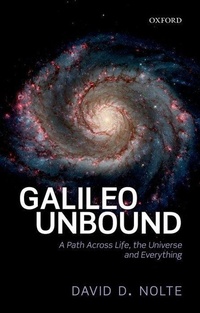
Galileo Unbound
A Path Across Life, the Universe and Everything
Published on 26. July 2018
Book
Hardback
348 pages
978-0-19-880584-7 (ISBN)
Description
Galileo Unbound traces the journey that brought us from Galileo's law of free fall to today's geneticists measuring evolutionary drift, entangled quantum particles moving among many worlds, and our lives as trajectories traversing a health space with thousands of dimensions. Remarkably, common themes persist that predict the evolution of species as readily as the orbits of planets or the collapse of stars into black holes. This book tells the history of spaces of expanding dimension and increasing abstraction and how they continue today to give new insight into the physics of complex systems.
Galileo published the first modern law of motion, the Law of Fall, that was ideal and simple, laying the foundation upon which Newton built the first theory of dynamics. Early in the twentieth century, geometry became the cause of motion rather than the result when Einstein envisioned the fabric of space-time warped by mass and energy, forcing light rays to bend past the Sun. Possibly more radical was Feynman's dilemma of quantum particles taking all paths at once -- setting the stage for the modern fields of quantum field theory and quantum computing. Yet as concepts of motion have evolved, one thing has remained constant, the need to track ever more complex changes and to capture their essence, to find patterns in the chaos as we try to predict and control our world.
Galileo published the first modern law of motion, the Law of Fall, that was ideal and simple, laying the foundation upon which Newton built the first theory of dynamics. Early in the twentieth century, geometry became the cause of motion rather than the result when Einstein envisioned the fabric of space-time warped by mass and energy, forcing light rays to bend past the Sun. Possibly more radical was Feynman's dilemma of quantum particles taking all paths at once -- setting the stage for the modern fields of quantum field theory and quantum computing. Yet as concepts of motion have evolved, one thing has remained constant, the need to track ever more complex changes and to capture their essence, to find patterns in the chaos as we try to predict and control our world.
Reviews / Votes
the richness of the story-telling of the present book, which is able to let even the non-erudite reader to appreciate what the erudite scholar (probably) takes for granted * Salvatore Esposito, Contemporary Physics Journal * Highly Recommended. * CHOICE * Using very few equations, Nolte looks at nearly every area of physics and even includes chapters on chaos and Darwinian evolution. Some of the phase space illustrations are complicated, but Nolte does an excellent job of developing these from the basic ideas of a trajectory through physical space. There is an unexpressed argument here that it may be better for the uninitiated to learn about the sciences through phase space concepts. By learning about the sciences in this way, one gains an appreciation for the symmetry and beauty of the theories without having to learn the advanced mathematics. * Professor Eric Kincanon, Gonzaga University * David Nolte, in Galileo Unbound draws a continuous line starting from Galileo, to Newton, Lagrange and Poincare, all the way to Darwin and beyond. * Nature Astronomy *More details
Language
English
Place of publication
Oxford
United Kingdom
Target group
Professional and scholarly
Illustrations
60 figures/illustrations
Dimensions
Height: 222 mm
Width: 145 mm
Thickness: 22 mm
Weight
570 gr
ISBN-13
978-0-19-880584-7 (9780198805847)
Copyright in bibliographic data and cover images is held by Nielsen Book Services Limited or by the publishers or by their respective licensors: all rights reserved.
Schweitzer Classification
Other editions
Additional editions
E-Book
07/2018
1st Edition
OUP eBook
€20.99
Available for download
Person
David D. Nolte is the Edward M. Purcell Distinguished Professor of Physics and Astronomy at Purdue University. His research areas have included experimental high-energy physics, cosmology, semiconductor physics, laser physics and biophysics. He received his BA from Cornell University in 1981, his PhD from the University of California at Berkeley in 1988, and a post-doctoral appointment at AT&T Bell Labs before joining the faculty at Purdue. He is a Fellow of the Optical Society of America, a Fellow of the American Physical Society and a Fellow of the AAAS. In 2005, he received the Herbert Newby McCoy Award of Purdue University. He is the inventor of the BioCD and Biodynamic Imaging and is the technical founder of two biotech companies using interferometry and holography for diagnostic screening.
Content
1: Flight of the Swallows
Introduction to motion and trajectories
2: A New Scientist
Galileo's beginnings
3: Galileo's Trajectory
Publication of Two New Sciences
4: On the Shoulders of Giants
100 years from Newton to Lagrange
5: Geometry on my Mind
The beginnings of abstract spaces
6: The Tangled Tale of Phase Space
The geometry of dynamics
7: The Lens of Gravity
From Einstein to Wheeler
The Golden Age of General Relativity
8: On the Quantum Footpath
Quantum dynamics
9: From Butterflies to Hurricanes
Chaos theory
10: Darwin in the Clockworks
Evolutionary dynamics
11: The Measure of Life
Population dynamics
Introduction to motion and trajectories
2: A New Scientist
Galileo's beginnings
3: Galileo's Trajectory
Publication of Two New Sciences
4: On the Shoulders of Giants
100 years from Newton to Lagrange
5: Geometry on my Mind
The beginnings of abstract spaces
6: The Tangled Tale of Phase Space
The geometry of dynamics
7: The Lens of Gravity
From Einstein to Wheeler
The Golden Age of General Relativity
8: On the Quantum Footpath
Quantum dynamics
9: From Butterflies to Hurricanes
Chaos theory
10: Darwin in the Clockworks
Evolutionary dynamics
11: The Measure of Life
Population dynamics