

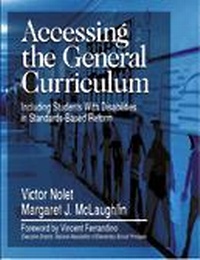
Accessing the General Curriculum
Including Students With Disabilities in Standards-Based Reform
1st Edition
Published on 10. November 2000
Book
Paperback/Softback
152 pages
978-0-7619-7670-7 (ISBN)
Description
This book presents a framework and strategies, for all primary teachers in inclusive environments, to understand the general curriculum, design instruction that will allow ALL students to access and make progress in the general curriculum, design measures that can be used to assess the progress of disabled students within the general curriculum, and develop effective collaborative relationships between general and special education teachers. The challenge of making the general curriculum accessible for all students requires a new way of thinking and problem solving. Therefore this is not just a "how-to" book-it is a "how to think" book.
Reviews / Votes
"Simply put, students with disabilities should be learning the same challenging curriculum as other students. Though this is a simple concept, the diverse needs of the students with disabilities make implementation of this requirement complex. Nolet and McLaughlin have provided the field with a valuable resource for meeting this challenge." -- Thomas HehirMore details
Language
English
Place of publication
Thousand Oaks
United States
Publishing group
SAGE Publications Inc
Target group
Professional and scholarly
Dimensions
Height: 279 mm
Width: 216 mm
Weight
438 gr
ISBN-13
978-0-7619-7670-7 (9780761976707)
Copyright in bibliographic data and cover images is held by Nielsen Book Services Limited or by the publishers or by their respective licensors: all rights reserved.
Schweitzer Classification
Other editions
New editions
Victor Nolet | Margaret J. McLaughlin
Accessing the General Curriculum
Including Students With Disabilities in Standards-Based Reform
Book
08/2005
2nd Edition
Corwin Press Inc
€38.70
Shipment within 10-20 days
Persons
Victor W. Nolet is Director of Assessment and Evaluation for the Woodring College of Education at Western Washington University. He received his Ph.D. from the University of Oregon. His current interests include the impact of teacher education programs on P-12 student outcomes and the impact of accountability systems on students with disabilities. Address: Victor Nolet, Woodring College of Education, 251F Miller Hall, Western Washington University, Bellingham, WA. 98225.
Margaret McLaughlin has been involved in special education all of her professional career, beginning as a teacher of students with serious emotional and behavior disorders. Currently she is the associate director of the Institute for the Study of Exceptional Children, a research institute within the College of Education at the University of Maryland. She directs several national projects investigating educational reform and students with disabilities, including the national Educational Policy Reform Research Institute (EPRRI), a consortium involving the University Maryland; The National Center on Educational Outcomes (NCEO); and the Urban Special Education Collaborative. She also directs a national research project investigating special education in charter schools and leads a policy leadership doctoral and postdoctoral program in conducting large-scale research in special education.
McLaughlin has worked in Bosnia, Nicaragua, and Guatemala in developing programs for students with developmental disabilities. She has consulted with numerous state departments of education and local education agencies on issues related to students with disabilities and the impact of standards-driven reform policies. McLaughlin co-chaired the National Academy of Sciences Committee on Goals 2000 and Students with Disabilities, which resulted in the report Educating One and All. She was a member of the NAS committee on the disproportionate representation of minority students in special education.
McLaughlin teaches graduate courses in disability policy and has written extensively in the area of school reform and students with disabilities. She earned her PhD at the University of Virginia and has held positions at the U.S. Office of Education and the University of Washington.
Margaret McLaughlin has been involved in special education all of her professional career, beginning as a teacher of students with serious emotional and behavior disorders. Currently she is the associate director of the Institute for the Study of Exceptional Children, a research institute within the College of Education at the University of Maryland. She directs several national projects investigating educational reform and students with disabilities, including the national Educational Policy Reform Research Institute (EPRRI), a consortium involving the University Maryland; The National Center on Educational Outcomes (NCEO); and the Urban Special Education Collaborative. She also directs a national research project investigating special education in charter schools and leads a policy leadership doctoral and postdoctoral program in conducting large-scale research in special education.
McLaughlin has worked in Bosnia, Nicaragua, and Guatemala in developing programs for students with developmental disabilities. She has consulted with numerous state departments of education and local education agencies on issues related to students with disabilities and the impact of standards-driven reform policies. McLaughlin co-chaired the National Academy of Sciences Committee on Goals 2000 and Students with Disabilities, which resulted in the report Educating One and All. She was a member of the NAS committee on the disproportionate representation of minority students in special education.
McLaughlin teaches graduate courses in disability policy and has written extensively in the area of school reform and students with disabilities. She earned her PhD at the University of Virginia and has held positions at the U.S. Office of Education and the University of Washington.
Content
Acknowledgments
Foreword
Introduction
1. Accessing the General Curriculum
2. Understanding What Curriculum Is
3. The Learning-Teaching Connection
4. Evaluating the Outcomes of Access
5. Access to Curriculum and the Individual Education Program
6. Creating the Conditions for Access
Appendix: Resources for Facilitating Access
References
Index
Foreword
Introduction
1. Accessing the General Curriculum
2. Understanding What Curriculum Is
3. The Learning-Teaching Connection
4. Evaluating the Outcomes of Access
5. Access to Curriculum and the Individual Education Program
6. Creating the Conditions for Access
Appendix: Resources for Facilitating Access
References
Index