

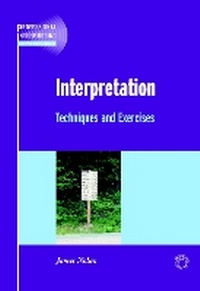
Interpretation
Techniques and Exercises
Published on 7. March 2005
Book
Hardback
328 pages
978-1-85359-791-6 (ISBN)
Description
This book provides a structured syllabus and an overview of interpretation accompanied by exercises in the main aspects of the art. It is meant as a practical guide for interpreters and as a complement to interpreter training programmes, particularly for students preparing for conference interpreting in international governmental and business settings.
Reviews / Votes
I read James Nolan's handbook as a conference interpreting student and found it very useful. This book gives a comprehensive overview of numerous techniques and explains how to use them in a very clear manner. I particularly liked the excerpts from speeches given as examples by the author - a long-time UN-insider. They make this handbook a stimulating reading by showing real-life aspects of this exciting profession. -- Jean-Luc Rostan, free-lance conference interpreter This book is a well-organized practical handbook for interpreter trainees. It is a solid and innovative tool which can be used by teachers, students and practitioners of interpretation. The exercises are instructive and the excerpts from speeches and the potpourri of stock phrases and idioms are well chosen and interesting. I highly recommend it. -- Jean Matthews, Chief, English Section, Interpretation Service, United Nations, New York The book is a great, original, necessary and quite novel approach to interpretation studies from a linguistic and academic point of view. Its structure is perfect from a pedagogical perspective. The exercises presented are numerous and varied in methodology and objectives. The titles and authors included in the bibliography are varied, interesting and practical from several points of view. -- Dr. Ingrid Mosquera Gende, University of A Coruna, Spain The contents of Interpretation: Techniques and Exercises, the fruit of decades of analysis and experience, provide a wealth of material for both students and teachers. Nolan's treatment of many other topics, including suggestions for coping with humor, numerals, Latinisms and notetaking techniques, should all prove extremely valuable for both students and teachers of interpretation. -- Dr. Lynn Visson, Editorial Board, Mosty Translation Journal Mr Nolan's appreciation of the interpreter's great love affair with language informs his book throughout and will make it a valuable source for interpreters and teachers of interpreting for many years to come. -- Joanna Dezio * Proteus, Volume XVI, No. 3 * Nolan's work is unique because his concern is with pedagogy, specifically the training of interpreters. This book is highly recommended not only for those who are driven by a professional career in consecutive or simultaneous interpreting at international events, but also for those who pride themselves on their bilingual abilities. -- Robert N. St. Clair, University of Louisville * Language Problems and Language Planning 30:3. *More details
Series
Language
English
Place of publication
Bristol
United Kingdom
Publishing group
Channel View Publications Ltd
Target group
Professional and scholarly
Dimensions
Height: 210 mm
Width: 148 mm
Thickness: 23 mm
Weight
530 gr
ISBN-13
978-1-85359-791-6 (9781853597916)
Copyright in bibliographic data and cover images is held by Nielsen Book Services Limited or by the publishers or by their respective licensors: all rights reserved.
Schweitzer Classification
Other editions
Additional editions
Book
03/2005
Multilingual Matters
€47.18
Article exhausted; check different version
Person
James Nolan is Chief of the Verbatim Reporting Service and Deputy Director of the Interpretation, Meetings and Publishing Division of the United Nations. He previously served as a UN Senior Interpreter and as Head of Linguistic and Conference Services of the International Tribunal for the Law of the Sea. Mr. Nolan is a graduate of the School of Translation and Interpretation of the University of Geneva and of New York Law School. He has taught interpretation at Marymount Manhattan College and New York University.
Content
Introduction / Frequently Asked Questions 1. Speaking; 2. Preparation / Anticipating The Speaker; 3. Complex Syntax / Compression; 4. Word Order / Clusters; 5. General Adverbial Clauses; 6. Untranslatability; 7.Figures Of Speech; 8. Argumentation; 9. Diction / Register; 10. Formal Style; 11. A Policy Address; 12. Quotations / Allusions / Transposition; 13. Political Discourse; 14. Economic Discourse; 15. Humor; 16. Latinisms; 17. Numbers; 18. Note-Taking Bibliography