

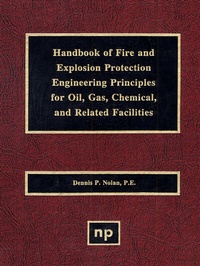
Handbook of Fire & Explosion Protection Engineering Principles for Oil, Gas, Chemical, & Related Facilities
Published on 31. December 1996
Book
Hardback
312 pages
978-0-8155-1394-0 (ISBN)
Description
The security and economic stability of many nations and multinational oil companies are highly dependent on the safe and uninterrupted operation of their oil, gas and chemical facilities. One of the most critical impacts that can occur to these operations are fires and explosions from accidental or political incidents. This publication is intended as a general engineering handbook and reference guideline for those personnel involved with fire and explosion protection aspects of critical hydrocarbon facilities. Design guidelines and specifications of major, small and independent oil companies as well as information from engineering firms and published industry references have been reviewed to assist in its preparation. Some of the latest published practices and research into fire and explosions have also been mentioned.
More details
Language
English
Place of publication
Norwich
United States
Target group
Professional and scholarly
Safety engineers, plants managers and hygiene personnel in the chemical and petrochemical industries.
Dimensions
Height: 229 mm
Width: 152 mm
Weight
940 gr
ISBN-13
978-0-8155-1394-0 (9780815513940)
Copyright in bibliographic data and cover images is held by Nielsen Book Services Limited or by the publishers or by their respective licensors: all rights reserved.
Schweitzer Classification
Other editions
New editions
Dennis P. Nolan
Handbook of Fire and Explosion Protection Engineering Principles
for Oil, Gas, Chemical and Related Facilities
Book
12/2010
2nd Edition
William Andrew Publishing
€175.30
Article exhausted; check for reprint
Additional editions
E-Book
12/2001
Noyes Publications
€124.00
Available for download
Person
Dr. Dennis P. Nolan has had a long career devoted to risk engineering, fire protection engineering, loss prevention engineering and systems safety engineering. He holds a Doctor of Philosophy degree in Business Administration from Berne University, Master of Science degree in Systems Management from Florida Institute of Technology and a Bachelor of Science Degree in Fire Protection Engineering from the University of Maryland. He is a U.S. registered professional engineer in fire protection engineering in the state of California.He is currently on the Executive Management staff of Saudi Aramco, located in Dhahran, Saudi Arabia, as a Loss Prevention Consultant/Chief Fire Prevention Engineer. He covers some of the largest oil and gas facilities in the world. As part of his career, he has examined oil production, refining, and marketing facilities under severe conditions and in various unique worldwide locations, including Africa, Asia, Europe, the Middle East, Russia, and North and South America. His activity in the aerospace field has included engineering support for the NASA Space Shuttle launch facilities at Kennedy Space Center (and for those undertaken at Vandenburg Air Force Base, California) and "classified? national defense systems. Dr. Nolan has received numerous safety awards and is a member of the American Society of Safety Engineers, He is the author of many technical papers and professional articles in various international fire safety publications. He has written at least four books, several published by Elsevier.
Content
IntroductionOverview of Oil and Gas FacilitiesPhilosophy of Protection PrincipalsPhysical Properties of HydrocarbonsCharacteristics of Hydrocarbon Releases, Fires and ExplosionsHistorical Survey of Fire and Explosions in the Hydrocarbon IndustriesRisk AnalysisDegregation, Separation and ArrangementGrading, Containment, and Drainage SystemsProcess ControlsEmergency ShutdownDepressurization, Blowdown and VentingOverpressure and Thermal ReliefControl of Ignition SourcesElimination of Process ReleasesFire and Explosion Resistant SystemsFire and Gas Detection and Alarm SystemsEvacuationMethods of Fire SuppressionSpecial Locations, Facilities and EquipmentHuman Factor and Ergonomic ConsiderationsAppendix A: Testing Firewater SystemsAppendix B: Reference DataAcronym ListGlossaryIndex