

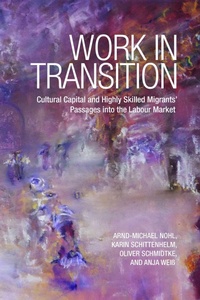
Work in Transition
Cultural Capital and Highly Skilled Migrants' Passages Into the Labour Market
Published on 3. November 2014
Book
Hardback
360 pages
978-1-4426-4760-2 (ISBN)
Description
Despite the fact that many countries target highly skilled migrants for recruitment in the global labour market, few of those migrants are able to take full advantage of their educational and professional qualifications in their new homes. Work in Transition examines this paradox, using extended narrative interviews that focus on the role that cultural capital plays in the labour market.
Comparing the migrant experience in Germany, Canada, and Turkey, Work in Transition shows how migrants develop their cultural capital in order to enter the workforce, as well as how failure to leverage that capital can lead to permanent exclusion from professional positions. Exposing the mechanisms that drive inclusion and exclusion for migrants from a transatlantic comparative perspective, this book provides a unique analytical approach to an increasingly important global issue.
Comparing the migrant experience in Germany, Canada, and Turkey, Work in Transition shows how migrants develop their cultural capital in order to enter the workforce, as well as how failure to leverage that capital can lead to permanent exclusion from professional positions. Exposing the mechanisms that drive inclusion and exclusion for migrants from a transatlantic comparative perspective, this book provides a unique analytical approach to an increasingly important global issue.
More details
Language
English
Place of publication
Toronto
Canada
Target group
College/higher education
Professional and scholarly
Product notice
sewn/stitched
Cloth over boards
Illustrations
7 figures
Dimensions
Height: 229 mm
Width: 160 mm
Thickness: 30 mm
Weight
635 gr
ISBN-13
978-1-4426-4760-2 (9781442647602)
Copyright in bibliographic data and cover images is held by Nielsen Book Services Limited or by the publishers or by their respective licensors: all rights reserved.
Schweitzer Classification
Persons
Arnd-Michael Nohl is a professor of Education Science at Helmut-Schmidt-University.
Karin Schittenhelm is a professor of Sociology at the University of Siegen.
Oliver Schmidtke is a professor in the Departments of Political Science and History and Director of the Centre for Global Studies at the University of Victoria.
Anja Weiss is a professor in the Department of Sociology at the University of Duisburg-Essen.
Karin Schittenhelm is a professor of Sociology at the University of Siegen.
Oliver Schmidtke is a professor in the Departments of Political Science and History and Director of the Centre for Global Studies at the University of Victoria.
Anja Weiss is a professor in the Department of Sociology at the University of Duisburg-Essen.
Content
List of Tables
List of Figures
Acknowledgements
1. Highly Skilled Migrants: A Puzzling Socioeconomic Reality and a Challenge to Migrations Research
2. The Relational Character of Cultural Capital in Migration
3. Multidimensional Status Passages: Migration, Labour Market Inclusion, and Private Life Domains
4. Aspects of the Multidimensional Status Passage: Phases, Migration Motives, and Cultural Capital among Foreign-trained Migrants in Germany
5. Migration Control and Migrants' Agency
6. Symbolic Struggles over Cultural Capital: Racial Discrimination and Symbolic Exclusion
7. Up- and Downgrading Cultural Credit: A Cross-Country Comparison
8. Conclusions
Appendix I
Appendix II
Appendix III
References
List of Figures
Acknowledgements
1. Highly Skilled Migrants: A Puzzling Socioeconomic Reality and a Challenge to Migrations Research
2. The Relational Character of Cultural Capital in Migration
3. Multidimensional Status Passages: Migration, Labour Market Inclusion, and Private Life Domains
4. Aspects of the Multidimensional Status Passage: Phases, Migration Motives, and Cultural Capital among Foreign-trained Migrants in Germany
5. Migration Control and Migrants' Agency
6. Symbolic Struggles over Cultural Capital: Racial Discrimination and Symbolic Exclusion
7. Up- and Downgrading Cultural Credit: A Cross-Country Comparison
8. Conclusions
Appendix I
Appendix II
Appendix III
References