

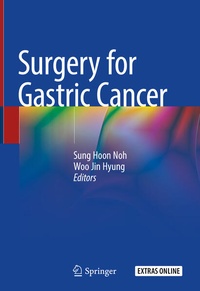
Surgery for Gastric Cancer
Published on 6. June 2019
Book
Hardback
VII, 378 pages
978-3-662-45582-1 (ISBN)
Description
This book clearly describes the surgical procedures employed in patients with gastric cancer. The techniques used in the various types of gastrectomy are presented step by step, and the roles of endoscopic treatment and chemotherapy are also discussed. A distinctive practical feature is the provision of accompanying online videos of standard surgical procedures, which will serve as excellent learning aids for novice practitioners and provide ideal teaching material for experienced surgeons.
Surgery remains the mainstay in the treatment of gastric cancer. With advances in tumor biology and technical developments, gastric cancer surgery has become more diverse and its outcomes have steadily improved. However, further improvement of certain aspects of surgical procedures and techniques is still required. Surgery for Gastric Cancer will acquaint readers with the state of the art in the field and prove a valuable tool in the quest for optimal practice.
More details
Edition
2019 ed.
Language
English
Place of publication
Berlin
Germany
Publishing group
Springer Berlin
Target group
Professional and scholarly
Professional/practitioner
Illustrations
181 farbige Abbildungen, 60 s/w Abbildungen
VII, 378 p. 241 illus., 181 illus. in color.
Dimensions
Height: 260 mm
Width: 183 mm
Thickness: 26 mm
Weight
1012 gr
ISBN-13
978-3-662-45582-1 (9783662455821)
DOI
10.1007/978-3-662-45583-8
Schweitzer Classification
Other editions
Additional editions
Sung Hoon Noh | Woo Jin Hyung
Surgery for Gastric Cancer
E-Book
05/2019
1st Edition
Springer
€171.19
Available for download
Persons
Sung Hoon Noh MD Ph.D., is a professor in surgery at Yonsei University College of Medicine.
Woo Jin Hyung MD Ph.D., is a professor in surgery at Yonsei University College of Medicine.
Content
PART 1: History of Gastric Cancer Surgery.- PART 2: Gastric Pathophysiology.- 1. Preneoplastic lesions, Gastric Carcinogenesis and Molecular Mechanisms (including Role of H. pylori).- 2. Pathology and Pathologic Classifications.- 3. Staging.- PART 3: Diagnosis of Gastric Cancer.- 1. Endoscopic Diagnosis (EGD & EUS).- 2. Radiologic Diagnosis (CT, MRI, & PET-CT).- PART 4: Treatment of Gastric Cancer.- 1. Endoscopic Treatment.- 2. Open surgery for Gastric Cancer.- 1) Distal Subtotal gastrectomy with D2 lymph node dissection.- 2) Total Gastrectomy with D2 lymph node dissection.- 3) Gastrectomy with D3 lymph node dissection.- 4) Reconstruction.- 3. Laparoscopic surgery for Gastric Cancer.- 1)Distal Subtotal gastrectomy with D2 lymph node dissection.- 2) Total Gastrectomy with D2 lymph node dissection.- 3) Reconstruction.- 4. Robotic surgery for Gastric Cancer.- 1) Distal Subtotal gastrectomy with D2 lymph node dissection.- 2) Total Gastrectomy with D2 lymph node dissection.- 3) Reconstruction.- 5. Function-preserving Surgery.- 1) Pylorous-preserving gastrectomy.- 2) Proximal Gastrectomy.- 3) Vagus-preserving gastrectomy.- 6. Sentinel node navigation surgery.- 7. Surgery for EG Junction Cancer.- 8. Surgery after neoadjuvant chemotherapy; Schuhmacher.- 9. Surgery for Remnant gastric Cancer.- 1) Open surgery.- 2) Laparoscopic Surgery.- 3) Robotic Surgery.- 10. Peritonectomy and HIPEC.- 11. Palliative surgery (including resection, bypass & stent).- PART 5: Postoperative Management& Follow-up.- 1. Management of early postoperative complications.- 2. Management of late postoperative complications.- 3. Follow-up after Gastric cancer treatment.- PART 6: Neoadjuvant and Adjuvant Treatments for Gastric Cancer.- 1. Neoadjuvant Treatment.- 2. Adjuvant Treatment.- 3. Radiation Therapy.- 4. Novel Agents and the Future perspectives.