

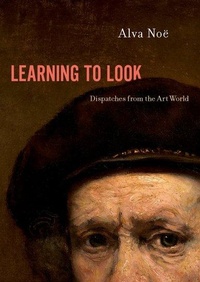
Learning to Look
Dispatches from the Art World
Published on 5. April 2022
Book
Hardback
216 pages
978-0-19-092821-6 (ISBN)
Description
Learning to Look is a wandering journey through the nature of art - and the ways it can transform us, if we let it. Author of Infinite Baseball, Alva Noe, presents a collection of short, stimulating essays that explore how we experience art and what it means to be an "observer." Experiencing art - letting it do its work on us - takes thought, attention, and focus. It requires creation, even from the beholder. And it is in this process of confrontation and reorganization that artworks can lead us to remake ourselves.
Ranging far and wide, from Pina Bausch to Robocop, from Bob Dylan to Vermeer, Noe uses encounters with specific artworks to gain entry into a world of fascinating issues - like how philosophy and science are represented in film; what evolutionary biology says about art; or the role of relics, fakes, and copies in our experience of a work. The essays in Learning to Look are short, accessible, and personal. Each one arises out of an art encounter - in a museum, listening to records, or going to a concert. Each essay stands on its own, but taken together, they form an intimate picture of our relationship with art. Carefully articulating the experience of each of these encounters, Noe proposes that, like philosophy, art is a sort of technology for understanding ourselves. Put simply, art is an opportunity for us to enact ourselves anew.
Ranging far and wide, from Pina Bausch to Robocop, from Bob Dylan to Vermeer, Noe uses encounters with specific artworks to gain entry into a world of fascinating issues - like how philosophy and science are represented in film; what evolutionary biology says about art; or the role of relics, fakes, and copies in our experience of a work. The essays in Learning to Look are short, accessible, and personal. Each one arises out of an art encounter - in a museum, listening to records, or going to a concert. Each essay stands on its own, but taken together, they form an intimate picture of our relationship with art. Carefully articulating the experience of each of these encounters, Noe proposes that, like philosophy, art is a sort of technology for understanding ourselves. Put simply, art is an opportunity for us to enact ourselves anew.
More details
Language
English
Place of publication
New York
United States
Target group
College/higher education
Product notice
sewn/stitched
Cloth over boards
Dimensions
Height: 183 mm
Width: 135 mm
Thickness: 21 mm
Weight
272 gr
ISBN-13
978-0-19-092821-6 (9780190928216)
Copyright in bibliographic data and cover images is held by Nielsen Book Services Limited or by the publishers or by their respective licensors: all rights reserved.
Schweitzer Classification
Other editions
Additional editions
E-Book
11/2021
OUP eBook
€9.99
Available for download
E-Book
11/2021
OUP eBook
€9.99
Available for download
Person
Alva Noe is a writer and a philosopher living in Berkeley and New York. He works on the nature of mind and human experience. He is the author of Action in Perception (2004); Out of Our Heads (2009); Varieties of Presence (2012); and Strange Tools (2015). His latest book is Infinite Baseball: Notes from a Philosopher at the Ballpark (2019). Alva received his Ph.D. from Harvard in 1995 and is Professor of Philosophy at the University of California, Berkeley, where he is also a member of the Institute for Cognitive and Brain Sciences and the Center for New Media. He previously was a Distinguished Professor of Philosophy at the Graduate Center of the City University of New York. He has been philosopher-in-residence with The Forsythe Company and has also collaborated creatively with dance artists Deborah Hay, Nicole Peisl, Jess Curtis, Claire Cunningham, Katye Coe, and Charlie Morrissey. Alva is a 2012 recipient of a Guggenheim fellowship and a former fellow of the
Wissenschaftskolleg zu Berlin. He is a 2018 recipient of the Judd/Hume Prize in Advanced Visual Studies.
Wissenschaftskolleg zu Berlin. He is a 2018 recipient of the Judd/Hume Prize in Advanced Visual Studies.
Content
Preface
Encounters
1 Soup is an anagram of opus
2 I am sitting in a room
3 40 speakers in a room
4 Two left hands
5 Rock art
6 The power of performance
7 Cheap thrills at the Whitney
8 Whaling with Turner
9 Take my breath away
10 Speak, draw, dance
11 Beach beasts on the move
11 Making the work work
13 Irrational man
14 RoboCop's philosophers
15 Pointing the way to liberation, in Star Trek: Voyager
16 An Awkward Synthesis
Pictures
17 The anatomy lesson
18 The importance of being dressed
19 The art of the brain
20 Faces and masks
21 The philosophical eye
22 The camera and the dance
23 Why are 3-D movies so bad?
24 The myth of 3-D immersion
25 Storying telling and the
Encounters
1 Soup is an anagram of opus
2 I am sitting in a room
3 40 speakers in a room
4 Two left hands
5 Rock art
6 The power of performance
7 Cheap thrills at the Whitney
8 Whaling with Turner
9 Take my breath away
10 Speak, draw, dance
11 Beach beasts on the move
11 Making the work work
13 Irrational man
14 RoboCop's philosophers
15 Pointing the way to liberation, in Star Trek: Voyager
16 An Awkward Synthesis
Pictures
17 The anatomy lesson
18 The importance of being dressed
19 The art of the brain
20 Faces and masks
21 The philosophical eye
22 The camera and the dance
23 Why are 3-D movies so bad?
24 The myth of 3-D immersion
25 Storying telling and the