

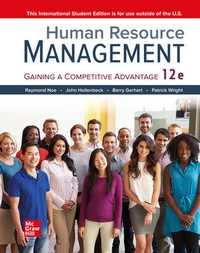
ISE Human Resource Management
12th Edition
Published on 24. March 2020
Book
Paperback/Softback
978-1-260-57074-8 (ISBN)
Description
Human Resource Management: Gaining a Competitive Advantage 12e offers comprehensive coverage of HRM concepts that teach students how to strategically overcome challenges and gain competitive advantage in the workplace.
Based on the authors' diverse research, teaching and consulting experiences, this product has incredibly strong depth and breadth that is current in research and practice simply not found in other texts.
Based on the authors' diverse research, teaching and consulting experiences, this product has incredibly strong depth and breadth that is current in research and practice simply not found in other texts.
More details
Edition
12th edition
Language
English
Place of publication
OH
United States
Target group
College/higher education
Dimensions
Height: 252 mm
Width: 203 mm
Thickness: 33 mm
Weight
1175 gr
ISBN-13
978-1-260-57074-8 (9781260570748)
Copyright in bibliographic data and cover images is held by Nielsen Book Services Limited or by the publishers or by their respective licensors: all rights reserved.
Schweitzer Classification
Other editions
New editions

Raymond Noe | John Hollenbeck | Barry Gerhart
Human Resource Management: Gaining a Competitive Advantage: 2025 Release ISE
Book
03/2025
14th Edition
McGraw-Hill Education
€70.61
Available immediately
Persons
Raymond A. Noe received his B.S. in psychology from Ohio State University and his M.A. and Ph.D. in psychology from Michigan State University. He is the Robert and Anne Hoyt Designated Professor of Management at the Ohio State University. Dr. Noe conducts research and teaches students in human resource management, managerial skills, quantitative methods, human resource information systems, training, employee development, performance management, and organizational behavior. He has published more than 70 articles and invited chapters and has authored, coauthored, or edited seven books covering training and development. Dr. Noe has received awards for teaching and research excellence, including the Ernest J. McCormick Award for Distinguished Early Career Contribution from the Society for Industrial and Organizational Psychology, and is a fellow of the Society of Industrial and Organizational Psychology and the American Psychological Association.
John R. Hollenbeck received his Ph.D. in management from New York University. He is a University Distinguished Professor at Michigan State University and Eli Broad Professor of Management at the Eli Broad Graduate School of Business Administration. Dr. Hollenbeck served as acting editor at Organizational Behavior and Human Decision Processes (1995), associate editor of Decision Sciences (19992004), and editor of Personnel Psychology (19962002). He has published more than 90 articles and chapters on team decision-making and work motivation. Dr. Hollenbeck has been awarded fellowship status in both the Academy of Management and the American Psychological Association and was recognized with the Career Achievement Award by the HR Division of the Academy of Management (2011), the Distinguished Service Contributions Award (2014), and the Early Career Award by the Society of Industrial and Organizational Psychology (1992).
Barry Gerhart received his B.S. in psychology from Bowling Green State University and his Ph.D. in industrial relations from the University of Wisconsin-Madison. He is professor of management and human resources and Bruce R. Ellig Distinguished Chair in Pay and Organizational Effectiveness, Wisconsin School of Business, University of Wisconsin-Madison. Dr. Gerhart serves on the editorial boards of and has published in the Academy of Management Journal, Industrial and Labor Relations Review, International Journal of Human Resource Management, Journal of Applied Psychology, Management and Organization Review, and Personnel Psychology. He is a recipient of the Heneman Career Achievement Award, the Scholarly Achievement Award, and the International Human Resource Management Scholarly Research Award from the Academy of Management. He is a Fellow of the Academy of Management, the American Psychological Association, and the Society for Industrial and Organizational Psychology.
Patrick M. Wright earned a B.A. in psychology from Wheaton College and an M.B.A. from Michigan State University. He is Thomas C. Vandiver Bicentennial Chair and director of the Center for Executive Succession, Darla Moore School of Business, University of South Carolina. Professor Wright is an expert in strategic human resource management and a faculty leader for the Cornell ILR Executive Education/NAHR program. He was lead editor of The Chief HR Officer: Defining the New Role of Human Resource Leaders and has published more than 60 journal articles and more than 20 book chapters. He was editor at the Journal of Management, co-edited a special issue of Research in Personnel and Human Resources Management, and guest edited a special issue of Human Resource Management Review. He is a board member of the Society for Human Resource Management (SHRM) and the National Academy of Human Resources, and is a former board member of HRPS, SHRM Foundation, and World at Work.
John R. Hollenbeck received his Ph.D. in management from New York University. He is a University Distinguished Professor at Michigan State University and Eli Broad Professor of Management at the Eli Broad Graduate School of Business Administration. Dr. Hollenbeck served as acting editor at Organizational Behavior and Human Decision Processes (1995), associate editor of Decision Sciences (19992004), and editor of Personnel Psychology (19962002). He has published more than 90 articles and chapters on team decision-making and work motivation. Dr. Hollenbeck has been awarded fellowship status in both the Academy of Management and the American Psychological Association and was recognized with the Career Achievement Award by the HR Division of the Academy of Management (2011), the Distinguished Service Contributions Award (2014), and the Early Career Award by the Society of Industrial and Organizational Psychology (1992).
Barry Gerhart received his B.S. in psychology from Bowling Green State University and his Ph.D. in industrial relations from the University of Wisconsin-Madison. He is professor of management and human resources and Bruce R. Ellig Distinguished Chair in Pay and Organizational Effectiveness, Wisconsin School of Business, University of Wisconsin-Madison. Dr. Gerhart serves on the editorial boards of and has published in the Academy of Management Journal, Industrial and Labor Relations Review, International Journal of Human Resource Management, Journal of Applied Psychology, Management and Organization Review, and Personnel Psychology. He is a recipient of the Heneman Career Achievement Award, the Scholarly Achievement Award, and the International Human Resource Management Scholarly Research Award from the Academy of Management. He is a Fellow of the Academy of Management, the American Psychological Association, and the Society for Industrial and Organizational Psychology.
Patrick M. Wright earned a B.A. in psychology from Wheaton College and an M.B.A. from Michigan State University. He is Thomas C. Vandiver Bicentennial Chair and director of the Center for Executive Succession, Darla Moore School of Business, University of South Carolina. Professor Wright is an expert in strategic human resource management and a faculty leader for the Cornell ILR Executive Education/NAHR program. He was lead editor of The Chief HR Officer: Defining the New Role of Human Resource Leaders and has published more than 60 journal articles and more than 20 book chapters. He was editor at the Journal of Management, co-edited a special issue of Research in Personnel and Human Resources Management, and guest edited a special issue of Human Resource Management Review. He is a board member of the Society for Human Resource Management (SHRM) and the National Academy of Human Resources, and is a former board member of HRPS, SHRM Foundation, and World at Work.
Content
1. Human Resource Management: Gaining a Competitive Advantage
PART 1: The Human Resource Environment
2. Strategic Human Resource Management
3. The Legal Environment: Equal Employment Opportunity and Safety
4. The Analysis and Design of Work
PART 2: Acquisition and Preparation of Human Resources
5. Human Resource Planning and Recruitment
6. Selection and Placement
7. Training
PART 3: Assessment and Development of Human Resources
8. Performance Management
9. Employee Development
10. Employee Separation and Retention
PART 4: Compensation of Human Resources
11. Pay Structure Decisions
12. Recognizing Employee Contributions with Pay
13. Employee Benefits
PART 5: Special Topics in Human Resource Management
14. Collective Bargaining and Labor Relations
15 Managing Human Resources Globally
16. Strategically Managing the HRM Function
PART 1: The Human Resource Environment
2. Strategic Human Resource Management
3. The Legal Environment: Equal Employment Opportunity and Safety
4. The Analysis and Design of Work
PART 2: Acquisition and Preparation of Human Resources
5. Human Resource Planning and Recruitment
6. Selection and Placement
7. Training
PART 3: Assessment and Development of Human Resources
8. Performance Management
9. Employee Development
10. Employee Separation and Retention
PART 4: Compensation of Human Resources
11. Pay Structure Decisions
12. Recognizing Employee Contributions with Pay
13. Employee Benefits
PART 5: Special Topics in Human Resource Management
14. Collective Bargaining and Labor Relations
15 Managing Human Resources Globally
16. Strategically Managing the HRM Function