

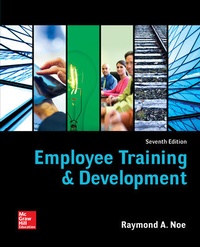
Employee Training & Development
7th Edition
Published on 16. April 2016
Book
Paperback/Softback
576 pages
978-0-07-811285-0 (ISBN)
Description
Best selling title for this course.
Companies that use innovative training and development practices are likely to report better financial performance than their competitors that do not. Training and development also help a company develop the human capital needed to meet competitive challenges. Many companies now recognize that learning through training, development, and knowledge management helps employees strengthen or increase their skills directly impacting their job performance, satisfaction, and career advancement.
Training has moved from an emphasis of a onetime event to the creation of conditions for learning that can occur through collaboration, online learning, traditional classroom training, or a combination of these methods.
The 7th edition covers and addresses the changes in training and development from an employer and employee perspective - adding value to the employer and employee.
Based on the author's extensive experience in teaching training and development courses to both graduate and undergraduate students, Employee Training and Development, Seventh Edition, retains the lively writing style, inspiring examples, and emphasis on new technology and strategic training from previous editions.
AUTHOR NOTE: Ray Noe has taught for more than 25 years at Big Ten universities, including Michigan State University and University of Minnesota. Professor Noe conducts research and teaches all levels of students - from undergraduates to executives - in human resource management, training and development, performance management, and talent management. He has published articles and has served on the editorial boards of many top journals. He has received numerous awards for his teaching and research excellence, and is also a fellow of the Society of Industrial and Organizational Psychology.
Companies that use innovative training and development practices are likely to report better financial performance than their competitors that do not. Training and development also help a company develop the human capital needed to meet competitive challenges. Many companies now recognize that learning through training, development, and knowledge management helps employees strengthen or increase their skills directly impacting their job performance, satisfaction, and career advancement.
Training has moved from an emphasis of a onetime event to the creation of conditions for learning that can occur through collaboration, online learning, traditional classroom training, or a combination of these methods.
The 7th edition covers and addresses the changes in training and development from an employer and employee perspective - adding value to the employer and employee.
Based on the author's extensive experience in teaching training and development courses to both graduate and undergraduate students, Employee Training and Development, Seventh Edition, retains the lively writing style, inspiring examples, and emphasis on new technology and strategic training from previous editions.
AUTHOR NOTE: Ray Noe has taught for more than 25 years at Big Ten universities, including Michigan State University and University of Minnesota. Professor Noe conducts research and teaches all levels of students - from undergraduates to executives - in human resource management, training and development, performance management, and talent management. He has published articles and has served on the editorial boards of many top journals. He has received numerous awards for his teaching and research excellence, and is also a fellow of the Society of Industrial and Organizational Psychology.
More details
Edition
7th edition
Language
English
Place of publication
London
United States
Publishing group
McGraw-Hill Education - Europe
Target group
College/higher education
US School Grade: College Freshman
Illustrations
55 Illustrations
Dimensions
Height: 234 mm
Width: 185 mm
Thickness: 23 mm
Weight
830 gr
ISBN-13
978-0-07-811285-0 (9780078112850)
Copyright in bibliographic data and cover images is held by Nielsen Book Services Limited or by the publishers or by their respective licensors: all rights reserved.
Schweitzer Classification
Person
Raymond A. Noe received his B.S. in psychology from Ohio State University and his M.A. and Ph.D. in psychology from Michigan State University. He is the Robert and Anne Hoyt Designated Professor of Management at the Ohio State University. Dr. Noe conducts research and teaches students in human resource management, managerial skills, quantitative methods, human resource information systems, training, employee development, performance management, and organizational behavior. He has published more than 70 articles and invited chapters and has authored, coauthored, or edited seven books covering training and development. Dr. Noe has received awards for teaching and research excellence, including the Ernest J. McCormick Award for Distinguished Early Career Contribution from the Society for Industrial and Organizational Psychology, and is a fellow of the Society of Industrial and Organizational Psychology and the American Psychological Association.
Content
PART ONE
The Context for Training and Development
1 Introduction to Employee Training and Development
2 Strategic Training
PART TWO
Designing Training
3 Needs Assessment
4 Learning and Transfer of Training
5 Program Design
6 Training Evaluation
PART THREE
Training and Development Methods
7 Traditional Training Methods
8 Technology-Based Training Methods
9 Employee Development and Career Management
PART FOUR
Social Responsibility and the Future
10 Social Responsibility: Legal Issues, Managing Diversity, and Career Challenges
11 The Future of Training and Development
The Context for Training and Development
1 Introduction to Employee Training and Development
2 Strategic Training
PART TWO
Designing Training
3 Needs Assessment
4 Learning and Transfer of Training
5 Program Design
6 Training Evaluation
PART THREE
Training and Development Methods
7 Traditional Training Methods
8 Technology-Based Training Methods
9 Employee Development and Career Management
PART FOUR
Social Responsibility and the Future
10 Social Responsibility: Legal Issues, Managing Diversity, and Career Challenges
11 The Future of Training and Development