

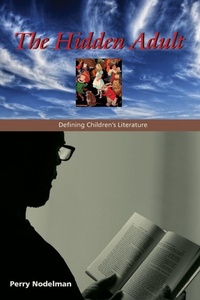
The Hidden Adult
Defining Children's Literature
Published on 25. November 2008
Book
Paperback/Softback
408 pages
978-0-8018-8980-6 (ISBN)
Description
What exactly is a children's book? How is children's literature defined as a genre? A leading scholar presents close readings of six classic stories to answer these questions and offer a clear definition of children's writing as a distinct literary form. Perry Nodelman begins by considering the plots, themes, and structures of six works: "The Purple Jar," Alice in Wonderland, Dr. Doolittle, Henry Huggins, The Snowy Day, and Plain City-all written for young people of varying ages in different times and places-to identify shared characteristics. He points out markers in each work that allow the adult reader to understand it as a children's story, shedding light on ingrained adult assumptions and revealing the ways in which adult knowledge and experience remain hidden in apparently simple and innocent texts. Nodelman then engages a wide range of views of children's literature from authors, literary critics, cultural theorists, and specialists in education and information sciences. Through this informed dialogue, Nodelman develops a comprehensive theory of children's literature, exploring its commonalities and shared themes.
The Hidden Adult is a focused and sophisticated analysis of children's literature and a major contribution to the theory and criticism of the genre.
The Hidden Adult is a focused and sophisticated analysis of children's literature and a major contribution to the theory and criticism of the genre.
Reviews / Votes
A 'must' for any collection catering to librarians or any studying children's literature, especially at the college level. Midwest Book Review 2008 Without question essential reading for professionals of all stripes engaged in the study of children's literature. BCCB, The Bulletin of the Center for Children's Books 2009 Drawing on his deep understanding of literary scholarship, postmodern theory, and children's literature for this learned work, Nodelman builds extensive arguments informed by philosophy, psychology, and culture studies as well as literary criticism. Highly recommended. Choice The capstone of a long and distinguished career, by an author who relishes the complexity and ambiguity he finds inherent in books intended for children. School Library Journal 2009 The Hidden Adult is ground breaking; it will inform the study of children's literature for a long time to come. Children's Literature 2009 This is a massively important book. Go buy it. -- Peter Hunt Children's Literature Association Quarterly 2009 It is without question essential reading for professionals of all stripes engaged in the study of children's literature. Professional Connections: Resources for Teachers and Librarians 2009 Orbiting around children and their books are hundreds of academic books and courses, puzzling out what children's literature is, and what it does, and how it works. A lot has been thought and written about this (some good, some bad) - and Perry Nodelman's brilliantly comprehensive and accessible analysis pulls it all together. No need to keep re-inventing the wheel of defining children, children's books, response, literature, value, or why and how we talk about these books... it's all here. This book shows the kind of knowledge that I only wish I had - and it's a model of readability and generosity of spirit. Anyone who wants to know what has been thought about children and books - from the absolutely essential to the rather strange - could not find a better place to start. -- Peter Hunt Books For Keeps, The Children's Book Magazine Online 2010More details
Language
English
Place of publication
Baltimore, MD
United States
Target group
College/higher education
Product notice
Paperback (trade)
Dimensions
Height: 234 mm
Width: 156 mm
Thickness: 24 mm
Weight
685 gr
ISBN-13
978-0-8018-8980-6 (9780801889806)
DOI
10.56021/9780801889790
Copyright in bibliographic data and cover images is held by Nielsen Book Services Limited or by the publishers or by their respective licensors: all rights reserved.
Schweitzer Classification
Other editions
Additional editions
E-Book
11/2008
Johns Hopkins University Press
€29.99
Available for download
Book
11/2008
Johns Hopkins University Press
€77.50
Article not available for order
Person
Perry Nodelman is professor emeritus of English at the University of Winnipeg and author of The Pleasure of Children's Literature and Words About Pictures: The Narrative Art of Children's Picture Books. Professor Nodelman is also an accomplished author of children's books such as Behaving Bradley.
Content
Acknowledgments
1. Six Texts
Different Texts, Same Genre
Language: The Text and Its Shadows
Focalization: Who Sees and What They Know
Desire Confronts Knowledge
Home and Away: Essential Doubleness
Variation
Summary
2. Exploring Assumptions
Reading as an Adult
Making Choices: Exploring Representativeness
Assumptions about Genre
Genre and Field
Genre and Genres
3. Children's Literature as a Genre
Defining Children's Literature
No Genre
Different but Not Distinct
Literature and Children
For the Good of Children
Literature for Boys and Literature for Girls
Middle-Class Subjectivity
Doubleness
Specific Markers
About Children
The Eyes of Children
Simplicity and Sublimation
The Hidden Adult
Narrator and Narratee
Showing, Not Telling
Happy Endings
Achieving Utopia
Binaries
Repetition
Variation
A Comprehensive Statement?
The Genre in the Field
Sameness and Difference
The Sameness of Children's Literature
Different Children's Literatures: The Effects of Personality and History
Different Children's Literatures: The Effects of Nationality
4. The Genre in the Field
Distinctive Texts in the Genre
Conclusion: Children's Literature as Nonadult?
Notes
Bibliography
Index
1. Six Texts
Different Texts, Same Genre
Language: The Text and Its Shadows
Focalization: Who Sees and What They Know
Desire Confronts Knowledge
Home and Away: Essential Doubleness
Variation
Summary
2. Exploring Assumptions
Reading as an Adult
Making Choices: Exploring Representativeness
Assumptions about Genre
Genre and Field
Genre and Genres
3. Children's Literature as a Genre
Defining Children's Literature
No Genre
Different but Not Distinct
Literature and Children
For the Good of Children
Literature for Boys and Literature for Girls
Middle-Class Subjectivity
Doubleness
Specific Markers
About Children
The Eyes of Children
Simplicity and Sublimation
The Hidden Adult
Narrator and Narratee
Showing, Not Telling
Happy Endings
Achieving Utopia
Binaries
Repetition
Variation
A Comprehensive Statement?
The Genre in the Field
Sameness and Difference
The Sameness of Children's Literature
Different Children's Literatures: The Effects of Personality and History
Different Children's Literatures: The Effects of Nationality
4. The Genre in the Field
Distinctive Texts in the Genre
Conclusion: Children's Literature as Nonadult?
Notes
Bibliography
Index