

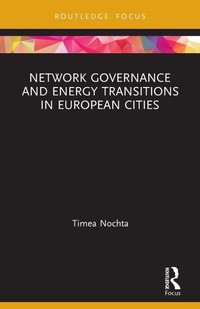
Network Governance and Energy Transitions in European Cities
1st Edition
Published on 29. April 2022
Book
Paperback/Softback
170 pages
978-0-367-54752-3 (ISBN)
Description
This book investigates and evaluates the opportunities and limitations of network governance in building local capacity for energy infrastructure governance.
Presenting a comparative analysis of three city cases from across Europe- Birmingham, Frankfurt and Budapest- this book demonstrates how local factors shape the prospect of network governance to support low-carbon energy transitions. It maps out existing governance networks, highlighting the actors involved and their interactions with one another, and also discusses the role and embeddedness of networks in the urban governance of low-carbon energy. Drawing on case study evidence, Nochta develops a comparative analysis which discusses the intricate connections between network characteristics, context and impact. It highlights that organisational fragmentation; the complexity of the low-carbon energy problem and historical developments all influence network characteristics in terms of degree of integration and vertical (hierarchical) power relationships among network actors. Overall, the book concludes that understanding such links between context and networks is crucial when designing and implementing new governance models aimed at facilitating and governing low-carbon urban development.
Low-Carbon Energy Transitions in European Cities will be of great interest to scholars of energy policy, urban governance and sustainability transitions.
Presenting a comparative analysis of three city cases from across Europe- Birmingham, Frankfurt and Budapest- this book demonstrates how local factors shape the prospect of network governance to support low-carbon energy transitions. It maps out existing governance networks, highlighting the actors involved and their interactions with one another, and also discusses the role and embeddedness of networks in the urban governance of low-carbon energy. Drawing on case study evidence, Nochta develops a comparative analysis which discusses the intricate connections between network characteristics, context and impact. It highlights that organisational fragmentation; the complexity of the low-carbon energy problem and historical developments all influence network characteristics in terms of degree of integration and vertical (hierarchical) power relationships among network actors. Overall, the book concludes that understanding such links between context and networks is crucial when designing and implementing new governance models aimed at facilitating and governing low-carbon urban development.
Low-Carbon Energy Transitions in European Cities will be of great interest to scholars of energy policy, urban governance and sustainability transitions.
Reviews / Votes
Prof. Chris SkelcherProfessor Emeritus
Institute of Local Government Studies (INLOGOV), University of Birmingham, UK
"The climate emergency mandates that cities transition to low carbon. Dr Nochta shows how the complexity of urban networks can be better understood and aid the practice of transition management. Her novel and accessible interdisciplinary approach is essential reading for those working in and studying energy policy, urban governance and change management."
Dr Jonathan Radcliffe
Reader in Energy Systems and Policy
School of Chemical Engineering, University of Birmingham, UK
"This book provides valuable insights into the structures and processes involved in urban governance, and the response of local authorities to the climate emergency. Based on in-depth case-studies, it is essential reading to appreciate the role that cities can play in the transition to decarbonised societies."
Dr Dai Morgan
Deputy Course Director, MPhil in Engineering for Sustainable Development
Department of Engineering, University of Cambridge, UK
"This volume uses network and governance perspectives to provide a rich account of myriad contextual factors affecting low carbon transitions. The rich case studies provide a vivid account of the terrain, and highlight key issues, making a valuable contribution for anyone wishing to better study, understand, or influence urban transitions."
Dr Louise Reardon
Lecturer in Governance and Public Policy
Institute of Local Government Studies (INLOGOV), University of Birmingham, UK
"This book is a must read for anyone interested in how we can transition towards a low carbon society. Its emphasis on the importance of governance networks, and the influence of the local contexts in which they sit, is unique and an essential contribution to the field."
Mr Peter Braithwaite
Director of Engineering Sustainability
Birmingham Centre for Resilience Research and Education, University of Birmingham, UK
"This book is an important step in furthering our understanding of network forms of governance in cities. The topic is approached in a clear, systematic way building on existing research, but challenging and testing theories from a basis of local interpretation and socio-economic development. Planners, engineers and policy makers will find new evidence and a nascent approach to successful low-carbon transitions."
More details
Series
Language
English
Place of publication
London
United Kingdom
Publishing group
Taylor & Francis Ltd
Target group
College/higher education
Postgraduate
Illustrations
12 s/w Abbildungen, 12 s/w Zeichnungen, 6 s/w Tabellen
6 Tables, black and white; 12 Line drawings, black and white; 12 Illustrations, black and white
Dimensions
Height: 216 mm
Width: 140 mm
Thickness: 9 mm
Weight
223 gr
ISBN-13
978-0-367-54752-3 (9780367547523)
Copyright in bibliographic data and cover images is held by Nielsen Book Services Limited or by the publishers or by their respective licensors: all rights reserved.
Schweitzer Classification
Other editions
Additional editions
Book
10/2020
1st Edition
Routledge
€69.70
Shipment within 15-20 days
E-Book
10/2020
1st Edition
Routledge
€31.49
Available for download
E-Book
10/2020
1st Edition
Routledge
€31.49
Available for download
Person
Dr Timea Nochta is a Research Associate at the Centre for Smart Infrastructure and Construction, University of Cambridge, Cambridge, United Kingdom. She completed her doctoral studies at the Institute of Local Government Studies, University of Birmingham, Birmingham, United Kingdom.
Content
Introduction
Chapter 1. Network Governance in Urban Sustainability Transitions
Chapter 2. Analysing Energy Transition Networks in Birmingham, Frankfurt and Budapest
Chapter 3. Case Study I. Energy Transitions in Birmingham
Chapter 4. Case Study II. Energy Transitions in Frankfurt
Chapter 5. Case Study III. Energy Transitions in Budapest
Chapter 6. Contextualising Energy Transition Networks
Appendix I. Details of primary data collection and analysis
Appendix II. Network analysis - Actor centrality scores (core groups)
Chapter 1. Network Governance in Urban Sustainability Transitions
Chapter 2. Analysing Energy Transition Networks in Birmingham, Frankfurt and Budapest
Chapter 3. Case Study I. Energy Transitions in Birmingham
Chapter 4. Case Study II. Energy Transitions in Frankfurt
Chapter 5. Case Study III. Energy Transitions in Budapest
Chapter 6. Contextualising Energy Transition Networks
Appendix I. Details of primary data collection and analysis
Appendix II. Network analysis - Actor centrality scores (core groups)