

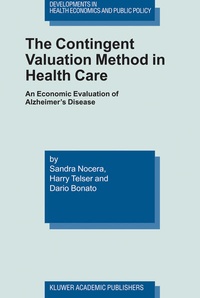
The Contingent Valuation Method in Health Care
An Economic Evaluation of Alzheimer's Disease
Published on 30. November 2003
Book
Hardback
XI, 116 pages
978-1-4020-7718-0 (ISBN)
Description
In the future, as our society becomes older and older, an increasing number of people will be confronted with Alzheimer's disease. Some will suffer from the illness themselves, others will see parents, relatives, their spouse or a close friend afflicted by it. Even now, the psychological and financial burden caused by Alzheimer's disease is substantial, most of it borne by the patient and her family. Improving the situation for the patients and their caregivers presents a challenge for societies and decision makers. Our work contributes to improving the in decision making situation con cerning Alzheimer's disease. At a fundamental level, it addresses methodo logical aspects of the contingent valuation method and gives a holistic view of applying the contingent valuation method for use in policy. We show all stages of a contingent valuation study beginning with the design, the choice of elicitation techniques and estimation methods for willingness-to-pay, the use of the results in a cost-benefit analysis, and finally, the policy implica tions resulting from our findings. We do this by evaluating three possible programs dealing with Alzheimer's disease. The intended audience of this book are health economists interested in methodological problems of contin gent valuation studies, people involved in health care decision making, plan ning, and priority setting, as well as people interested in Alzheimer's disease. We would like to thank the many people and institutions who have pro vided their help with this project.
More details
Series
Edition
2003 ed.
Language
English
Place of publication
New York
United States
Target group
Professional and scholarly
Research
Product notice
sewn/stitched
Cloth over boards
Illustrations
XI, 116 p.
Dimensions
Height: 247 mm
Width: 167 mm
Thickness: 16 mm
Weight
367 gr
ISBN-13
978-1-4020-7718-0 (9781402077180)
DOI
10.1007/978-1-4419-9133-1
Schweitzer Classification
Other editions
Additional editions
Sandra Nocera | Harry Telser | Dario Bonato
The Contingent Valuation Method in Health Care
An Economic Evaluation of Alzheimer's Disease
Book
10/2012
Springer
€53.49
Shipment within 7-9 days
Content
Preface.- List of Abbreviations.- 1 : Introduction.- 1. The contingent valuation method.- 2. Alzheimer's disease.- 3. Study objectives.- 4. Organization of the book.- 2: Study Design.- 1. Economic burden of Alzheimer's disease.- 2. Program 'care' - helping caregivers.- 3. Program 'diagnosis' - detecting AD early.- 4. Program 'research' - search for a cure of AD.- 5. Financing of the programs.- 3 : Elicitation Methods.- 1. Continuous contingent valuation format.- 2. Discrete contingent valuation format.- 3. Biases in contingent valuation studies 17 3.1 Yea-saying.- 4. Chosen elicitation techniques.- 4: Estimation Methods.- 1. Estimation methods for the discrete CV (DC and DM).- 2. Estimation methods for payment card (PC).- 5: Data.- 1. Sample structure and data collection.- 2. Descriptive statistics.- 6: Results.- 1. Program 'care' with taxes.- 2. Program 'diagnosis'.- 3. Program 'research'.- 7: Possible Reasons for Variation in the WTP values.- 1. Mean versus median WTP.- 2. Yea-saying and protest answers.- 3. Question ordering.- 4. Payment vehicle.- 5. Representation of the valuation function.- 6. Warm glow effect.- 7. Information bias.- 8: Cost-benefit analysis.- 1. Cost-benefit analysis for the program 'care'.- 2. Cost-benefit analysis for the program 'diagnosis'.- 3. Cost-benefit analysis for the program 'research'.- 4. Policy implications.- 9: Conclusions.- 1. Summary.- 2. Guideline for a contingent valuation study.- 10 : Appendix.- 1. Correlation matrix.- 2. Detail diagnosis.- 3. Detail Research.- 4. Detail care with insurance.- 5. Questionnaires.- Acknowledgments.- References.