

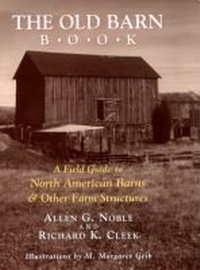
The Old Barn Book
A Field Guide to North American Barns & Other Farm Structures
Will be published approx. on 1. September 1996
Book
Paperback/Softback
240 pages
978-0-8135-2173-2 (ISBN)
Description
Barns give character to the countryside. Their structures reflect the ethnic heritage of a region's settlers and the nature of the land itself. With The Old Barn Book, you'll be able to spot the difference between a Dutch barn and a Swedish barn, a barn for cows and a barn for tobacco. You'll find out why some barns have hipped roofs and others gables, why some have doors at the end and others have them on the side, why some are wood and some are stone, why some are round. Whether you are nostalgic for farm life or like to drive out in the country or want to join in the barn preservation movement, you will find this book an indispensable guide.
More details
Language
English
Place of publication
New Brunswick NJ
United States
Target group
College/higher education
Professional and scholarly
Dimensions
Height: 229 mm
Width: 152 mm
Thickness: 25 mm
Weight
397 gr
ISBN-13
978-0-8135-2173-2 (9780813521732)
Copyright in bibliographic data and cover images is held by Nielsen Book Services Limited or by the publishers or by their respective licensors: all rights reserved.
Schweitzer Classification
Persons
ALLEN G. NOBLE is Professor of Geography at the University of Akron and author of Wood, Brick, and Stone: The North American Settlement Landscape.
RICHARD K. CLEEK is Professor of Geography at the University of Wisconsin Center.
RICHARD K. CLEEK is Professor of Geography at the University of Wisconsin Center.
Content
Preface (p.ix)
Acknowledgments (p.xi)
Introduction (p.1)
Part one: The barn. An overview of barn types (p.19)
Barn features (p.26)
Crib barns (p.62)
Crib-derived barns (p.71)
Ethnic barns (p.67)
More recent barns (p.114)
Special-purpose barns (p.120)
Part two: Other farm structures. Secondary farm buildings (p.133)
Food and water storage (p.138)
Food processing (p.144)
Grain and fodder storage and hay processing (p.152)
Fencing (p.164)
Part three: Where and what. Where to look, and for what (p.181)
What to look for, and where (p.191)
Sources for more information (p.199)
Barn report form (p.209)
Index (p.211)
Acknowledgments (p.xi)
Introduction (p.1)
Part one: The barn. An overview of barn types (p.19)
Barn features (p.26)
Crib barns (p.62)
Crib-derived barns (p.71)
Ethnic barns (p.67)
More recent barns (p.114)
Special-purpose barns (p.120)
Part two: Other farm structures. Secondary farm buildings (p.133)
Food and water storage (p.138)
Food processing (p.144)
Grain and fodder storage and hay processing (p.152)
Fencing (p.164)
Part three: Where and what. Where to look, and for what (p.181)
What to look for, and where (p.191)
Sources for more information (p.199)
Barn report form (p.209)
Index (p.211)