

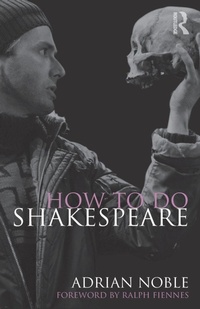
How to do Shakespeare
1st Edition
Published on 27. November 2009
Book
Paperback/Softback
272 pages
978-0-415-54927-1 (ISBN)
Description
'Adrian Noble vigorously highlights the extraordinary rhythmic, linguistic patterns Shakespeare gives the speaker. Any actor will find this book invaluable. For any student of Shakespeare it should be essential.' (From the Foreword by Ralph Fiennes)
'How can I bring the text alive, make it vivid, how do I make people hear it for the first time? How can I enter into that world and not feel a stranger. How can I not feel clumsy and inept? ... How can I speak it without sounding artificial or "actory"? In other words, how can I make it real ...?'
Adrian Noble has worked on Shakespeare with everyone from oscar-nominated actors to groups of schoolchildren. Here he draws on several decades of top-level directing experience to shed new light on how to bring some of theatre's seminal texts to life.
He shows you how to approach the perennial issues of performing Shakespeare, including:
wordplay - using colour and playing plain, wit and comedy, making language muscular
building a character - different strategies, using the text, Stanislavski and Shakespeare
shape and structure - headlining a speech, playing soliloquys, determining a speech's purpose and letting the verse empower you
dialogue - building tension, sharing responsibility and 'passing the ball'.
This guided tour of Shakespeare's complex but unfailingly rewarding work stunningly combines instruction and inspiration.
'How can I bring the text alive, make it vivid, how do I make people hear it for the first time? How can I enter into that world and not feel a stranger. How can I not feel clumsy and inept? ... How can I speak it without sounding artificial or "actory"? In other words, how can I make it real ...?'
Adrian Noble has worked on Shakespeare with everyone from oscar-nominated actors to groups of schoolchildren. Here he draws on several decades of top-level directing experience to shed new light on how to bring some of theatre's seminal texts to life.
He shows you how to approach the perennial issues of performing Shakespeare, including:
wordplay - using colour and playing plain, wit and comedy, making language muscular
building a character - different strategies, using the text, Stanislavski and Shakespeare
shape and structure - headlining a speech, playing soliloquys, determining a speech's purpose and letting the verse empower you
dialogue - building tension, sharing responsibility and 'passing the ball'.
This guided tour of Shakespeare's complex but unfailingly rewarding work stunningly combines instruction and inspiration.
Reviews / Votes
'Noble, who has worked with Kenneth Branagh and Ralph Fiennes, achieves a winning mix of the theoretical and the practical' - WhatsOnStage.comMore details
Language
English
Place of publication
London
United Kingdom
Publishing group
Taylor & Francis Ltd
Target group
Professional and scholarly
Professional Practice & Development
Product notice
Paperback (UK-B)
Illustrations
25 s/w Photographien bzw. Rasterbilder
25 Halftones, black and white
Dimensions
Height: 216 mm
Width: 140 mm
Thickness: 15 mm
Weight
349 gr
ISBN-13
978-0-415-54927-1 (9780415549271)
Copyright in bibliographic data and cover images is held by Nielsen Book Services Limited or by the publishers or by their respective licensors: all rights reserved.
Schweitzer Classification
Other editions
Additional editions
Adrian Noble
How to do Shakespeare
Book
11/2009
1st Edition
Routledge
€206.20
Shipment within 15-20 days
Person
Adrian Noble was the artistic director and chief executive of the Royal Shakespeare Company between 1990 and 2003, having previously served as Associate Director for nine years. He has also held key positions at the Bristol Old Vic and the Manchester Royal Exchange. He regularly works in Theatre and Opera in Canada, France and the USA as well as the UK and has received over 20 Olivier Award nominations during his career.
Content
Part 1 - Principles 1. Apposition 2. Metaphor 3. Metre and pulse 4. Line endings 5. Word play 6. Vocabulary 7. Shape and structure Part 2 - Practice 8. Early, middle and late 9. Prose 10. Soliloquy 11. Comedy 12. Dialogue 13. Building a Character 14. Conclusion