

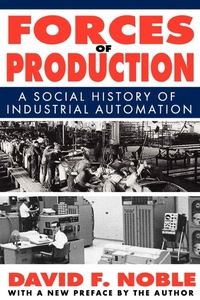
Forces of Production
A Social History of Industrial Automation
1st Edition
Published on 30. March 2011
Book
Paperback/Softback
444 pages
978-1-4128-1828-5 (ISBN)
Description
Focusing on the design and implementation of computer-based automatic machine tools, David F. Noble challenges the idea that technology has a life of its own. Technology has been both a convenient scapegoat and a universal solution, serving to disarm critics, divert attention, depoliticize debate, and dismiss discussion of the fundamental antagonisms and inequalities that continue to beset America. This provocative study of the postwar automation of the American metal-working industry-the heart of a modern industrial economy-explains how dominant institutions like the great corporations, the universities, and the military, along with the ideology of modern engineering shape, the development of technology.
Noble shows how the system of "numerical control," perfected at the Massachusetts Institute of Technology (MIT) and put into general industrial use, was chosen over competing systems for reasons other than the technical and economic superiority typically advanced by its promoters. Numerical control took shape at an MIT laboratory rather than in a manufacturing setting, and a market for the new technology was created, not by cost-minded producers, but instead by the U. S. Air Force. Competing methods, equally promising, were rejected because they left control of production in the hands of skilled workers, rather than in those of management or programmers.
Noble demonstrates that engineering design is influenced by political, economic, managerial, and sociological considerations, while the deployment of equipment-illustrated by a detailed case history of a large General Electric plant in Massachusetts-can become entangled with such matters as labor classification, shop organization, managerial responsibility, and patterns of authority. In its examination of technology as a human, social process, Forces of Production is a path-breaking contribution to the understanding of this phenomenon in American society.
Noble shows how the system of "numerical control," perfected at the Massachusetts Institute of Technology (MIT) and put into general industrial use, was chosen over competing systems for reasons other than the technical and economic superiority typically advanced by its promoters. Numerical control took shape at an MIT laboratory rather than in a manufacturing setting, and a market for the new technology was created, not by cost-minded producers, but instead by the U. S. Air Force. Competing methods, equally promising, were rejected because they left control of production in the hands of skilled workers, rather than in those of management or programmers.
Noble demonstrates that engineering design is influenced by political, economic, managerial, and sociological considerations, while the deployment of equipment-illustrated by a detailed case history of a large General Electric plant in Massachusetts-can become entangled with such matters as labor classification, shop organization, managerial responsibility, and patterns of authority. In its examination of technology as a human, social process, Forces of Production is a path-breaking contribution to the understanding of this phenomenon in American society.
More details
Language
English
Place of publication
New York
United States
Publishing group
Taylor & Francis Inc
Target group
College/higher education
Dimensions
Height: 229 mm
Width: 152 mm
Thickness: 24 mm
Weight
639 gr
ISBN-13
978-1-4128-1828-5 (9781412818285)
Copyright in bibliographic data and cover images is held by Nielsen Book Services Limited or by the publishers or by their respective licensors: all rights reserved.
Schweitzer Classification
Other editions
Additional editions
Book
10/2017
1st Edition
Routledge
€239.80
Shipment within 10-20 days
E-Book
07/2017
Routledge
€69.99
Available for download
E-Book
07/2017
Routledge
€69.99
Available for download
Person
Other projects from this author include "Ghost in the Rear View," 'Secret Within The Sphere," "Knight Squad," "Clarissa's Flame," and "Lost Treasures of Padre Mine." You can find out more on Noble Park movies and books by joining them on Instagram, Facebook, and Youtube.
Content
One: Command and Control; One: The Setting; Two: The Setting: The War at Home; Three: Power and the Power of Ideas; Four: Toward the Automatic Factory; Two: Social Choice in Machine Design; Five: By the Numbers I; Six: By the Numbers II; Seven: The Road Not Taken; Three: A New Industrial Revolution; Eight: Development; Nine: Diffusion:; Ten: Deployment; Eleven: Who's Running the Shop?; Epilogue: Another Look at Progress