

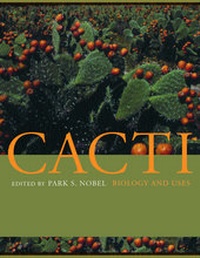
Cacti
Biology and Uses
1st Edition
Will be published approx. on 10. July 2002
Book
Hardback
290 pages
978-0-520-23157-3 (ISBN)
Description
The Cactaceae family, with about sixteen hundred species, is cultivated worldwide for fruits, forage, fodder, and even as a vegetable. Cacti are recognized for their attractive flowers, special stem shapes, and ability to tolerate drought. Because of their efficient use of water and other adaptations, biological and agronomic interest in cacti has soared. These fascinating plants also have much to teach us about biodiversity and conservation. Yet a current, synthetic, wide-ranging reference on cacti has not been available until now. This comprehensive book, compiled by a well-known cactus biologist, includes authoritative, up-to-date chapters by thirty-five contributors from around the world on topics ranging from evolution to biotechnology. It is the first book of its kind to compile information on cactus biology, ecology, and uses in one convenient place. The first half of the book provides a thorough overview of cactus biology and morphology and discusses the environmental and conservation issues that affect the plants. It includes a discussion of the evolution of the family, paying particular attention to new genetic and molecular approaches.
The second half of the book focuses on the practical concerns of cultivating cacti, such as pest control and diseases, horticultural and forage applications, and techniques for agronomy. Other chapters cover the different markets for cacti and products that are made from them. This unique volume will be a reliable and informative reference for ecologists and environmentalists, agriculturists, plant biologists, and anyone seriously interested in these remarkable plants.
The second half of the book focuses on the practical concerns of cultivating cacti, such as pest control and diseases, horticultural and forage applications, and techniques for agronomy. Other chapters cover the different markets for cacti and products that are made from them. This unique volume will be a reliable and informative reference for ecologists and environmentalists, agriculturists, plant biologists, and anyone seriously interested in these remarkable plants.
Reviews / Votes
"There is nothing in the world like this book. It should be in every library and on the bookshelves of all those interested in cacti. The book will be an important resource for plant physiology, agronomy, and horticulture classes at both the undergraduate and graduate level."-Bruce Smith, Brigham Young UniversityMore details
Edition
First Edition
Language
English
Place of publication
Berkerley
United States
Target group
Professional and scholarly
Product notice
Cloth over boards
Illustrations
76 b-w photographs, 34 line illustrations, 39 tables
Dimensions
Height: 279 mm
Width: 216 mm
Thickness: 25 mm
Weight
1134 gr
ISBN-13
978-0-520-23157-3 (9780520231573)
Copyright in bibliographic data and cover images is held by Nielsen Book Services Limited or by the publishers or by their respective licensors: all rights reserved.
Schweitzer Classification
Person
Park S. Nobel is Professor of Biology at the University of California, Los Angeles. He is the author of eight books, including Physicochemical and Environmental Plant Physiology (second edition, 1999), Remarkable Agaves and Cacti (1994), Environmental Biology of Agaves and Cacti (1988), and, with A.C. Gibson, The Cactus Primer (1986).
Content
List of Contributors Preface 1. Evolution and Systematics Robert S. Wallace and Arthur C. Gibson 2. Shoot Anatomy and Morphology Teresa Terrazas Salgado and James D. Mauseth 3. Root Structure and Function Joseph G. Dubrovsky and Gretchen B. North 4. Environmental Biology Park S. Nobel and Edward G. Bobich 5. Reproductive Biology Eulogio Pimienta-Barrios and Rafael F. del Castillo 6. Population and Community Ecology Alfonso Valiente Banuet and Hector Godinez-Alvarez 7. Consumption of Platyopuntias by Wild Vertebrates Eric Mellink and Monica E. Riojas-Lopez 8. Biodiversity and Conservation Thomas H. Boyle and Edward F. Anderson 9. Mesoamerican Domestication and Diffusion Alejandro Casas and Giuseppe Barbera 10.Cactus Pear Fruit Production Paolo Inglese, Filadelfio Basile, and Mario Schirra 11. Fruits of Vine and Columnar Cacti Avinoam Nerd, Noemi Tel-Zur, and Yosef Mizrahi 12. Forage, Fodder, and Animal Nutrition Ali Nefzaoui and Hichem Ben Salem 13. Nopalitos, Mucilage, Fiber, and Cochineal Carmen Saenz-Hernandez, Joel Corrales-Garcia, and Gildardo Aquino-Perez 14. Insect Pests and Diseases Helmuth G. Zimmermann and Giovanni Granata 15. Cactus Breeding and Biotechnology Brad Chapman, Candelario Mondragon Jacobo, Ronald A. Bunch, and Andrew H. Paterson Index