

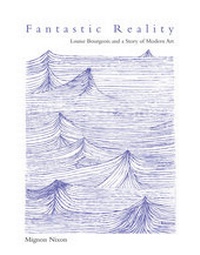
Fantastic Reality
Louise Bourgeois and a Story of Modern Art
Published on 27. May 2005
Book
Hardback
352 pages
978-0-262-14089-8 (ISBN)
Description
The art of Louise Bourgeois stages a dynamic encounter between modern art and
psychoanalysis, argues Mignon Nixon in the first full-scale critical study of the artist's work. A
pivotal figure in twentieth-century art, Louise Bourgeois (b. 1911, France) emigrated to New York in
1938 and is still actively working and exhibiting today. From Bourgeois's formative struggle with
the "father figures" of surrealism, including Andre Breton and Marcel Duchamp, to her galvanizing
role in the feminist art movement of the 1970s, to her subsequent emergence as a leading voice in
postmodernism, this book explores the artist's responses to war, dislocation, and motherhood, to the
predicament of the "woman artist" and the politics of sexual and social liberation, as a dialogue
with psychoanalysis.Convinced that she could express "deeper things in three dimensions," Bourgeois
abandoned painting for sculpture in the 1940s, founding her art in one of the twentieth century's
most radical and controversial accounts of subjectivity, the object relations psychoanalysis of
Melanie Klein. Rejecting the Oedipal narratives of Freud and the dream imagery of surrealism for the
object world of the infantile drives, Bourgeois turned to the child analysis pioneered by Klein, the
figure Julia Kristeva has called "the boldest reformer in the history of modern psychoanalysis."
With Klein, Bourgeois thinks the negative -- fragmentation, splitting, and formlessness -- where we
might least expect to find it, in the corporeal fantasies of mother and child. This turn to the
mother and the death drive at once in child psychoanalysis, Nixon contends, not only finds powerful
expression in Bourgeois's art, but is echoed in the work of other artists, including Marcel Duchamp,
Jasper Johns, Yayoi Kusama, and Eva Hesse, and in a return to Klein in recent art."Fantastic
reality," Bourgeois calls the condition of her art. Starting from Bourgeois's investigation, through
a multiplicity of forms and materials, of the problem of subjectivity on the very threshold of
emergence, this book argues for a new psychoanalytic story of modern art.
psychoanalysis, argues Mignon Nixon in the first full-scale critical study of the artist's work. A
pivotal figure in twentieth-century art, Louise Bourgeois (b. 1911, France) emigrated to New York in
1938 and is still actively working and exhibiting today. From Bourgeois's formative struggle with
the "father figures" of surrealism, including Andre Breton and Marcel Duchamp, to her galvanizing
role in the feminist art movement of the 1970s, to her subsequent emergence as a leading voice in
postmodernism, this book explores the artist's responses to war, dislocation, and motherhood, to the
predicament of the "woman artist" and the politics of sexual and social liberation, as a dialogue
with psychoanalysis.Convinced that she could express "deeper things in three dimensions," Bourgeois
abandoned painting for sculpture in the 1940s, founding her art in one of the twentieth century's
most radical and controversial accounts of subjectivity, the object relations psychoanalysis of
Melanie Klein. Rejecting the Oedipal narratives of Freud and the dream imagery of surrealism for the
object world of the infantile drives, Bourgeois turned to the child analysis pioneered by Klein, the
figure Julia Kristeva has called "the boldest reformer in the history of modern psychoanalysis."
With Klein, Bourgeois thinks the negative -- fragmentation, splitting, and formlessness -- where we
might least expect to find it, in the corporeal fantasies of mother and child. This turn to the
mother and the death drive at once in child psychoanalysis, Nixon contends, not only finds powerful
expression in Bourgeois's art, but is echoed in the work of other artists, including Marcel Duchamp,
Jasper Johns, Yayoi Kusama, and Eva Hesse, and in a return to Klein in recent art."Fantastic
reality," Bourgeois calls the condition of her art. Starting from Bourgeois's investigation, through
a multiplicity of forms and materials, of the problem of subjectivity on the very threshold of
emergence, this book argues for a new psychoanalytic story of modern art.
More details
Series
Language
English
Place of publication
Cambridge, Mass.
United States
Publishing group
MIT Press Ltd
Target group
Professional and scholarly
US School Grade: College Graduate Student and over
Illustrations
103 illus.
Dimensions
Height: 229 mm
Width: 178 mm
Thickness: 0 mm
Weight
907 gr
ISBN-13
978-0-262-14089-8 (9780262140898)
Copyright in bibliographic data and cover images is held by Nielsen Book Services Limited or by the publishers or by their respective licensors: all rights reserved.
Schweitzer Classification