

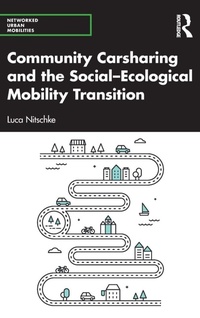
Community Carsharing and the Social-Ecological Mobility Transition
1st Edition
Published on 14. July 2022
Book
Hardback
228 pages
978-1-032-20588-5 (ISBN)
Description
This book investigates how practices of community carsharing are influencing everyday mobility. It argues that hegemonic practices of automobility are reconfigured through practices of community carsharing, thereby challenging capitalist mobilities in the realm of everyday life.
Through a detailed empirical study of practices of community carsharing and its practitioners in the rural regions around Munich, Germany, this book reveals how the practice contributes to the emergence of alternative automobile practices, meanings, identities and subjectivities. It also explores the embedding of automobility into its ecological context, the connection of function and community in practices of community carsharing and the changing of ownership relations through a process of commoning mobility. This reconfiguration of everyday practices of automobility takes place through processes of everyday resistance, re-embedding and commoning, and ultimately results in the emergence of an alternative mobility culture, thereby facilitating the dissemination of an alternative common sense of community carsharing.
This book on community carsharing provides a valuable insight into carsharing in rural settings and exemplifies how carsharing specifically, and sharing mobilities in general, can contribute to a social-ecological mobility transition. The work will be of particular interest to scholars and practitioners working in mobility studies and mobilities.
Through a detailed empirical study of practices of community carsharing and its practitioners in the rural regions around Munich, Germany, this book reveals how the practice contributes to the emergence of alternative automobile practices, meanings, identities and subjectivities. It also explores the embedding of automobility into its ecological context, the connection of function and community in practices of community carsharing and the changing of ownership relations through a process of commoning mobility. This reconfiguration of everyday practices of automobility takes place through processes of everyday resistance, re-embedding and commoning, and ultimately results in the emergence of an alternative mobility culture, thereby facilitating the dissemination of an alternative common sense of community carsharing.
This book on community carsharing provides a valuable insight into carsharing in rural settings and exemplifies how carsharing specifically, and sharing mobilities in general, can contribute to a social-ecological mobility transition. The work will be of particular interest to scholars and practitioners working in mobility studies and mobilities.
Reviews / Votes
"With this strong empirical account of community carsharing, Luca Nitschke offers rich insights into the nitty-gritty details and problems of changing mobility on the micro-scale. Convincingly arguing for a new culture of mobility, he also points to the intricacies and necessary frictions of socio-technical transformations on the macro-scale."Prof. Dr. Sabine Maasen, Science Studies and Innovation Research, Hamburg University
"Luca Nitschke brilliantly investigates the scarcely researched practice of non-commercial community carsharing. The case allows a grounded critique of the capitalist logic of modern automobility and commercial carsharing and thus provides a much needed and fresh understanding of causal mechanisms behind practicing carsharing and explores in a systematic way the shifting meanings of the car and automobility. This book is essential in grasping how local change and local transition to sustainable mobility are possible and indeed how car use can be sustainable."
Dennis Zuev, Professor, University of Saint Joseph, Macau, China and Senior Researcher, Center for Research and Studies in Sociology, Portugal.
"This book provides a timely contribution to our understanding of sustainable mobility transitions. Nitschke provides us with an empirically grounded account that analyses the intersection of technology and community. In doing so he gives us a theoretically rich post-structuralist account that analyses the agency of technological actants in re-shaping practices at both individual and communal scales. A much needed contribution to current debates that will be of interest to anyone interested in greening mobility."
Justin Spinney, Ph.D., School of Geography and Planning, Cardiff University
More details
Series
Language
English
Place of publication
London
United Kingdom
Publishing group
Taylor & Francis Ltd
Target group
College/higher education
Postgraduate
Illustrations
6 s/w Abbildungen, 3 s/w Photographien bzw. Rasterbilder, 3 s/w Zeichnungen, 6 s/w Tabellen
6 Tables, black and white; 3 Line drawings, black and white; 3 Halftones, black and white; 6 Illustrations, black and white
Dimensions
Height: 235 mm
Width: 157 mm
Thickness: 18 mm
Weight
510 gr
ISBN-13
978-1-032-20588-5 (9781032205885)
Copyright in bibliographic data and cover images is held by Nielsen Book Services Limited or by the publishers or by their respective licensors: all rights reserved.
Schweitzer Classification
Other editions
Additional editions
Book
01/2024
1st Edition
Routledge
€65.30
Shipment within 10-20 days
E-Book
07/2022
1st Edition
Routledge
€59.49
Available for download
E-Book
07/2022
1st Edition
Routledge
€59.49
Available for download
Person
Luca Nitschke completed his Ph.D. at the Munich Center for Technology in Society (MCTS) and Nuertingen-Geislingen University as a member of the mobil.LAB Doctoral Research Group, funded by the Hans-Boeckler-Foundation, located at the Chair for Urban Structure and Transport Planning at the Technical University of Munich. He works at the Institute for Social-Ecological Research (ISOE) in Frankfurt. His research interests lie in the relationship between mobilities practices, capitalism and processes of change.
He studied Environmental Sciences in Bielefeld and Environmental Studies in Barcelona, Aveiro, Aalborg and New York City, and he is a founding member of the Center for Emancipatory Technology (ZET), Basel.
He studied Environmental Sciences in Bielefeld and Environmental Studies in Barcelona, Aveiro, Aalborg and New York City, and he is a founding member of the Center for Emancipatory Technology (ZET), Basel.
Content
1 Capitalist Mobilities, Sharing Mobilities and the Need for Reconfiguring the Everyday 2 Empirical Introduction: Investigating Community Carsharing 3 Reconstituting Automobility: Changing the Meanings of the Car and (Auto)Mobility 4 Re-Embedding Automobility: Ecological Critique and Counterhegemonic Practice Interlude: The Collective and Organizational Character of Everyday Life 5 "We Do It Together for Us": Community, Collective Identity and Social Re-Embedding 6 Commoning Mobility: Community Carsharing and Changing Ownership 7 Community Carsharing and the Social-Ecological Mobility Transition