

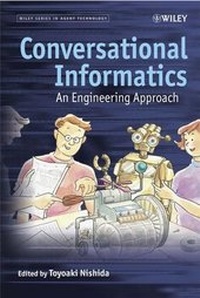
Conversational Informatics
An Engineering Approach
Will be published approx. on 2. November 2007
Book
Hardback
430 pages
978-0-470-02699-1 (ISBN)
Description
Conversational informatics investigates human behaviour with a view to designing conversational artifacts capable of interacting with humans in a conversational fashion. It spans a broad array of topics including linguistics, psychology and human-computer interaction. Until recently research in such areas has been carried out in isolation, with no attempt made to connect the various disciplines. Advancements in science and technology have changed this.
Conversational Informatics provides an interdisciplinary introduction to conversational informatics and places emphasis upon the integration of scientific approaches to achieve engineering goals and to advance further understanding of conversation.
It features a collection of surveys structured around four prominent research areas: conversational artifacts, conversational contents, conversation environment design and conversation measurement, analysis and modelling
* Conversational artifacts shows how synthetic characters or intelligent robots use eye gaze, gestures and other non-verbal communicators to interact.
* Conversational contents looks at developing techniques for acquiring, editing, distributing and utilising the contents that are produced and consumed in conversation.
* Conversation environment design explains techniques for creating intelligent virtual environments and for representing individuals within a virtual environment by monitoring and reproducing their non-verbal conversational behaviour.
* Conversation measurement, analysis and modelling demonstrate how conversational behaviour can be measured and analyzed.
Conversational Informatics will be an invaluable resource for postgraduate students and researchers in Computer Science and Electrical Engineering as well as engineers and developers working in the field of automation, robotics and agents technology.
More details
Product info
gebunden
Series
Edition
1. Auflage
Language
English
Place of publication
New York
United States
Target group
Professional and scholarly
Product notice
sewn/stitched
Paper over boards
Dimensions
Height: 251 mm
Width: 173 mm
Thickness: 28 mm
Weight
853 gr
ISBN-13
978-0-470-02699-1 (9780470026991)
Schweitzer Classification
Other editions
Additional editions
E-Book
08/2008
Wiley
€107.99
Available for download
Person
Toyoaki Nishida is Professor, Department of Intelligence Science and Technology, Graduate School of Informatics, Kyoto University. His research centers on artificial intelligence and human computer interaction.?He leads several projects, including a Japan Society for the Promotion of Science project on intelligent media technology for supporting natural communication between people, and The Research Institute of Science and Technology for Society project on conversational knowledge process for risk communication.?He is editorial board member of publications including New Generation Computing, Autonomous Agents and Multiagent Systems, Knowledge and Information Systems, Web Intelligence and Agent Systems, and Springer Series on Advanced Information and Knowledge Processing.?He is a founder of a series of international workshops on social intelligence design, originating in JSAI-Synsophy International Workshop on Social Intelligence Design (SID2001), May 2001.
Content
Table of Contents
1. Introduction
Toyoaki Nishida
Part I Conversational Artifacts
2. Conversational Agents and the Construction of Humorous Acts
Anton Nijholt
3. Why emotions should be integrated into conversational agents
Christian Becker, Stefan Kopp, and Ipke Wachsmuth
4. More Than Just a Friendly Phrase: Multimodal Aspects of Polite Behavior in Agents
Matthias Rehm and Elisabeth André
5. Attentional behaviors as Nonverbal Communicative Signals in Situated Interactions with Conversational Agents
Yukiko I. Nakano and Toyoaki Nishida
6. Attentional Gestures in Dialogues between People and Robots
Candace Sidner and Christopher Lee
7. Dialogue Context for Visual Feedback Recognition
Louis-Philippe Morency, Candace Sidner, and Trevor Darrell
8. Trading Spaces: How Humans and Humanoids use Speech and Gesture
to Give Directions
Stefan Kopp, Paul A. Tepper, Kim Ferriman, Kristina Striegnitz, and Justine Cassell
9. Facial Gestures: Taxonomy and Application of Non-Verbal,
Non-Emotional Facial Displays for Embodied Conversational Agents
Goranka Zoric, Karlo Smid, Igor S. Pandzic
Part II Conversational Contents
10. Conversation Quantization and Sustainable Knowledge Globe
Hidekazu Kubota, Yasuyuki Sumi, and Toyoaki Nishida
11. Automatic Text Presentation for Conversational Knowledge Process
Sadao Kurohashi, Daisuke Kawahara, and Tomohide Shibata
12. Video Content Acquisition and Editing for Conversation Scenes
Yuichi Nakamura
13. Personalization of Video Contents
Noboru Babaguchi
Part III Conversation Environment Design
14. Conversational Content Acquisition by Ubiquitous Sensors
Yasuyuki Sumi, Kenji Mase, and Toyoaki Nishida
15. Real-time Human Proxy
Rin-ichiro Taniguchi and Daisaku Arita
16. Lecture Archiving System
Satoshi Nishiguchi, Koh Kakusho and Michihiko Minoh
Part IV Conversation Measurement, Analysis and Modeling
17. A Scientific Approach to Conversational Informatics:
Description, Analysis, and Modeling of Human Conversation
Yasuharu Den and Mika Enomoto
18. Embodied Synchrony in Conversation
Chika Nagaoka, Masashi Komori, and Sakiko Yoshikawa
19. Modeling Communication Atmosphere
Tomasz M. Rutkowski and Danilo Mandic
20. Analysis of Interaction Mechanism in Online Communities
Naohiro Matsumura
21. Mutual Adaptation:
A New Criterion for Designing and Evaluating Human-Computer Interaction
Kazuhiro Ueda and Takanori Komatsu