

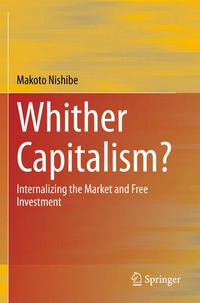
Whither Capitalism?
Internalizing the Market and Free Investment
Published on 2. December 2020
Book
Paperback/Softback
XIV, 172 pages
978-981-15-0700-7 (ISBN)
Description
This book is the first to clarify the essential meaning and serious impact of globalization at the most abstract level from the point of view of Polanyi's three socioeconomic principles of exchange, reciprocity and redistribution. It also provides a theoretically coherent explanation of the evolution of the market and capitalist economies with respect to the advancement of commodification through Marx's internalization of the market into the community and state.
Globalization is the long-term tendency of the market to extensively expand and deepen, and of the community and state to contract and become shallower. The ultimate goal of globalization is free investment capitalism for all people - not only capitalists and speculators, but workers, students, and housewives as well.
The book also examines Hayek's criticism of a centrally planned economy and Lange's proposal of market socialism in the "Socialist Calculation" debate, which has been ongoing since the 1920s, and acknowledges Hayek's vision of a distributed market with local and tacit knowledge to explain why socialism is infeasible and capitalism is robust.
The outcomes of globalization are disastrous in socioeconomic, cultural and ecological realms. As such, it argues that in the twenty-first century, a post-capitalist, cooperative market economy mediated by new forms of money as communication media must be achieved. These new media will include community currencies and local exchange trading systems (LETS) that can maintain the merits of money and the market and can overcome the defects of free investment capitalism.
Lastly, this English version of the book includes a postscript explaining the significance and prospects of the socioeconomic changes around the globe since the publication of Japanese version in 2011.
Globalization is the long-term tendency of the market to extensively expand and deepen, and of the community and state to contract and become shallower. The ultimate goal of globalization is free investment capitalism for all people - not only capitalists and speculators, but workers, students, and housewives as well.
The book also examines Hayek's criticism of a centrally planned economy and Lange's proposal of market socialism in the "Socialist Calculation" debate, which has been ongoing since the 1920s, and acknowledges Hayek's vision of a distributed market with local and tacit knowledge to explain why socialism is infeasible and capitalism is robust.
The outcomes of globalization are disastrous in socioeconomic, cultural and ecological realms. As such, it argues that in the twenty-first century, a post-capitalist, cooperative market economy mediated by new forms of money as communication media must be achieved. These new media will include community currencies and local exchange trading systems (LETS) that can maintain the merits of money and the market and can overcome the defects of free investment capitalism.
Lastly, this English version of the book includes a postscript explaining the significance and prospects of the socioeconomic changes around the globe since the publication of Japanese version in 2011.
More details
Edition
2019 ed.
Language
English
Place of publication
Singapore
Singapore
Target group
Professional and scholarly
Illustrations
8 s/w Abbildungen, 12 farbige Abbildungen
XIV, 172 p. 20 illus., 12 illus. in color.
Dimensions
Height: 235 mm
Width: 155 mm
Thickness: 11 mm
Weight
295 gr
ISBN-13
978-981-15-0700-7 (9789811507007)
DOI
10.1007/978-981-13-0704-1
Schweitzer Classification
Other editions
Additional editions
Book
12/2019
Springer
€106.99
Shipment within 15-20 days
Person
Dr. Makoto Nishibe is a Professor at the School of Economics, Senshu University, Professor Emeritus at Hokkaido University, and President of the Japanese Association for Evolutionary Economics, and of the Senshu University Digital Community Currency Consortium Laboratory (Good Money Lab). He completed his M.A. in Economics at York University, Canada, and his Ph.D. in Economics at the University of Tokyo, Japan. He specializes in evolutionary economics and money evolution, and he is the author of
Community Dock by Local Currency
(Japanese, Senshu University Press, 2018),
The Enigma of Money
(Springer, 2016) and
Community Currency
(Japanese, ed., Minerva Shobo, 2012).
Content
Chap. 1 Globalization as Extensive Widening and Intensive Deepening of Market.- Chap. 2 Why is Socialism Infeasible and Why is Capitalism Robust? .- Chap. 3 Money and Autonomous and Dispersive Market.- Chap. 4 Internalization of Market and Evolution of Capitalism.- Chap. 5 Money as Communication Media.