

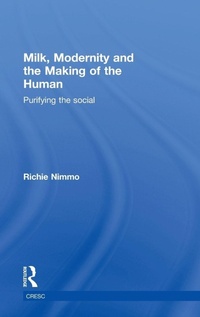
Milk, Modernity and the Making of the Human
Purifying the Social
1st Edition
Published on 17. February 2010
Book
Hardback
222 pages
978-0-415-55874-7 (ISBN)
Description
This book undertakes a critique of the pervasive notion that human beings are separate from and elevated above the nonhuman world and explores its role in the constitution of modernity.
The book presents a socio-material analysis of the British milk industry in the late nineteenth and early twentieth centuries. It traces the dramatic development of the milk trade from a cottage industry into a modernised and integrated system of production and distribution, examining the social, economic and political factors underpinning this transformation, and also highlighting the important roles played by various nonhumans, such as microbes, refrigeration technologies, diseases, and even cows themselves. Milk as a substance posed deep social and material problems for modernity, being hard to transport and keep fresh as well as a highly fertile environment for the growth of bacteria and the transmission of diseases such as tuberculosis from cows to humans. Milk, Modernity and the Making of the Human demonstrates how the resulting insecurities and dilemmas posed a threat to the nature/culture divide as milk consumption grew along with urbanization, and had therefore to be managed by emergent forms of scientific and sanitary knowledge and expertise.
Milk, Modernity and the Making of the Human is an ideal volume for any researcher interested in the hybrid socio-material, economic and political factors underpinning the transformation of the milk industry.
The book presents a socio-material analysis of the British milk industry in the late nineteenth and early twentieth centuries. It traces the dramatic development of the milk trade from a cottage industry into a modernised and integrated system of production and distribution, examining the social, economic and political factors underpinning this transformation, and also highlighting the important roles played by various nonhumans, such as microbes, refrigeration technologies, diseases, and even cows themselves. Milk as a substance posed deep social and material problems for modernity, being hard to transport and keep fresh as well as a highly fertile environment for the growth of bacteria and the transmission of diseases such as tuberculosis from cows to humans. Milk, Modernity and the Making of the Human demonstrates how the resulting insecurities and dilemmas posed a threat to the nature/culture divide as milk consumption grew along with urbanization, and had therefore to be managed by emergent forms of scientific and sanitary knowledge and expertise.
Milk, Modernity and the Making of the Human is an ideal volume for any researcher interested in the hybrid socio-material, economic and political factors underpinning the transformation of the milk industry.
More details
Series
Language
English
Place of publication
London
United Kingdom
Publishing group
Taylor & Francis Ltd
Target group
College/higher education
Product notice
Paper over boards
Dimensions
Height: 240 mm
Width: 161 mm
Thickness: 17 mm
Weight
508 gr
ISBN-13
978-0-415-55874-7 (9780415558747)
Copyright in bibliographic data and cover images is held by Nielsen Book Services Limited or by the publishers or by their respective licensors: all rights reserved.
Schweitzer Classification
Other editions
Additional editions
Book
11/2012
1st Edition
Routledge
€71.20
Shipment within 15-20 days
E-Book
02/2010
Routledge
€64.49
Available for download
E-Book
02/2010
Routledge
€64.49
Available for download
Person
Dr. Richie Nimmo is a Lecturer in Sociology at the University of Manchester, UK. His research explores the ambiguous status of nonhumans in modern knowledge-practices and the constitution of 'the social' across materially heterogeneous relations, systems and flows.
Content
Introduction: modernity, humanity and nonhumans 1. The anthropocentrism of 'culture': a critique of humanist discourse 2. Milk and modernity Part I: commodities, networks and monopolies 3. Culture, order and disease in late nineteenth-century British dairying 4. Purifying milk: knowledge, sanitation and discipline 5. Milk and modernity Part II: measurement, rationalization and control 6. Beyond 'culture' and 'nature': towards a post-humanist knowledge