

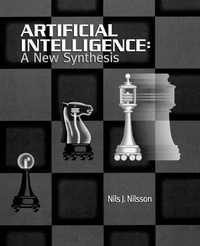
Artificial Intelligence: A New Synthesis
A New Synthesis
Published on 17. April 1998
Book
Paperback/Softback
513 pages
978-1-55860-535-0 (ISBN)
Description
Intelligent agents are employed as the central characters in this introductory text. Beginning with elementary reactive agents, Nilsson gradually increases their cognitive horsepower to illustrate the most important and lasting ideas in AI. Neural networks, genetic programming, computer vision, heuristic search, knowledge representation and reasoning, Bayes networks, planning, and language understanding are each revealed through the growing capabilities of these agents. A distinguishing feature of this text is in its evolutionary approach to the study of AI. This book provides a refreshing and motivating synthesis of the field by one of AI's master expositors and leading researches.
More details
Language
English
Place of publication
San Francisco
United States
Publishing group
Elsevier Science & Technology
Target group
College/higher education
Product notice
Paperback (trade)
Dimensions
Height: 232 mm
Width: 189 mm
Thickness: 28 mm
Weight
885 gr
ISBN-13
978-1-55860-535-0 (9781558605350)
Copyright in bibliographic data and cover images is held by Nielsen Book Services Limited or by the publishers or by their respective licensors: all rights reserved.
Schweitzer Classification
Other editions
Additional editions
Nils J. Nilsson
Artificial Intelligence: A New Synthesis
E-Book
04/1998
Morgan Kaufmann
€43.99
Available for download
E-Book
01/1998
Elsevier
€62.99
Available for download
Person
Nils J. Nilsson's long and rich research career has contributed much to AI. He has written many books, including the classic Principles of Artificial Intelligence. Dr. Nilsson is Kumagai Professor of Engineering, Emeritus, at Stanford University. He has served on the editorial boards of Artificial Intelligence and Machine Learning and as an Area Editor for the Journal of the Association for Computing Machinery. Former Chairman of the Department of Computer Science at Stanford, and former Director of the SRI Artificial Intelligence Center, he is also a past president and Fellow of the American Association for Artificial Intelligence.
Content
Reactive Machines. Neural Networks. Machine Evolution. State Machines. Robot Vision. Search in State Spaces. Agents that Plan. Uninformed Search. Heuristic Search. Planning, Acting and Learning. Alternative Search. Knowledge Representation and Reasoning. The Propositional Calculus. The Predicate Calculus. Knowledge-based Systems. Representing Common sense Knowledge. Reasoning with Uncertain Information. Learning and Acting with Bayes Nets. Planning Methods Based on Logic. The Situation Calculus. Planning. Communication and Integration. Multiple Agents. Communication Among Agents. Agent Architectures.