

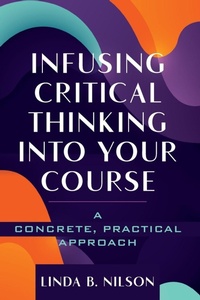
Infusing Critical Thinking Into Your Course
A Concrete, Practical Approach
1st Edition
Published on 29. March 2021
Book
Paperback/Softback
180 pages
978-1-64267-169-8 (ISBN)
Description
Critical thinking-every scholar in the literature has defined it, but there is no clearly agreed upon definition. No wonder polls and surveys reveal that few college-level faculty can define critical thinking or know how to teach it. Still, critical thinking keeps appearing in accreditation standards and surveys of the skills employers seek in college graduates. The good news is that we do know that critical thinking can be taught. But the concept cries out for the simplification, translation into discipline-relevant course outcomes, tangible teaching strategies, and concrete assessment techniques that this book will provide.Like a course or a workshop, this book proposes learning outcomes for the reader-promises of what the reader will be able to do after reading it. These include:* explain what critical thinking is in simple terms;* convincingly explain to students why it is important for them to learn critical thinking, and, if they tune out, what they stand to lose;* overcome the challenges that teaching critical thinking presents;* identify the type of course content to which critical thinking can be applied and, therefore, that readers can use to teach critical thinking;* integrate critical thinking into the design of a new or existing course in any discipline;* write assessable critical thinking learning outcomes that are compatible with and make sense in any discipline;* select and adapt activities and assignments that will give students no- or low-stakes practice with feedback in critical thinking using a variety of questions, tasks, and teaching methods.
Reviews / Votes
"Linda Nilson does the seemingly impossible: unpacks the multifaceted, varied definitions and approaches to critical thinking and then deftly weaves them into a rich set of useful approaches and strategies for instructors to integrate into their own outcomes, assignments and assessments."Patty Payette, Executive Director, Ideas to Action; Senior Associate Director, Delphi Center for Teaching and Learning
University of Louisville
"We often say that critical thinking is not only among the key attributes employers seek in college graduates, but also an essential quality for informed citizens in a democracy. Yet there's a marked lack of clear guidance for how educators can teach critical thinking in the classroom. Linda Nilson's book performs an essential service by showing faculty how they can teach critical thinking while also teaching disciplinary content, thereby helping students gain an essential skill for life after college, in their professional, personal, and public life."
Dr. Gleb Tsipursky, CEO, Disaster Avoidance Experts, LLC, and author of The Blindspots Between Us: How to Overcome Unconscious Cognitive Bias and Build Better Relationships
"This book should be read and used by every faculty member. Improved critical thinking is an essential outcome for all courses and for research training in any field. Dr. Nilson has drawn on her long experience as an outstanding faculty developer to make it easier for any of us to foster advanced critical thinking. She clearly explains the underlying rationale and provides powerful ways to engage students. She includes: 1) a quick and accurate review of major alternative frameworks, 2) extensively developed examples of ways to implement each of them with students and 3) multiple approaches to assess students' thinking while fostering further sophistication. I would have been a much more effective teacher if I had had this foundation to build on."
Craig E. Nelson, Professor Emeritus, Biology
Indiana University
"The ability to think critically is vital to our capacity to 'routinely confront dishonesty' in Linda Nilson's words. In this lively and accessible book, Nilson reviews how students can be helped to investigate claims made across a wide range of disciplines. She provides numerous examples of classroom exercises and assessment formats for college teachers seeking practical guidance on how to infuse critical thinking across the curriculum."
Stephen D. Brookfield
Distinguished Scholar, Antioch University
More details
Language
English
Place of publication
Oxford
United States
Publishing group
Taylor & Francis Inc
Target group
College/higher education
Professional and scholarly
Postgraduate and Professional Practice & Development
Dimensions
Height: 229 mm
Width: 152 mm
Thickness: 10 mm
Weight
265 gr
ISBN-13
978-1-64267-169-8 (9781642671698)
Copyright in bibliographic data and cover images is held by Nielsen Book Services Limited or by the publishers or by their respective licensors: all rights reserved.
Schweitzer Classification
Other editions
Additional editions
E-Book
07/2023
1st Edition
Routledge
€32.99
Available for download
E-Book
07/2023
1st Edition
Routledge
€32.99
Available for download
Book
03/2021
1st Edition
Stylus Publishing
€205.90
Shipment within 3-4 weeks
Person
Linda B. Nilson is founding director emeritus of the Office of Teaching Effectiveness and Innovation (OTEI) at Clemson University and author of Teaching at Its Best: A Research-Based Resource for College Instructors, now in its fourth edition.
Content
Preface Acknowledgments 1. Promoting Critical Thinking to Your Students. Being Nobody's Fool 2. The Critical Thinking Literature. A Sticky Thicket 3. Ten Reasons Why Teaching Critical Thinking Is So Challenging 4. Formulating Critical Thinking Learning Outcomes 5. Fostering Your Students' Cognitive Awareness to Teach Critical Thinking 6. Asking Your Students the Right Questions to Teach Critical Thinking 7. Using the Most Effective Methods to Teach Critical Thinking 8. Assessing Your Students' Critical Thinking with Objective Items 9. Assessing Your Students' Critical Thinking With Constructed-Response Questions and Tasks 10. Assessing Constructed Responses Using Rubrics 11. Assessing Constructed Responses Using Specifications Grading 12. Critical Thinking and the Promise of Higher Education Appendix A. Discussion Activities for Various Purposes References About the Author Index