

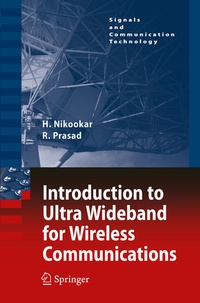
Introduction to Ultra Wideband for Wireless Communications
Published on 14. October 2008
Book
Hardback
XVIII, 188 pages
978-1-4020-6632-0 (ISBN)
Description
asakta-buddhih sarvatra . jitatma vigata-sprhah . . . . naiskarmya-siddhim paramam . sannyasenadhigacchati Detached by spiritual intelligence from everything controlling the mind, without material desires, one attains the paramount perfection in cessation of re- tions by renunciation. The Bhagvad Gita (18.49) Compared to traditional carrier-based, Ultra-Wide Band (UWB), or carrier-less, systems implement new paradigms in terms of signal generation and reception. Thus, designing an UWB communication system requires the understanding of how excess bandwidth and very low transmitted powers can be used jointly to provide a reliable radio link. UWB offers systems transceiver potential for very simple implementations. Comparison between UWB and traditional narrow-band systems highlights the following features: Large bandwidth enables very fine time-space resolution for accurate lo- tion of the UWB nodes and for distributing network time stamps. Very short pulses are effectively counter-fighting the channel effect in very dense multipath environments. Data rate (number of pulses transmitted per bit) can be traded with power emission control and distance coverage. Very low power density leads to low probability of signal detection and adds security for all the layers of the communication stack. Very low power density is obtained through radio regulation emission masks; UWB systems are suitable for coexistence with already deployed narrow-band systems.
Reviews / Votes
From the reviews: "One of several books on ultra wideband (UWB) technologies, the Introduction to Ultra Wideband for Wireless Communications has coverage overlap with other titles. It includes history, basic theory . considerations on UWD-specific issues (bandwidth, circuits, signal processing, and interference), applications and regulatory issues. Intended as a tutorial for graduate students and professionals, the book includes an index, black and white photos and figures, and end-of-chapter summaries and problems." (Bogdan Hoanca, Optics & Photonics News, December, 2009)More details
Series
Edition
2009 ed.
Language
English
Place of publication
Dordrecht
Netherlands
Target group
Professional and scholarly
Professional/practitioner
Product notice
Unsewn / adhesive bound
Paper over boards
Illustrations
XVIII, 188 p.
Dimensions
Height: 240 mm
Width: 163 mm
Thickness: 23 mm
Weight
458 gr
ISBN-13
978-1-4020-6632-0 (9781402066320)
DOI
10.1007/978-1-4020-6633-7
Schweitzer Classification
Other editions
Additional editions
Homayoun Nikookar | Ramjee Prasad
Introduction to Ultra Wideband for Wireless Communications
Book
10/2010
Springer
€149.98
Shipment within 15-20 days
Homayoun Nikookar | Ramjee Prasad
Introduction to Ultra Wideband for Wireless Communications
E-Book
10/2008
1st Edition
Springer
€149.79
Available for download
Persons
Prof. Ramjee Prasad is the Director of the Wireless Centre at Aalborg University in Denmark. He recently won a distinguished "Nordic" award for research achievements in the field of wireless communications. Ramjee Prasad is editor-in-chief for our Wireless Personal Communication journal and has also published over 15 books, mostly with Artech House though he is now eager to start publishing more of his books also with Springer.
Content
UWB For Wireless Communications.- UWB Antennas.- Ultra Wide Band Wireless Channels.- UWB Interference.- UWB Signal Processing.- UWB Technologies.- UWB Wireless Locationing.- UWB Applications.- UWB Regulation.- The Vision of Europe on UWB Applications.