

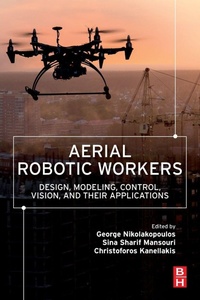
Aerial Robotic Workers
Design, Modeling, Control, Vision and Their Applications
Published on 9. November 2022
Book
Paperback/Softback
280 pages
978-0-12-814909-6 (ISBN)
Description
Aerial Robotic Workers: Design, Modeling, Control, Vision and Their Applications provides an in-depth look at both theory and practical applications surrounding the Aerial Robotic Worker (ARW). Emerging ARWs are fully autonomous flying robots that can assist human operations through their agile performance of aerial inspections and interaction with the surrounding infrastructure. This book addresses all the fundamental components of ARWs, starting with the hardware and software components and then addressing aspects of modeling, control, perception of the environment, and the concept of aerial manipulators, cooperative ARWs, and direct applications.
The book includes sample codes and ROS-based tutorials, enabling the direct application of the chapters and real-life examples with platforms already existing in the market.
The book includes sample codes and ROS-based tutorials, enabling the direct application of the chapters and real-life examples with platforms already existing in the market.
More details
Language
English
Place of publication
Woburn
United States
Publishing group
Elsevier - Health Sciences Division
Target group
Professional and scholarly
Product notice
Paperback (trade)
Dimensions
Height: 229 mm
Width: 152 mm
Thickness: 15 mm
Weight
380 gr
ISBN-13
978-0-12-814909-6 (9780128149096)
Copyright in bibliographic data and cover images is held by Nielsen Book Services Limited or by the publishers or by their respective licensors: all rights reserved.
Schweitzer Classification
Other editions
Additional editions
George Nikolakopoulos | Sina Sharif Mansouri | Christoforos Kanellakis
Aerial Robotic Workers
Design, Modeling, Control, Vision and Their Applications
E-Book
11/2022
Butterworth-Heinemann
€147.00
Available for download
Persons
George Nikolakopoulos works as a Chair Professor in Robotics and Artificial Intelligence (RAI), while heading the Robotics Team at the Division of Systems and Interaction in the Department of Computer Science, Electrical and Space Engineering, Lulea University of Technology, Sweden.
In the past he was also affiliated with the NASA Jet Propulsion Laboratory (JPL) at Pasadena, California for contacting collaborative research on Aerial Planetary Exploration, where his team participated in the DARPA Grand challenge on Sub-T exploration with the COSTAR team of NASA and won the second stage of the competition in February 2020.
George is also a member of the Board of Directors at euRobotics , as a member of the Scientific Council of ARTEMIS in the field of Robotics and AI and member of the IFAC TC on Robotics. George is also an elected expert for the permanent working group (PWG) of A.SPIRE with a focus on Process Optimisation and Ultra Carbon Coal as well as an elected member on the Aeneas-XECS in embedded control systems.
Finally, George has established the Digital Innovation Hub on Applied AI at Lulea University of Technology, has created 2 spin-offs where FieldRobotix has been selected from IVA to joing the REACHME Silicon Valley accelerator. The work of George and his team has been included 3 times in a row at IVA top 100 list. Dr. Sina Sharif Mansouri obtained his Ph.D degree within the Control Engineering Group, Department of Computer Science, Electrical and Space Engineering, Lulea University of Technology (LTU), Lulea, Sweden. He received his master of science and bachelor of science from Technical University of Dortmund, Germany in 2014 and University of Tehran, Iran in 2012 respectively. He currently works as a researcher at the Autonomous Driving Lab in Scania Group. Sina has received the Vattenfall's award for best doctoral thesis 2021 and , his published scientific work includes more than 60 published International Journals and Conferences in the fields of his interest. Christoforos Kanellakis received the Ph.D. degree in 2020 from the Control Engineering Group, Lulea University of Technology (LTU), Sweden, and the Diploma degree from the Department of Electrical and Computer Engineering, University of Patras (UPAT), Greece, in 2015. He is currently an Associate Senior Lecturer at the Robotics and Artificial Intelligence Group at Lulea University of Technology. His main research interests are in imaging and perception, guidance and navigation capabilities of field robotics and their application to autonomous flying, legged and mobile robots, as well vision-aided aerial manipulation
In the past he was also affiliated with the NASA Jet Propulsion Laboratory (JPL) at Pasadena, California for contacting collaborative research on Aerial Planetary Exploration, where his team participated in the DARPA Grand challenge on Sub-T exploration with the COSTAR team of NASA and won the second stage of the competition in February 2020.
George is also a member of the Board of Directors at euRobotics , as a member of the Scientific Council of ARTEMIS in the field of Robotics and AI and member of the IFAC TC on Robotics. George is also an elected expert for the permanent working group (PWG) of A.SPIRE with a focus on Process Optimisation and Ultra Carbon Coal as well as an elected member on the Aeneas-XECS in embedded control systems.
Finally, George has established the Digital Innovation Hub on Applied AI at Lulea University of Technology, has created 2 spin-offs where FieldRobotix has been selected from IVA to joing the REACHME Silicon Valley accelerator. The work of George and his team has been included 3 times in a row at IVA top 100 list. Dr. Sina Sharif Mansouri obtained his Ph.D degree within the Control Engineering Group, Department of Computer Science, Electrical and Space Engineering, Lulea University of Technology (LTU), Lulea, Sweden. He received his master of science and bachelor of science from Technical University of Dortmund, Germany in 2014 and University of Tehran, Iran in 2012 respectively. He currently works as a researcher at the Autonomous Driving Lab in Scania Group. Sina has received the Vattenfall's award for best doctoral thesis 2021 and , his published scientific work includes more than 60 published International Journals and Conferences in the fields of his interest. Christoforos Kanellakis received the Ph.D. degree in 2020 from the Control Engineering Group, Lulea University of Technology (LTU), Sweden, and the Diploma degree from the Department of Electrical and Computer Engineering, University of Patras (UPAT), Greece, in 2015. He is currently an Associate Senior Lecturer at the Robotics and Artificial Intelligence Group at Lulea University of Technology. His main research interests are in imaging and perception, guidance and navigation capabilities of field robotics and their application to autonomous flying, legged and mobile robots, as well vision-aided aerial manipulation
Editor
Chair Professor in Robotics and Artificial Intelligence (RAI), Department of Computer Science, Electrical and Space Engineering, Lulea University of Technology, Sweden
Researcher, Autonomous Driving Lab in Scania Group, Sweden
Postdoctoral Researcher with the Department of Computer Science, Electrical and Space Engineering, LTU, Sweden
Content
1. Towards the realization of the Aerial Robotic Workers
2. The fundamental Hardware Modules of an ARW
3. Modeling for ARWs
4. Controller for ARWs
5. Perception Capabilities for ARWs
6. Navigation for ARWs
7. Exploration for ARWs
8. External Force Estimation for ARWs
9. Vision for Aerial Manipulation
10. Machine learning for ARWs
11. Aerial Infrastructures Inspection
12. ARW Deployment for Subterranean Environments
13. Edge Connected ARWs
2. The fundamental Hardware Modules of an ARW
3. Modeling for ARWs
4. Controller for ARWs
5. Perception Capabilities for ARWs
6. Navigation for ARWs
7. Exploration for ARWs
8. External Force Estimation for ARWs
9. Vision for Aerial Manipulation
10. Machine learning for ARWs
11. Aerial Infrastructures Inspection
12. ARW Deployment for Subterranean Environments
13. Edge Connected ARWs