

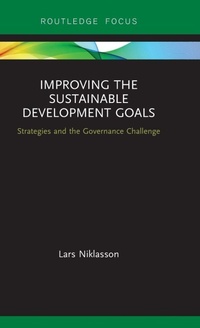
Improving the Sustainable Development Goals
Strategies and the Governance Challenge
1st Edition
Published on 24. April 2019
Book
Hardback
132 pages
978-0-367-14210-0 (ISBN)
Description
Improving the Sustainable Development Goals evaluates the Global Goals (Agenda 2030) by looking at their design and how they relate to theories of economic development. Adopted unanimously by the member states of the United Nations (UN) in 2015, the goals are remarkable for the global commitment on a set of targets to reach by 2030, but also for the lack of a strategy of implementation. The choice of appropriate action is handed over to individual governments, some of which are limited by their lack of resources.
This book explores how implementation of the sustainable development goals (SDGs) can be developed, especially in developing countries. The content, strengths and weaknesses of the SDGs are critically examined, alongside their relationship to ongoing academic research. The authors also investigate the actions of governments over the past three years by looking at the national strategies they have presented at annual meetings of the UN High-Level Political Forum.
Improving the Sustainable Development Goals takes a critical but constructive approach, pointing out risks as well as possible remedies. The SDGs are seen as an opportunity for a global conversation on what works in solving some fundamental problems relating to poverty and environmental degradation. With the inclusion of a chapter by Tobias Ogweno, former member of the Kenya's UN mission, this book will appeal to all those who are interested in policy analysis with a focus on development issues.
This book explores how implementation of the sustainable development goals (SDGs) can be developed, especially in developing countries. The content, strengths and weaknesses of the SDGs are critically examined, alongside their relationship to ongoing academic research. The authors also investigate the actions of governments over the past three years by looking at the national strategies they have presented at annual meetings of the UN High-Level Political Forum.
Improving the Sustainable Development Goals takes a critical but constructive approach, pointing out risks as well as possible remedies. The SDGs are seen as an opportunity for a global conversation on what works in solving some fundamental problems relating to poverty and environmental degradation. With the inclusion of a chapter by Tobias Ogweno, former member of the Kenya's UN mission, this book will appeal to all those who are interested in policy analysis with a focus on development issues.
Reviews / Votes
"This book explores the formulation and implementation of the Sustainable Development Goals; this type of analysis is critical to make progress on sustainable development. The authors apply a forward-looking perspective to discuss drivers and barriers for achieving the goals, adding to the multifaceted debate surrounding societal efforts to enhance sustainability."Henrik Selin, Frederick S Pardee School of Global Studies, Boston University
More details
Series
Language
English
Place of publication
London
United Kingdom
Publishing group
Taylor & Francis Ltd
Target group
College/higher education
Illustrations
14 s/w Tabellen
14 Tables, black and white
Dimensions
Height: 222 mm
Width: 145 mm
Thickness: 12 mm
Weight
322 gr
ISBN-13
978-0-367-14210-0 (9780367142100)
Copyright in bibliographic data and cover images is held by Nielsen Book Services Limited or by the publishers or by their respective licensors: all rights reserved.
Schweitzer Classification
Other editions
Additional editions
Book
12/2020
1st Edition
Routledge
€36.90
Shipment within 15-20 days
E-Book
04/2019
1st Edition
Routledge
€32.99
Available for download
E-Book
04/2019
Routledge
€32.99
Available for download
Person
Lars Niklasson is a researcher at the Swedish Institute for European Policy Studies (SIEPS), and a professor of political science at Linkoeping University, Sweden. His research interest is European Union (EU)-Africa relations and the global leadership role of the EU. He has taught international political economy and comparative politics, with a focus on global challenges and governance. Niklasson has been a visiting teacher at the University of Nairobi, Kenya.
Content
Preface Introduction Overview Chapter 1: Global goals in search of strategies A global agreement...Eradication of poverty in reach Environmental urgencyAmbitious and flexible goals...to achieve sustainable development...A political compromiseContested issues...through seventeen goals... Economic issuesSocial issuesEnvironmental issuesCross-cutting issues...without an explicit strategy...Weak on strategies for implementationHow flexible are the goals?Weak on compliance...and in an unclear relation to other global policies......but still an example of the art of the possibleReferencesChapter 2: A research gap on strategies and implementationFocus on the implementation of the SDGsForward-lookingConnecting policy to researchAfrica and developing countriesQuestions for the investigationAre the goals intended to be taken seriously?Problems with the existing literatureSustainable developmentTheoretical perspectivesEmpirical perspectivesPoverty reductionReferencesChapter 3: Refocus from the goals to learning over timePolicy by goalsThe role of goalsNew Public ManagementAnother interpretation: A learning policyRationalism vs realismA learning subjectThe importance of a program theory, a strategyHidden assumptionsA theory of change for sustainable developmentMethods and materialReferencesChapter 4: An inherent strategy in the goalsThe economic dimensionGoal 1: No povertyGoal 8: Decent work and economic growthGoal 9: Industry, innovation and infrastructureGoal 10: