

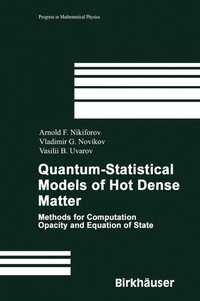
Quantum-Statistical Models of Hot Dense Matter
Methods for Computation Opacity and Equation of State
Published on 17. February 2005
Book
Hardback
XVII, 430 pages
978-3-7643-2183-3 (ISBN)
Description
In the processes studied in contemporary physics one encounters the most diverse conditions: temperatures ranging from absolute zero to those found in the cores of stars, and densities ranging from those of gases to densities tens of times larger than those of a solid body. Accordingly, the solution of many problems of modern physics requires an increasingly large volume of information about the propertiesofmatterundervariousconditions,includingextremeones. Atthesame time, there is a demand for an increasing accuracy of these data, due to the fact thatthereliabilityandcomputationalsubstantiationofmanyuniquetechnological devices and physical installations depends on them. The relatively simple models ordinarily described in courses on theoretical physics are not applicable when we wish to describe the properties of matter in a su?ciently wide range of temperatures and densities. On the other hand, expe- ments aimed at generating data on properties of matter under extreme conditions usually face considerably technical di?culties and in a number of instances are exceedingly expensive. It is precisely for these reasons that it is important to - velop and re?ne in a systematic manner quantum-statistical models and methods for calculating properties of matter, and to compare computational results with data acquired through observations and experiments. At this time, the literature addressing these issues appears to be insu?cient. If one is concerned with opacity, which determines the radiative heat conductivity of matter at high temperatures, then one can mention, for example, the books of D. A. Frank-Kamenetskii [67], R. D. Cowan [49], and also the relatively recently published book by D.
Reviews / Votes
From the reviews:
"This book presents quantum-statistical, self-consistent field models and methods . appropriate to describe e.g. plasmas and astrophysical phenomena. . Numerous special approximations for various problems are presented and supported by sample calculations using modern computer software programs . and richly illustrated by plots and tables, and are also compared with experimental results. The present work is of a very high technical standard and aimed at specialists and advanced students working in the field of non-ideal plasmas." (R. Steinbauer, Monatshefte für Mathematik, Vol. 152 (4), December, 2007)
More details
Series
Edition
2005 ed.
Language
English
Place of publication
Basel
Switzerland
Publishing group
Springer Basel
Target group
Professional and scholarly
Research
Illustrations
XVII, 430 p.
Dimensions
Height: 241 mm
Width: 160 mm
Thickness: 30 mm
Weight
840 gr
ISBN-13
978-3-7643-2183-3 (9783764321833)
DOI
10.1007/b137687
Schweitzer Classification
Other editions
Additional editions
Arnold F. Nikiforov | Vladimir G. Novikov | Vasili B. Uvarov
Quantum-Statistical Models of Hot Dense Matter
Methods for Computation Opacity and Equation of State
E-Book
02/2006
1st Edition
Birkhäuser
€96.29
Available for download
Persons
Content
Preface.- I. Quantum-statistical self-consistent field models - 1. The generalized Thomas-Fermi model - 2. Electron wave functions in a given potential - 3. Quantum-statistical self-consistent field models - 4. The Hartree-Fock-Slater model for the average atom.- II. Radiative and thermodynamical properties of high-temperature dense plasma - 5. Interaction of radiation with matter - 6. The equation of state.- III. Appendix. Methods for solving the Schrödinger and Dirac equations.- Bibliography.- Index