

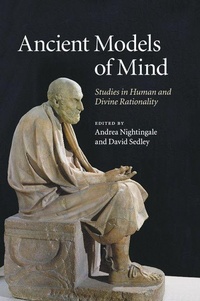
Ancient Models of Mind
Studies in Human and Divine Rationality
Published on 14. May 2015
Book
Paperback/Softback
262 pages
978-1-107-52595-5 (ISBN)
Description
How does God think? How, ideally, does a human mind function? Must a gap remain between these two paradigms of rationality? Such questions exercised the greatest ancient philosophers, including those featured in this book: Socrates, Plato, Aristotle, the Stoics and Plotinus. This volume encompasses a series of studies by leading scholars, revisiting key moments of ancient philosophy and highlighting the theme of human and divine rationality in both moral and cognitive psychology. It is a tribute to Professor A. A. Long, and reflects multiple themes of his own work.
Reviews / Votes
"....nice collection.... recommendable without any doubt.... some papers would be useful for students and beginners because of their general presentations. Others are of interest for specialists and researchers...."--Robert Zaborowski, Ph.D., University of Warmia and Mazury & Polish Academy of Sciences, Metapsychology Online Reviews
More details
Language
English
Place of publication
Cambridge
United Kingdom
Target group
Professional and scholarly
Product notice
Paperback (trade)
Illustrations
Worked examples or Exercises; Printed music items
Dimensions
Height: 229 mm
Width: 152 mm
Thickness: 14 mm
Weight
385 gr
ISBN-13
978-1-107-52595-5 (9781107525955)
Copyright in bibliographic data and cover images is held by Nielsen Book Services Limited or by the publishers or by their respective licensors: all rights reserved.
Schweitzer Classification
Other editions
Additional editions
E-Book
11/2010
1st Edition
Cambridge University Press
€27.99
Available for download
Book
11/2010
1st Edition
Cambridge University Press
€129.30
Shipment within 15-20 days
Persons
Andrea Wilson Nightingale is Professor of Classics and Comparative Literature at Stanford University. She is the author of Genres in Dialogue: Plato and the Construct of Philosophy (1995), Spectacles of Truth in Classical Greek Philosophy: Theoria in its Cultural Context (2004), and 'Once out of Nature': Augustine on Time and the Body (forthcoming). She has won a Guggenheim Fellowship, an ACLS Fellowship, and a fellowship at the Stanford Humanities Center. She has been a Stanford Fellow (2004-6) and is presently serving as a Harvard Senior Fellow of the Hellenic Center (2009-13). David Sedley is Laurence Professor of Ancient Philosophy at the University of Cambridge, where he is also a Fellow of Christ's College. He is the author of The Hellenistic Philosophers (1987, with A. A. Long), Lucretius and the Transformation of Greek Wisdom (1998), Plato's Cratylus (2003), The Midwife of Platonism. Text and Subtext in Plato's Theaetetus (2004), and Creationism and its Critics in Antiquity (2007), based on his 2004 Sather Lectures. He edited Oxford Studies in Ancient Philosophy from 1998 to 2007. He is a Fellow of the British Academy, and a Foreign Honorary Member of the American Academy of Arts and Sciences.
Content
1. Plato on aporia and self-knowledge Andrea Wilson Nightingale; 2. Cross-examining happiness: reason and community in the Socratic dialogues of Plato Sara Ahbel-Rappe; 3. Inspiration, recollection, and mimesis in Plato's Phaedrus Kathryn A. Morgan; 4. Plato's Theaetetus as an ethical dialogue David Sedley; 5. Divine contemplating mind Allan Silverman; 6. Aristotle and the history of Skepticism Alan Code; 7. Stoic selection: objects, actions, and agents Stephen White; 8. Beauty and its relation to goodness in Stoicism Richard Bett; 9. How dialectical was Stoic dialectic? Luca Castagnoli; 10. Socrates speaks in Seneca, De vita beata 24-28 James Ker; 11. Seneca's Platonism: the soul and its divine origin Gretchen Reydams-Schils; 12. The status of the individual in Plotinus Kenneth Wolfe; A. A. Long: Publications 1963-2009; Index locorum; General index.