

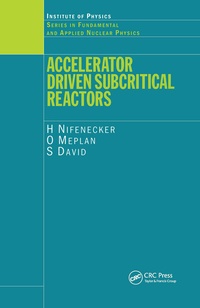
Accelerator Driven Subcritical Reactors
1st Edition
Will be published approx. on 1. June 2003
Book
Hardback
326 pages
978-0-7503-0743-7 (ISBN)
Description
This book describes the basic knowledge in nuclear, neutron, and reactor physics necessary for understanding the principle and implementation of accelerator driven subcritical nuclear reactors (ADSRs), also known as hybrid reactors.
Since hybrid reactors may contribute to future nuclear energy production, the book begins with a discussion of the general energy problem. It proceeds by developing the elementary physics of neutron reactors, including the basic nuclear physics involved. The book then presents computational methods, with special emphasis on Monte Carlo methods. It examines the specifics of ADSR, starting from the neutron spallation source to safety features. A thorough discussion is given on the size of hybrid reactors, which follows very different constraints from that of critical reactors. The possibility to optimize the source importance is examined in detail. The discussion of the fuel evolution follows with its relevance to safety and to the waste production and incineration. The conditions for having a constant reactivity over sufficiently long lapse of time are also discussed. The book also evaluates a number of practical designs that have been proposed. Finally, the last chapter deals with the examination of proposed and possible waste transmutation policies and the role which could be played by ADSR in this context. The potential advantage of the Thorium cycle is discussed as well as different scenarios that could be used to implement it.
Since hybrid reactors may contribute to future nuclear energy production, the book begins with a discussion of the general energy problem. It proceeds by developing the elementary physics of neutron reactors, including the basic nuclear physics involved. The book then presents computational methods, with special emphasis on Monte Carlo methods. It examines the specifics of ADSR, starting from the neutron spallation source to safety features. A thorough discussion is given on the size of hybrid reactors, which follows very different constraints from that of critical reactors. The possibility to optimize the source importance is examined in detail. The discussion of the fuel evolution follows with its relevance to safety and to the waste production and incineration. The conditions for having a constant reactivity over sufficiently long lapse of time are also discussed. The book also evaluates a number of practical designs that have been proposed. Finally, the last chapter deals with the examination of proposed and possible waste transmutation policies and the role which could be played by ADSR in this context. The potential advantage of the Thorium cycle is discussed as well as different scenarios that could be used to implement it.
More details
Series
Language
English
Place of publication
London
United Kingdom
Publishing group
Taylor & Francis Ltd
Target group
College/higher education
Professional and scholarly
Professional
Dimensions
Height: 234 mm
Width: 156 mm
Weight
680 gr
ISBN-13
978-0-7503-0743-7 (9780750307437)
Copyright in bibliographic data and cover images is held by Nielsen Book Services Limited or by the publishers or by their respective licensors: all rights reserved.
Schweitzer Classification
Other editions
Additional editions
H. Nifenecker | O. Meplan | S. David
Accelerator Driven Subcritical Reactors
E-Book
06/2003
CRC Press
€311.99
Available for download
H. Nifenecker | O. Meplan | S. David
Accelerator Driven Subcritical Reactors
E-Book
06/2003
CRC Press
€311.99
Available for download
Persons
H Nifenecker, O Meplan, S David
Content
Introduction. The Energy Issue. Elementary Reactor Theory. ADSRs Principles. Practical Simulation Methods. The Neutron Source. ADSR Kinetics. Reactivity Evolutions. Fuel Reprocessing Techniques. Generic Properties of ADSRs. Waste Incineration. Ground Laying Proposals. Scenarios for the Development of ADSRs. Appendix A: Deep Underground Disposal of Nuclear Waste. Appendix B: The Chernobyl Accident and the RMBK Reactors. Appendix C: Basics of Accelerator Physics.